
Energy Truce from Putin: February 3 Massive Strike
The February 3 massive strike on Ukrainian territory was entirely expected. All this talk about an “energy truce” in any form looked not just stupid but mockingly cynical. However, most likely this stream of falsehood affected someone and generated not just illusions but hallucinations. It was enough to look at those generating this narrative, and everything falls into place. Indeed, the source of information about this came from the “most beautiful president” of all time and Pootin.
That is, we’re talking about two liars revealing the topic. They’ve manipulated the narrative so many times — especially on the most critical issues — that taking anything they try to sell to the public seriously is a form of self-disrespect. That’s exactly what’s happening now. If the enemy had broken its weekly rhythm, we could talk about agreements, but we see nothing of the sort.
The “Energy Truce” Fairy Tale
If we take and forget everything these characters told us, and look at the sequence of precisely the enemy’s combined attacks, we can easily notice this happens approximately once a week, in exceptional cases — twice. And now, taking this into account, let’s look at what they called an “energy truce” and what the Nobel non-laureate in the field of peaceful war described as a personal achievement.
Everyone understood that transferring combat-capable Tu-95 boards from Ukrainka airbase in the Far East first to Engels-2 for munitions loading, and then to Oleneya to await orders, clearly signaled preparation for such an attack within a day or two. Well, the commotion at Dyagilevo airbase indicated that Tu-22M3 aircraft would also participate in the raid.
We know that three days ago the last month of winter began. So the time period when strikes on Ukraine’s energy infrastructure will have maximum effect gradually passes. Therefore, the orcs* sped up and tried to switch from the weekly cycle — namely, from Friday to Saturday — to twice weekly, adding Monday or Tuesday to the strike sequence. Weather forecast showed temperature drop on Ukrainian territory to -28°C.
Russia’s Maximum Effort Attack
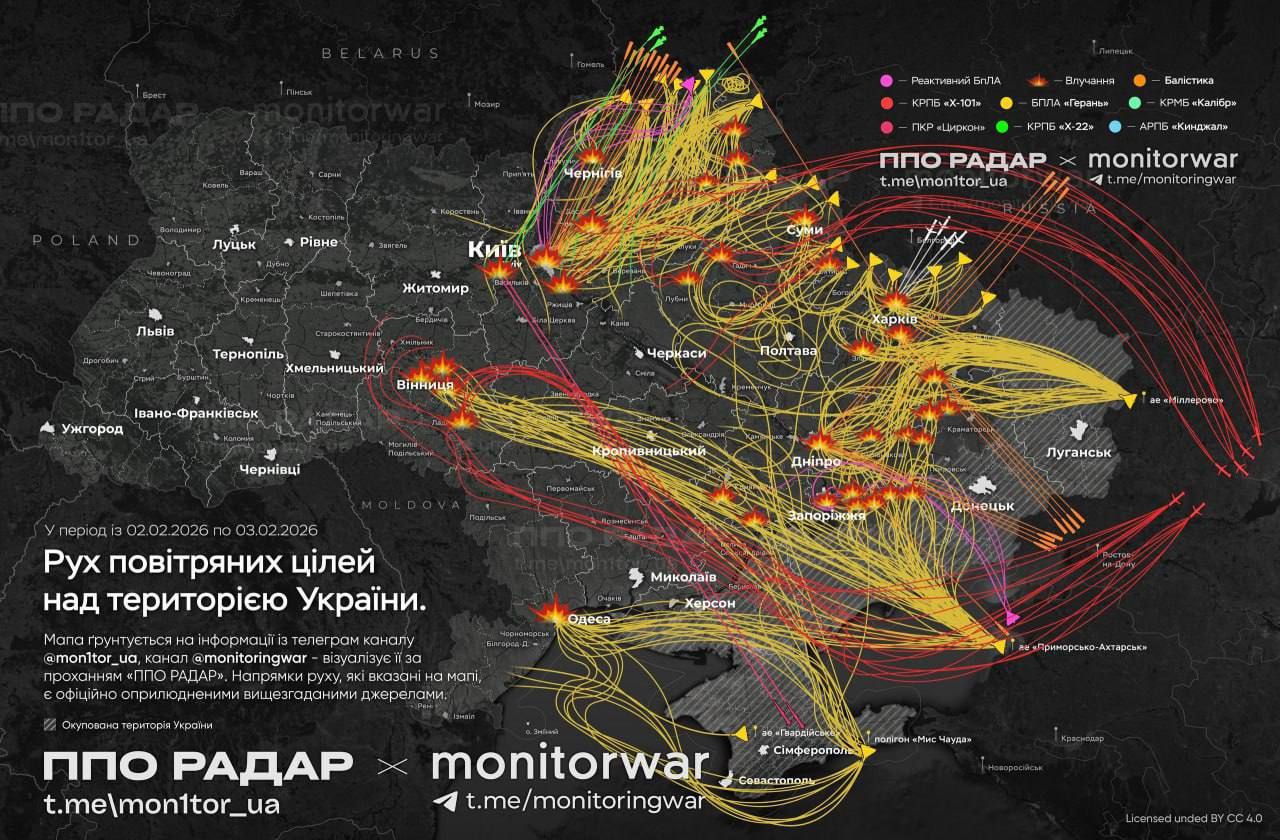
So, enemy media openly wrote that preparation for a mega-strike is underway. They’re gathering all missiles that can be launched here and now. They must execute the strike itself at peak frosts. Overall, this is exactly what we observed this night. As always, I can express only personal impressions — meaning about Kyiv. Air defense repelled the first ballistics wave cleanly. At least, everything I managed to see and hear in terms of explosions was high up in the air.
And then, as far as can be understood, the enemy tried to strike the place where our air defense was working. This was at quite a large distance from me, but everything turned out fine. If it were otherwise, the next wave would have passed without interceptions, but this didn’t happen. And judging by everything, the anti-aircraft gunners changed position by that time, because they were shooting from some other place already.
The Air Force report
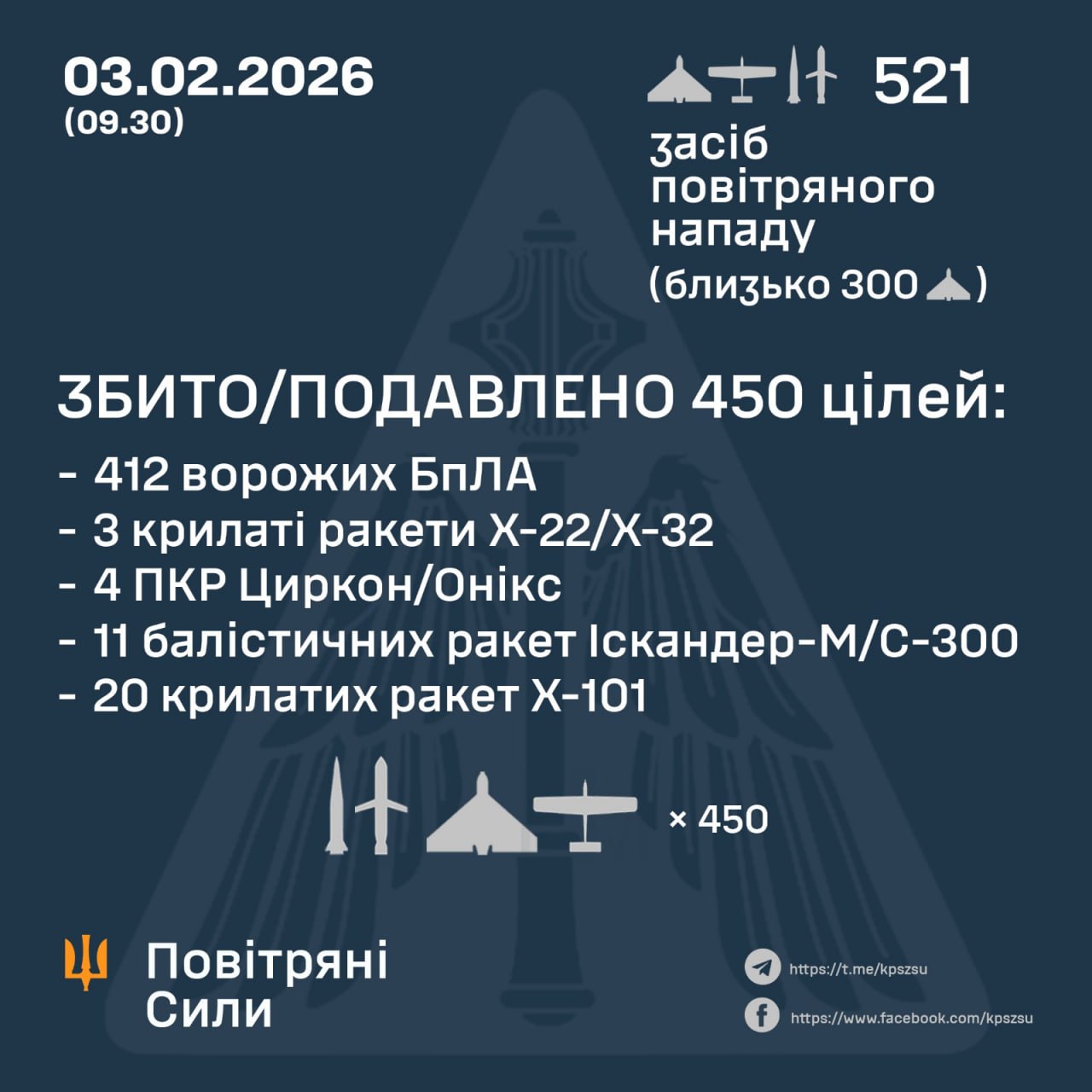
– Iskander-M type ballistic missiles – 32/11;
– Zircon anti-ship missiles – 4/4;
– Kh-22/Kh-32 anti-ship missiles – 7/3;
– Kh-101 air-launched and Iskander-K ground-launched cruise missiles – 28/20;
– Shahed-type drones and others – 450/412.
Plus, there was data that at least one surface carrier of Kalibr cruise missiles went to sea. Perhaps somewhere there was also a submarine also capable of launching this class of missiles. Thus, the enemy engaged all platforms and practically all missile types. Let’s just imagine that the Kalibr carrier already at sea didn’t cancel launches, and a submarine also fired along with it. This means that to those 71 missiles that entered Ukrainian airspace, one would need to add at least 16 sea-based cruise missiles. This would give a salvo of 87 units already. Apparently, something prevented the ship from firing, so it didn’t.
Why Anti-Ship Missiles Against Power Plants?
The missile component of this attack alone had 71 units, of which 36 were high-speed Iskander-M and Zircon. Moreover, of this quantity of used missiles, 11 are clearly not profile missiles. We’re talking about the same Zircons and Kh-22/32. Just for reference: designers created these missiles to hit enemy carrier groups. They have maximum effectiveness when equipped with nuclear warheads. In this case, the enemy uses missiles not against ships and not even against coastal military assets, but against thermal power plants. And this is despite the fact that our air defense means intercept Zircon most frequently among all missiles.
And here arises the question of why the enemy uses more and more non-profile missiles? After all, the same Zircon moves at hypersonic speed on a certain section of flight trajectory. Probably, this alone makes it a difficult target for most air defense systems, and for some — completely inaccessible. The answer lies on the surface. The war in Ukraine practically doesn’t provide naval targets. Therefore, the stockpile of precisely anti-ship missiles turned out to be quite large against the background of other missiles that get spent regularly.
Enemy works at the peak of its capabilities
Therefore, the presence of precisely such missiles in the list of strike means of a specific attack indicates that the enemy works at the peak of its capabilities. To ensure precisely the mass nature of the missile salvo, it attracts such missiles that, in theory, should be kept for possible naval battles. The February 3 massive strike showed Russia scraping the bottom of its arsenal, throwing anti-ship missiles at power plants in desperation.
From this, one can conclude that this night the enemy made a high bet. It really needed time to gather everything that can be fired literally within a few hours. It’s enough just to note that it drove its heavy and strategic bombers the last two-three days. At the same time, Russia was forced to engage Tu-22M3, which initially were designed to fight naval targets. Jet supersonic aircraft require more frequent servicing and repairs simply because they have different type engines. But apparently, the enemy already engaged the maximum of Tu-95 aircraft, and to solve the assigned tasks they’re clearly not enough. Therefore, today the orcs additionally lifted into the sky their heaviest: Tu-22M3 and Tu-160.
The Real Picture Behind the Propaganda
All of this was called an “energy truce”, and Donnie even described it as a personal achievement. Based on what we observed this night, one can conclude that precisely such a course of events was predictable. The enemy simply accumulated forces and means to manage to use the weather to the maximum. The February 3 massive strike demonstrated that Putin’s so-called “energy truce” was nothing but a cover for Russia’s largest winter strike yet. Probably, something similar cannot be left unpunished and is worth returning to them with the same coin.
*Orcs – a common term for Russians who support or participate in the armed aggression against Ukraine. Dehumanizing? Yes. Accurate? Also yes.
Related posts:

Iran Threatens Ukraine: How Ukrainians React to These Threats
Iran is a military ally of the Rabid Federation. The bearded towelhead¹ regime bears personal responsibility for the deaths of thousands of Ukrainians by helping Orcs² kill us. [...]
March 14 Massive Strike: Kremlin Spent $439M on Night Terror
As expected, pootin’s Friday syndrome returned. Again, the night from Friday to Saturday, Orcs arrange a combined massive strike on Ukraine. The enemy today fired about half a [...]