
General Staff Confirms Strike on Primorsk Oil Terminal
No filters. Just war as it is. Reader-supported.
Support →
The strike on Primorsk oil terminal made it into the General Staff’s official report by midday — unusually fast. Normally, there’s a gap between a high-profile strike and its appearance on official channels. Yet here, smoke was still rising over the port when the report landed. It read as follows:
The Transneft – Port Primorsk oil terminal (Primorsk, Leningrad Oblast, Russia) has been struck. According to preliminary information, both the tank farm and the oil loading infrastructure were hit. A fire on the facility’s territory is confirmed. Approximately 60 million tons of oil pass through Primorsk port annually. The aggressor state directs revenues from oil sales toward continuing the war against Ukraine and supplying the Russian occupation army.
By the same time, the internet was already flooded with videos of strikes filmed by bewildered locals, united by a common caption: “What is even happening?” That particular phrasing reflects the distance between the port and residential areas. If the strikes had been closer, the caption would have been different — something more like “Why us?” I think the residents of Odesa would have some colorful and specific answers to that question.
A Fire Visible for Dozens of Kilometers
A massive blaze broke out across the tank farm at Primorsk and the glow was visible for dozens of kilometers. A fire-tracking satellite returned this image:
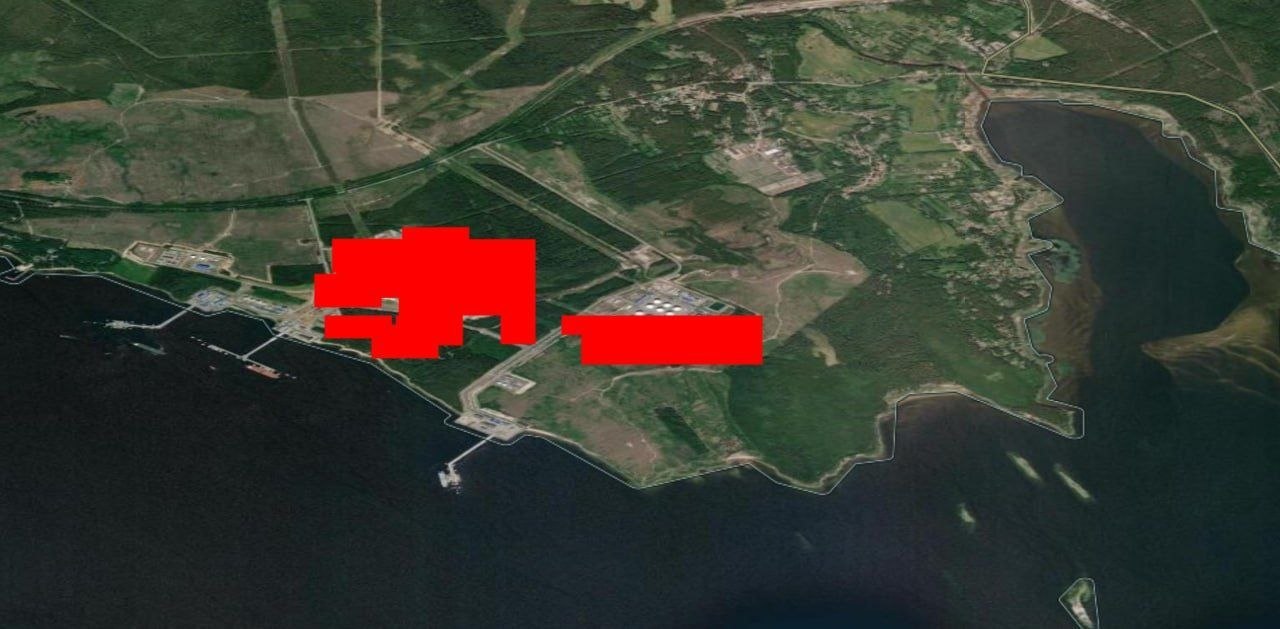
Neutral Telegram channels report that the satellite detected intense fire across the entire tank farm territory. How many tanks were directly hit and how many joined the fire out of solidarity remains unknown — but what is known for certain is that oil loading there has stopped. At Ust-Luga, loading was also halted — just in case.
And here it’s worth recalling the findings of a Japanese OSINT analyst AS-22, according to whom nearly 80% of air defense assets were withdrawn from Leningrad Oblast and redeployed to temporarily occupied Crimea — where all that hardware, crews and all, reportedly went up in smoke.
About European part
The Japanese analyst uses a somewhat unusual breakdown of the Rabid Federation’s geography. We’d argue the European part of the Swamps¹ should be assessed separately from the part called “Moscow” — because their air defense coverage differs for political reasons, not military ones. That means the European portion is now exposed by roughly 70–80%, with only pockets remaining around truly critical locations, like nuclear weapons production facilities.
Our own sources report that the local gauleiter held a very difficult meeting about how to present all this to the public. After all, who better than the residents of Leningrad Oblast to know Peter I’s famous instruction: “A subordinate, in the presence of his superior, must have a dashing and slightly dim-witted appearance.” After all those videos, telling people again that everything was shot down but debris fell would be neither dashing nor dim-witted. So alternative explanations were proposed.
In the end, they circled back to the debris version anyway, with the added detail of how many specialized vehicles are fighting how many square meters of fire. Putin was kept in the dark — so as not to follow in the footsteps of the Belgorod Oblast gauleiter. But that’s the Orcs’² problem. Since the General Staff has already confirmed the strike on Primorsk oil terminal, there’s plenty more worth unpacking here.
What Exactly Is Primorsk?
First, what exactly is Primorsk port. It sits on territory Stalin annexed from Finland during the Winter War of 1939–1940 — the Finns called it Koivisto. After seizing it, the Bolsheviks didn’t get around to renaming it to something grandiose before World War II started, so the name question sat until 1948. The city became Primorsk. Today it is the Swamps’ primary oil export port. Here’s how it ranks among the largest ports through which the Orcs move oil:
Russian oil exports by port (descending order):
| Port | Region | Export (bbl/day) |
|---|---|---|
| Primorsk | Leningrad Oblast | 1.2 million |
| Novorossiysk | Krasnodar Krai | 1.0 million |
| Kozmino | Primorsky Krai | 0.8 million |
| Ust-Luga | Leningrad Oblast | 0.4 million |
| Murmansk | Murmansk Oblast | 0.2 million |
As we can see, this port leads Novorossiysk — considered the Rotten Federation’s oil gateway — by a significant margin. It also ranks in the top three for petroleum product exports. So this was a two-for-one.
Petroleum product exports from Russian ports (descending order):
| Port | Region | Export (bbl/day) |
|---|---|---|
| Novorossiysk | Krasnodar Krai | ~700–800k |
| Ust-Luga | Leningrad Oblast | ~600–700k |
| Primorsk | Leningrad Oblast | ~300–400k |
Put simply: there is no juicier target in terms of oil export potential among the Orcs’ assets. And yet, as events have shown, they can no longer protect even the place where oil smoothly converts into money. They simply have nothing left to protect it with.
1,000 Kilometers and Still No Defense
From the nearest possible launch point on Ukrainian territory, Primorsk sits 950–1,000 kilometers away in a straight line. But as we know, good birds don’t fly straight. They need to route around known air defense clusters — like the area around Putin’s Valdai residence — and the flight path is almost certainly planned to avoid major population centers, minimizing the chance of visual or acoustic detection.
The bottom line: these drones flew 1,000+ kilometers to their target and arrived in considerable numbers. Just from the short clips that made it online, you can count up to a dozen clear hits. And given that locals almost certainly heard the first impacts before they reached for their phones, the actual number of strikes is likely much higher. It appears more drones reached the target than originally planned — so they selected the most valuable targets available.
What Burned, What Broke
Based on preliminary reports, the first wave of strikes hit the tank farm — and things got very lively there. The second wave apparently went after the loading terminals as a bonus round. The full picture of the damage can only be read from the scale of the fires and the smoke pouring out of the port. Precise figures will come later. What matters now is this: Ukraine’s Defense Forces are fully capable of cutting off oil exports from the Swamps’ European ports entirely.
That goes beyond military or economic impact — it becomes a political factor. The trajectory is clear: refineries will simply shut down unless the tsar does something drastic, or unless something equally drastic happens to the tsar. On the Swamps, there are no other options left. And the strike on Primorsk oil terminal made that clearer than any statement ever could.
¹Swamps – an ironic name for Russia, emphasizing decay, stagnation, and filth. The Commander of the USF, Robert Browdie, and most soldiers use this word.
²Orcs – a common term for Russians who support or participate in the armed aggression against Ukraine. Dehumanizing? Yes. Accurate? Also yes.
Related posts:

Deep Strikes on Russian Territory: Tikhoretsk, Belgorod, Luhansk
Probably deep strikes on russian territory last night became somehow special for orcs¹, even though they haven’t expressed this in texts and videos yet. Recently Ukraine’s Defense Forces [...]
Russian Air Defense Collapse: Path to Hell Like Black Sea Fleet
Still cautiously, but nevertheless it’s possible to state that enemy air defense started the same path that russian tanks and the russian Black Sea Fleet previously traveled. The [...]