
January 20 Massive Strike: 339 Drones, 34 Missiles Hit Ukraine

Today we endured another massive combined enemy raid. During the January 20 massive strike, the enemy once again bet heavily on the missile component. Alongside the usual cloud of drones, they launched a significant number of missiles. In our view, this looked like a desperate attempt to exploit a window of opportunity created by a prolonged stretch of extremely low temperatures. There are plenty of grounds for drawing such conclusions. The raid unfolded roughly as follows:
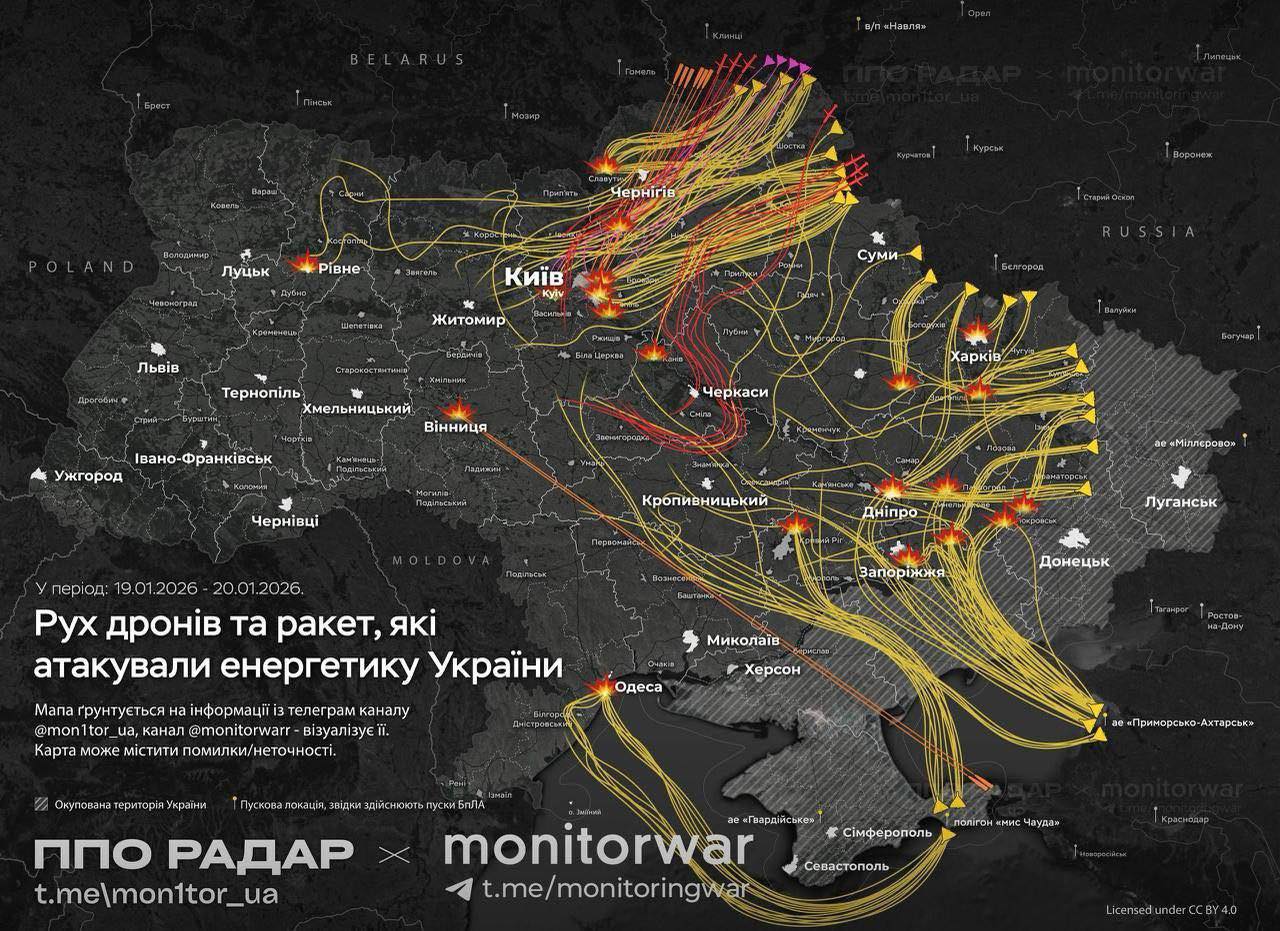
Expensive Weapons for the Capital
As often happens lately, the enemy uses expensive strike weapons for shelling the capital. These undoubtedly include Iskander-M ballistic missiles and heavy Kh-101 air-launched cruise missiles. And here you should consider that the enemy has clear statistics on the effectiveness of each type of his weapons for himself. By the way, our military also has it, but usually this is closed data. You can learn something about this effectiveness only from reports of the opposite side. And it’s clear that they will manipulate data based on the current situation.
Our General Staff data is as close to reality as possible. Here we’re talking not about quantitative indicators but rather about the method of presenting information. For example, here’s what follows from the just-published report of our Air Force:
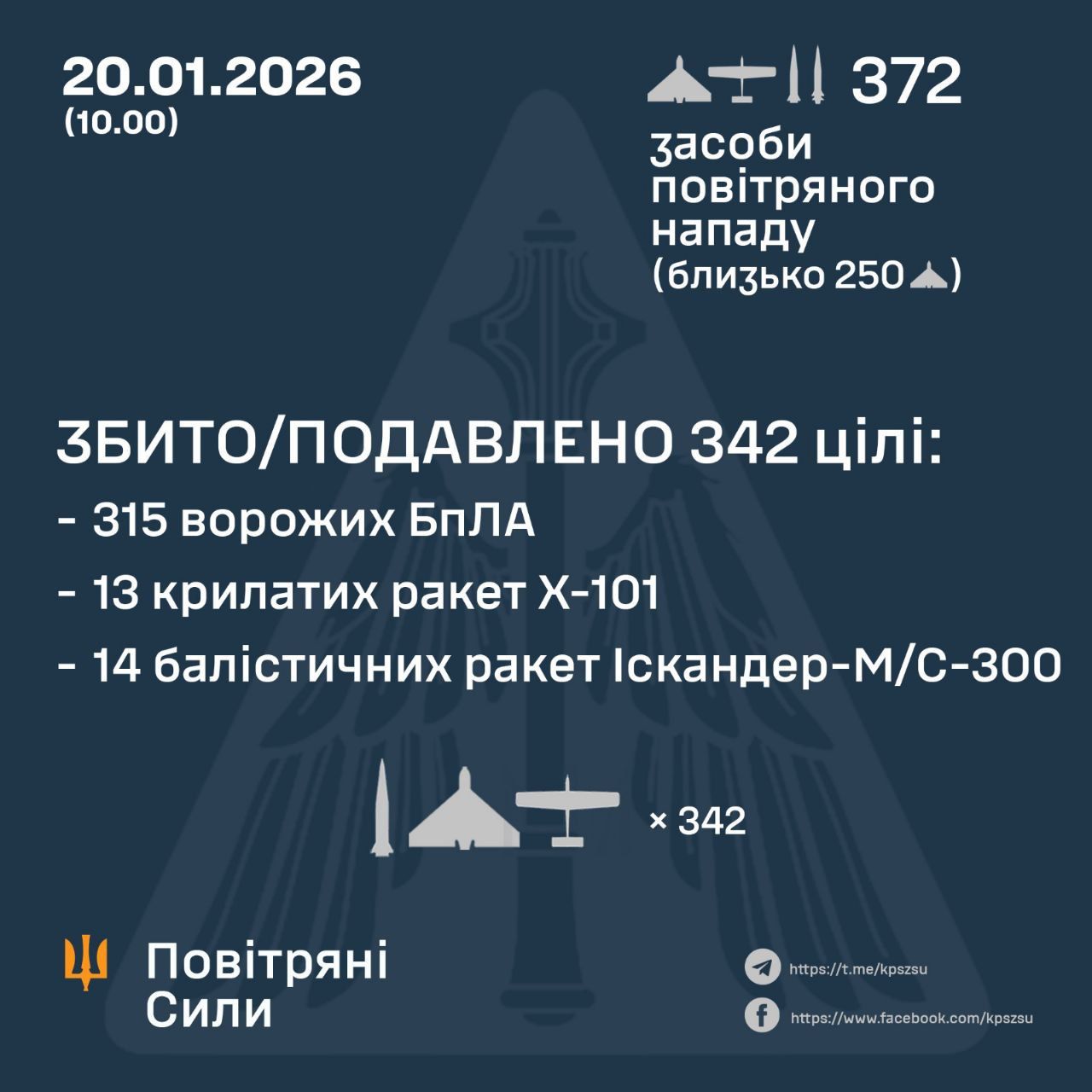
– Iskander-M type ballistic missiles – 18/14.
– Kh-101 type air-launched cruise missiles – 15/13.
– Zircon anti-ship speed missile – 1/0.
– Strike drones of various types – 339/315.
As a result, hits of five missiles and 24 drones were confirmed. Regarding two more missiles, data at the time of report publication was being clarified.
Just this presentation alone gives an approximate idea of how many and what strike weapons the enemy used to deliver the strike. Also how many of them we managed to neutralize in one way or another. Moreover, summary data on clearly recorded missed strikes is given each time. From here you can imagine the effectiveness of those or other strike weapons used during the raid, and accordingly, the effectiveness of air defense weapons when repelling the attack.
Enemy Manipulation vs. Ukrainian Transparency
Instead, the enemy maximally manipulates his data. Anyone can watch how Orcs¹ report. Personally, I couldn’t see the above ratio. Accordingly, I couldn’t get an idea of how effective the strikes of strike weapons turned out and how successfully air defense weapons worked. Instead, the enemy writes how many drones he shot down with distribution by regions. And here basic manipulation is already hidden, designed to hide from the observer what stands behind these figures.
An Orc or any outside observer tries to obtain specific, albeit somehow distorted information about the results of a specific raid. And in this case, he won’t receive any benefit at all from detailed Orc data that they shot down, conditionally, 30 drones over Rostov Oblast, 40 over Kursk, and another 20 over Asshole District. On the one hand, such presentation leaves the report authors freedom in describing heroism, as they say, “to their own taste.” But they deliberately don’t provide data on how many strike weapons were launched in total so you could see how many of them were shot down.
Reasons for Orc`s manipulation
An important lever of this manipulation is giving the reader the opportunity to come to the conclusion himself that, of course, everything was shot down. This isn’t even discussed. The data provided only indicates where and how much was shot down. Hence the legend about high-precision debris. Since air defense shot down everything, but the oil storage facility is still burning, this could only happen due to those same debris formed when hitting a drone with “duty air defense means.”
They let Orcs understand that they can add up the presented figures of downed devices and get the number of drones used by the Defense Forces of Ukraine. Thus they support the legend about the incredibly high efficiency of their air defense weapons. They hope to find naive buyers for whom they need to show the highest efficiency of devices during their combat use.
It’s clear that they won’t have a summary line about how many direct hits there were in principle. And for them it’s a sharp knife when videos of arrivals appear on the Network after they told that they shot down everything clean. This is important hot, but over time no one will return to this topic anymore.
January 20 Massive Strike: Failed Ultimatum
But let’s return to our night raid and finish the story about statistics. It’s clear that the Armed Forces of Ukraine won’t constantly provide accurate data at least so the enemy doesn’t have a clear idea of the effectiveness of his weapons. After all, one raid can use the same type of ammunition that differs in some new nodes and units or system settings features. Therefore, it’s extremely important for them to know how effective these changes turned out.
It’s already obvious that they planned this strike as ultimatum. At least the ratio of used missiles and drones testifies to this. For every 10 Shaheds, there was one cruise or ballistic missile. And this despite the fact that each missile is more expensive than a dozen drones simply by times, or even by an order of magnitude. It’s enough to look at recent massive raids to see that this ratio is always much greater in favor of drones.
Plus, you can subtract Kinzhals from the usual package of strike weapons. The enemy usually pounds the same target with them — the Starkon airbase. This didn’t happen this time, although we saw that Kinzhal carriers, MiG-31K aircraft, took to the air. But launches never happened. This is a very interesting moment that we’ll leave outside the brackets for now. As a result, this raid went without both Kinzhals and Kalibrs.
Reasons for Kalibrs absence
Regarding Kalibrs — the reasons for their absence lie on the surface. First, now in the Black Sea is the storm season. Perhaps for launching missiles from surface platforms there are some restrictions precisely regarding weather. At least satellite images recorded loading missiles onto two frigates of the Black Sea military shipping in Novorossiysk. It seems they were supposed to participate in today’s attack.
And there seems to be another reason for the absence of Kalibrs. Recently we observed a series of strikes by naval drones on enemy shadow fleet tankers on the approach to Novorossiysk. OSINT analysts compiled maps that showed approximate places of vessel attacks. As far as one can understand, this exactly corresponds to the zone from where enemy surface ships launch their missiles. They’ve long been trying not to go far from the base, where they’re under cover of coastal air defense batteries and anti-ship complexes. It’s quite likely that Ukrainian naval drones were already waiting for them in the launch zone.
What Could Have Been: The Full Picture
From this it follows that the night strike should have been bigger, at least by another 16 Kalibr-class cruise missiles and up to four Kinzhals. In the end, the missile component could contain 54 missiles of various types and classes. You’ll agree, this would already be a completely different picture.
But that’s not all yet. The main mass of precisely cruise missiles turned out to be air-based, but there are certain nuances here. A few days ago, messages passed that the enemy’s long-range and strategic aviation performs maneuvers that indicate preparation for a missile strike using aviation. There are monitoring channels that specifically track the movement of such airplanes. This time they showed a somewhat unusual picture. The usual scheme for using Tu-95 MS bombers looked like this: they took off from the Ukrainka permanent base airfield in the Far East, where it’s impossible to reach them. They flew to the Engels-2 airbase, where there’s infrastructure for current maintenance of ancient aircraft and their equipment with cruise missiles.
But due to the fact that this base has already been attacked more than once and such aircraft were lost there after maintenance and hanging missiles, the aircraft flew to the Olenya airbase in the Murmansk area. There they waited for takeoff commands and, accordingly, for attack. After this, they could land at Engels for refueling and minor repairs and immediately take off. Or they could fly directly to Ukrainka.
Aging Fleet of Strategic Bombers
This time everything looked very strange. Quite a few Tu-95 took off from Ukrainka in several visits. But part of them landed at the Belaya airbase near Irkutsk or halfway to Engels. Of those aircraft that flew to the European part of the Swamps², part landed at the Dyagilevo airbase. One can assume that during the flight they discovered problems there that took them out of the game. As a result, only a small part of the aircraft that flew from the Far East received their missiles and flew to Olenya. From there they made combat sorties with missile launches at night.
All of this points to a broader problem for the enemy: using strategic aviation for strikes is becoming increasingly difficult. After all, these aircraft are designed to deliver strikes with nuclear strike weapons, and in such a scenario, these are “one sortie” aircraft. Yet to carry out terror strikes against Ukraine, the enemy is forced to send them into the air frequently and over extreme distances. This rapidly drains the already limited remaining service life of an aging bomber fleet.
The January 20 massive strike clearly highlights the growing strain on russia’s strategic aviation and the rising effectiveness of Ukrainian air defenses — a combination that steadily narrows the enemy’s room for maneuver. And we hope that one day this old scrap metal will arrive in its launch zones and discover they’re not alone there. If “good birds” or Ukrainian fighters wait for them, they won’t be able to escape.
¹Orcs – a common term for Russians who support or participate in the armed aggression against Ukraine. Dehumanizing? Yes. Accurate? Also yes.
²Swamps – an ironic name for Russia, emphasizing decay, stagnation, and filth. The Commander of the USF, Robert Browdie, and most soldiers use this word.
Related posts:

March 7 Massive Strike: Russian Terrorists Hit Apartment Building
Today the enemy launched a combined massive strike on Ukrainian territory, and Kharkiv suffered especially severely. When the message arrived that ballistics hit an apartment building entrance, it [...]
February 22 Massive Strike: Nearly 300 Drones & 50 Missiles
As of 10:00 AM, our Air Force reported on the February 22 massive strike — a combined attack the enemy executed on Ukrainian territory overnight. The enemy attacked [...]