
Strait of Hormuz Blockade: Analysis from a Shahed Hunter
Increasingly more analysts converge on the thought that continuing military operation in Iran brings the US more problems than profit. Indeed, the operation has dragged on for two weeks, and a strait of Hormuz Blockade could create far greater problems. A simple question: “What are the States doing there now?” — seemingly has no coherent answer. After all, if we’re talking about the nuclear program — more precisely, its liquidation — then probably this operation should have lasted even less than 12 days last summer. Nuclear assets aren’t so large to spend so much time destroying them. Just a few powerful air bombs suffice to put them where enriched uranium is located and put a period on it.
But for this you need to know where this very uranium is located. And if you don’t know where it is — how to destroy all this? That is, why start an operation if you don’t have precise data on the main target’s location? As far as can be understood, the situation was precisely this. Nobody knew for sure where all this is located, so they started bombing places where it could be. However, judging that there were no confirmations of hitting the main target even after 17 days of round-the-clock bombardments — this task isn’t completed.
Mountain Tunnels and Missile Reserves
Regarding the missile program — considering complete air dominance, in two weeks all infrastructure somehow connected with the missile program could have been bombed to rubble instead of foundation. But the trick is that Iran roughly imagined this for itself. Therefore they riveted missiles in reserve and hid them in mountain tunnels, which are practically impossible to reach with air bombs. The towelheads¹ themselves, as far as can be understood, are capable of delivering missile strikes from their reserves without even replenishing them with new products for quite a long time. Nobody knows exactly how long.
But here the time factor plays a decisive role. Experience creating such productions already got worked out. As soon as the military operation ends, they can restore everything in a year or two. Moreover, now they gained experience of how everything will look during real combat clash. Therefore they’ll restore missile industry considering this experience. In such case, fulfilling this point of operation goals can be considered achieved only conditionally.
Not a single goal got achieved
As we know, regime change was part of the most optimistic scenario. But the bearded regime didn’t lose control over the population. The population itself so far doesn’t yield to Israeli and US government calls to overthrow the clerical regime.
That is, not a single goal got achieved. The longer the operation continues, the more obvious it becomes that with applied means and instruments, achieving such goals is impossible in principle. If at the initial stage, destroying Iran’s first persons, rout of air defense, aviation and towelheads’ fleet could be presented as progress — now there’s nothing special to present.
The Blockade Nobody Expected
Meanwhile, the bearded ones applied an extremely effective countermeasure they talked about long ago. The bearded ones always said that in case of direct military confrontation with the US, they’ll close the Strait of Hormuz. As White House sources say, Trump didn’t seriously consider such possibility — because Iran itself is interested in oil export. Except through this strait, there’s no way to export Iranian oil from the Persian Gulf. But as everyone now knows, the Strait of Hormuz blockade happened.
The longer Donny plays Napoleon, the longer tankers stand. Trump’s main sponsors — largest US oil companies — press on his tuft, forcing him to somehow resolve the blockade issue or curtail this event. Otherwise, a global energy crisis nobody needs may occur. The best president of the best golf club got into a situation whose name he can hardly pronounce: Zugzwang.
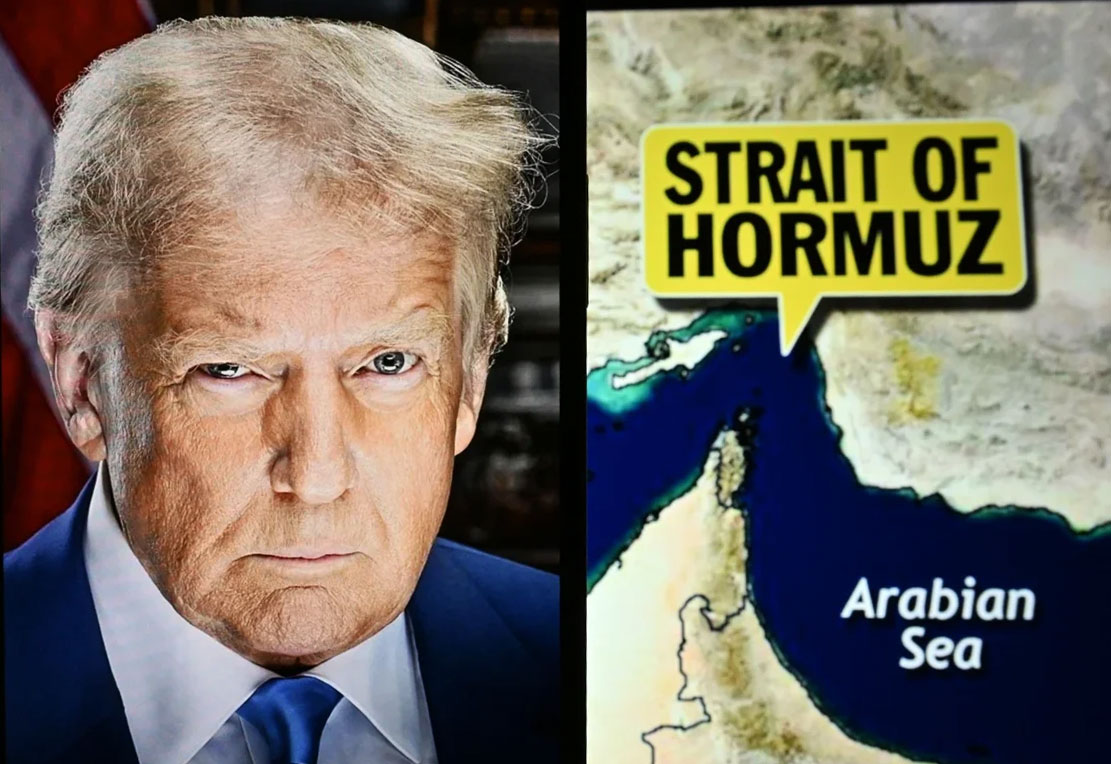
On one hand, continuing the military campaign devours an abyss of resources with inability to present any adequate results. On the other — this campaign already destabilizes the world economy, and the farther it goes, the stronger. Donny can’t stop the military operation anymore, and doesn’t know how to unblock the strait — because such variant wasn’t calculated, because Donny said this wouldn’t happen.
Fleet no exists but tankers was attacked
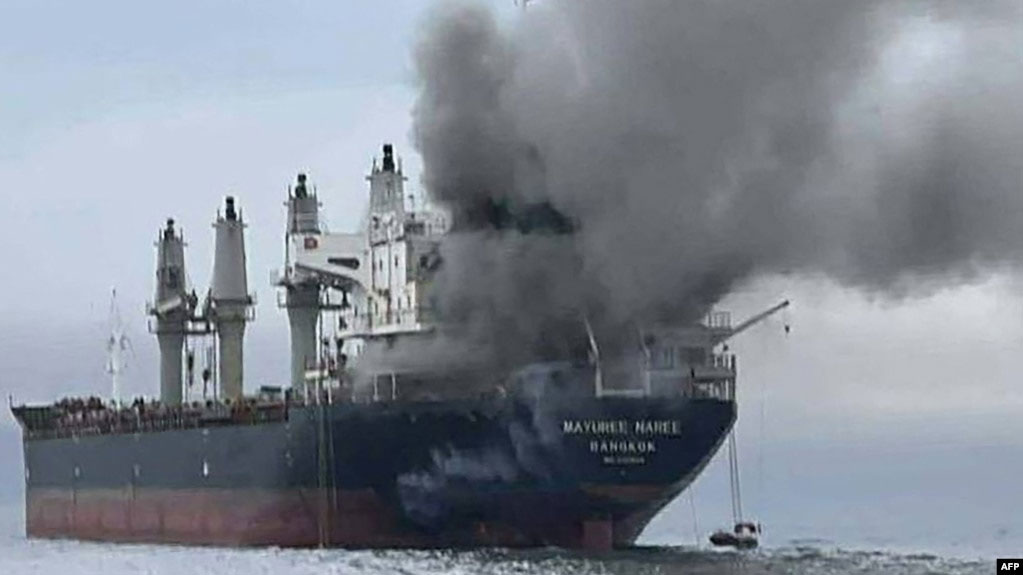
Here we propose looking at the situation more carefully. As we remember, Donny announced Iranian fleet no longer exists. Sounds very pompous — only this statement didn’t influence the strait blockade at all. Tankers burned and continue burning. Everyone who believed Trump’s words that “there’s no blockade” and that one should move more boldly through the strait got forced to check fire extinguishers’ serviceability.
Practically all reports about tanker attacks have identical format — that the tanker was attacked by unknown ammunition. But somehow such reports look not too convincing simply because in 17 days of combat operations and after a dozen attacked tankers, nobody understood what exactly attacked them.
What Actually Attacks the Tankers?
Let’s try figuring this out independently. First thing that comes to mind — mining announced by towelheads. But as various sources report, tankers with Iranian oil pass the strait without problems. Therefore mining is a very doubtful version. Of course, towelheads could leave a clean fairway near their shore. But as soon as mining of the strait’s rest became known, a couple US naval aviation aircraft would fly along the Iranian shore and mines would close this clean path literally in a few minutes. In other words, mining for Iran is no less dangerous than for others. Therefore we don’t exclude this variant, but still classify it as something like an extreme measure. The Strait of Hormuz blockade requires methods that don’t endanger Iran’s own oil exports.
The bearded fleet got sunk and physically can’t come out into the strait and do something to block movement. So this instrument falls away without variants.
The mosquito fleet of light boats hardly got destroyed completely. But if it got used, nobody would write about “unknown strike means” — they’d directly point to this variant. After all, not noticing a boat going to a tanker is impossible. Every ship has a locator that records other vessels’ movements for several dozen kilometers around, including boats. This means the distress signal would be given before the attack itself.
Shaheds: The Mathematical War
The next instrument towelheads can definitely use is anti-ship missiles. They transferred them to Houthis, who worked out experience using them near their shores already in Bab el-Mandeb Strait. This possibility can’t be excluded completely, but it also has its reverse side. Worth considering that Iran prepared for such event development for decades. Unlike Donny, who didn’t believe in this possibility, they seriously considered the Strait of Hormuz blockade and modeled the situation that would develop after this.
Probably they understood the US will definitely try unblocking the strait with fleet forces. Probably towelheads didn’t plan to sit straight watching these events, but prepared their countermeasure plans. If US military ships find themselves in the Strait of Hormuz, distance will turn out minimal, and their movement direction will be practically deprived of maneuver. In such case, the bearded ones get a unique chance to actually strike American ships. Precisely in this case, specialized anti-ship missiles will be needed. Considering missile production is now very strongly destroyed, they’ll have to defend with only the arsenal accumulated beforehand. Moreover, spending missiles very economically is necessary — because there’s nothing to replenish their stock with yet.
Why Shaheds, Not Missiles
Linear logic suggests anti-ship missiles would be senseless to spend striking tankers — they must be saved for military ships. Separately note the US already captured air dominance. Attempts to use precisely missiles will unmask those places where missiles are stored. Therefore missiles should be saved, and tankers can be reached with something lighter. This strategy relies on cost-effective asymmetric solutions rather than expensive conventional weapons.
This solution can be Shaheds. Most likely, precisely Shahed drones used on tankers. The bearded ones themselves are densely engaged in tanker oil supplies, therefore they know perfectly well where a tanker’s most vulnerable place is — where the Shahed must be put. Additionally note that anti-tanker Shaheds may differ from those Shaheds with which Orcs² kill Ukrainian civilians.
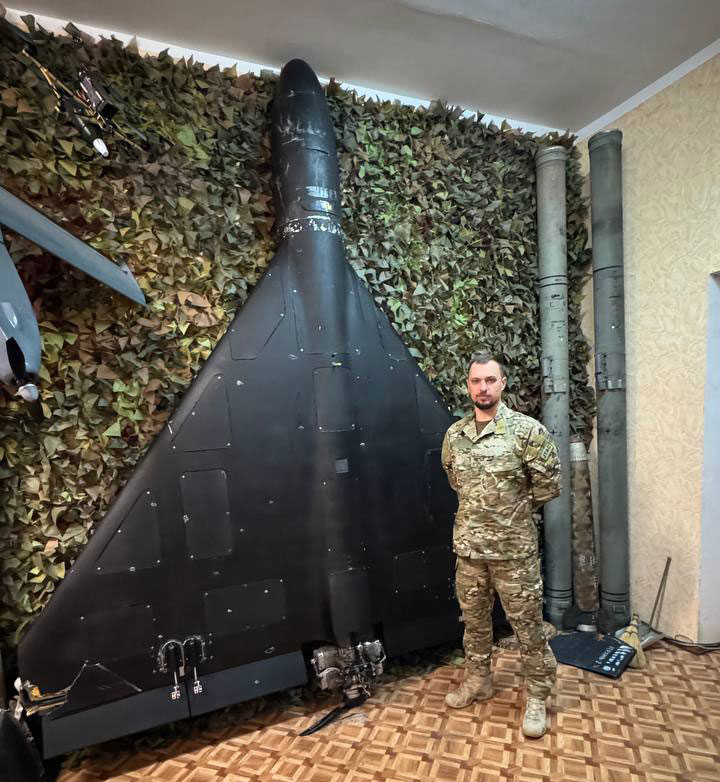
Considering from shore to tanker will be only 10-20 km, and from drone launch location — plus another 10-20 km, then due to minimal fuel quantity, the device can be provided with a much heavier warhead that will guaranteed lead to needed consequences in the form of a large fire.
Additional arguments
Drone use probability is even higher due to them delivering painful strikes on targets in Arabia, UAE, Bahrain and Qatar. That is, they unobstructedly fly to the Persian Gulf’s opposite shore and strike their targets there. If so, attacking tankers is even simpler for them — because flying to them is much closer.
There’s one more moment. With high probability we assume Orcs shared with towelheads technologies allowing drone control from first person. The fact that the Orks have such technologies is confirmed by several terrorist attacks on civilian transport in Ukraine. For example, this one or this one. This allows delivering strikes with very high precision, even when the target moves. Precisely what’s needed for tanker attacks.
The Lesson Countries Are Learning Now
Here one shouldn’t forget another extremely important moment Ukrainians have known for over four years. If the opponent doesn’t understand drone threat character, even successful drone interception can turn out to be the attacker’s victory. This follows from what exactly will intercept the drone. If intercepting a Shahed costs much higher than its own cost, then even in interception case, the Shahed did its job and forced using a missile tens of times more expensive than itself for its strike. Precisely this lesson Gulf countries are passing today.
We think it’s time to recall how a few days ago Donny told that he needs neither Ukraine’s help nor its experience fighting UAVs — because he himself is a handsome guy, and his interception means are the best in the world. We have no doubts old Donny has the most wonderful tuft. But we’re also convinced Iran perfectly understands war mathematics. Towelheads are quite agreeable with their penny drone getting intercepted by a million-dollar missile.
Ukraine’s Pocket Interceptors Draw Global Interest
Therefore other countries already received their drone-fighting lessons and drew needed conclusions. For example, Israel knows well what weapon and ammunition shortage is. It understands that fighting on a shoestring, literally everything must be saved. With such approach, extremely effective tactics and weapons systems are born — what happened in Ukraine. Israelis themselves write this on the topic:
After four years of war with russia, Ukraine found itself at the center of unexpected technological interest. The US, Israel and Persian Gulf countries show interest in Ukrainian cheap interceptor drones that are 3D-printed.
On March 14, 2026, Israeli Prime Minister Benjamin Netanyahu addressed Ukrainian President Volodymyr Zelensky with a proposal for cooperation in fighting Iranian UAVs. Simply recall we’re talking about a country that produces combat lasers, Iron Dome, Arrow missile defense systems and much else. But all this — extremely expensive systems impossible to quickly scale. Ukraine went the path of a country in very limited conditions, forced to produce combat systems on a shoestring but with outstanding combat properties. Simply put, such products can be produced quickly and cheaply compared to everything else. The result is a ratio of target to interceptor simply surprisingly favorable. They continue there the same way:
The main feature of Ukrainian developments — their extremely low cost with high efficiency. War with russia forced Kyiv to seek ways fighting mass kamikaze drone attacks, most of which are Iranian Shahed-136. In response, Ukrainians developed an entire lineup of inexpensive but technologically advanced solutions. We’re talking about a new generation of so-called pocket interceptors — small, fast and surprisingly cheap drones whose cost doesn’t exceed approximately $2,000 per unit. They’re capable of performing tasks with which expensive missile systems cope significantly worse fighting mass attacks of cheap drones…
From Mass Attacks to Strategic Solutions
The key phrase in this quote — “mass attacks”. Israel caught the essence of the bearded ones’ game — who bombard neighbors, including Israel, with masses of their inexpensive drones. In this case, the antidote must be cheaper and angrier. Only Ukraine currently has such at its disposal — and nobody else. This asymmetric warfare approach demonstrates how cost-effective solutions can counter expensive military threats globally.
Now let’s return again to the Strait of Hormuz and its blockade. Suppose our conclusions are correct and the bearded ones provide blockade precisely with Shaheds. If we’re talking about drone attacks on tankers, the problem solution already exists. It’s cheaper than everything the States and other countries opposing Iran have. It scales easily and doesn’t require any special conditions for use.
Simply imagine each tanker can take aboard a small group of Ukrainian specialists with equipment. Or local specialists whom Ukrainian specialists trained. The Strait of Hormuz blockade problem will be solved without noise and dust once and for all. Thus unexpectedly for itself, Ukraine moved to the forefront of military technologies — already on a global scale.
¹Towelhead – sarcastic term used for Iran’s regime and IRGC. Offensive? Yes. Context matters when they supply Shahed drones used to kill civilians.
²Orcs – a common term for Russians who support or participate in the armed aggression against Ukraine. Dehumanizing? Yes. Accurate? Also yes.
Related posts:

War Against Iran Results: A Shahed Hunter’s Perspective
The preliminary results of war against Iran don’t match the ambitious goals announced on day one. A masterclass is happening right now that clearly shows how mass consciousness [...]
Air Defense Performance Analysis: US, Israel, Russia, China
The Middle East is now engulfed in combat operations. Against this backdrop, moments emerge that allow viewing our war from a somewhat different angle and seeing certain details [...]