
Strike on Votkinsk Missile Plant and Two Refineries in Neftegorsk

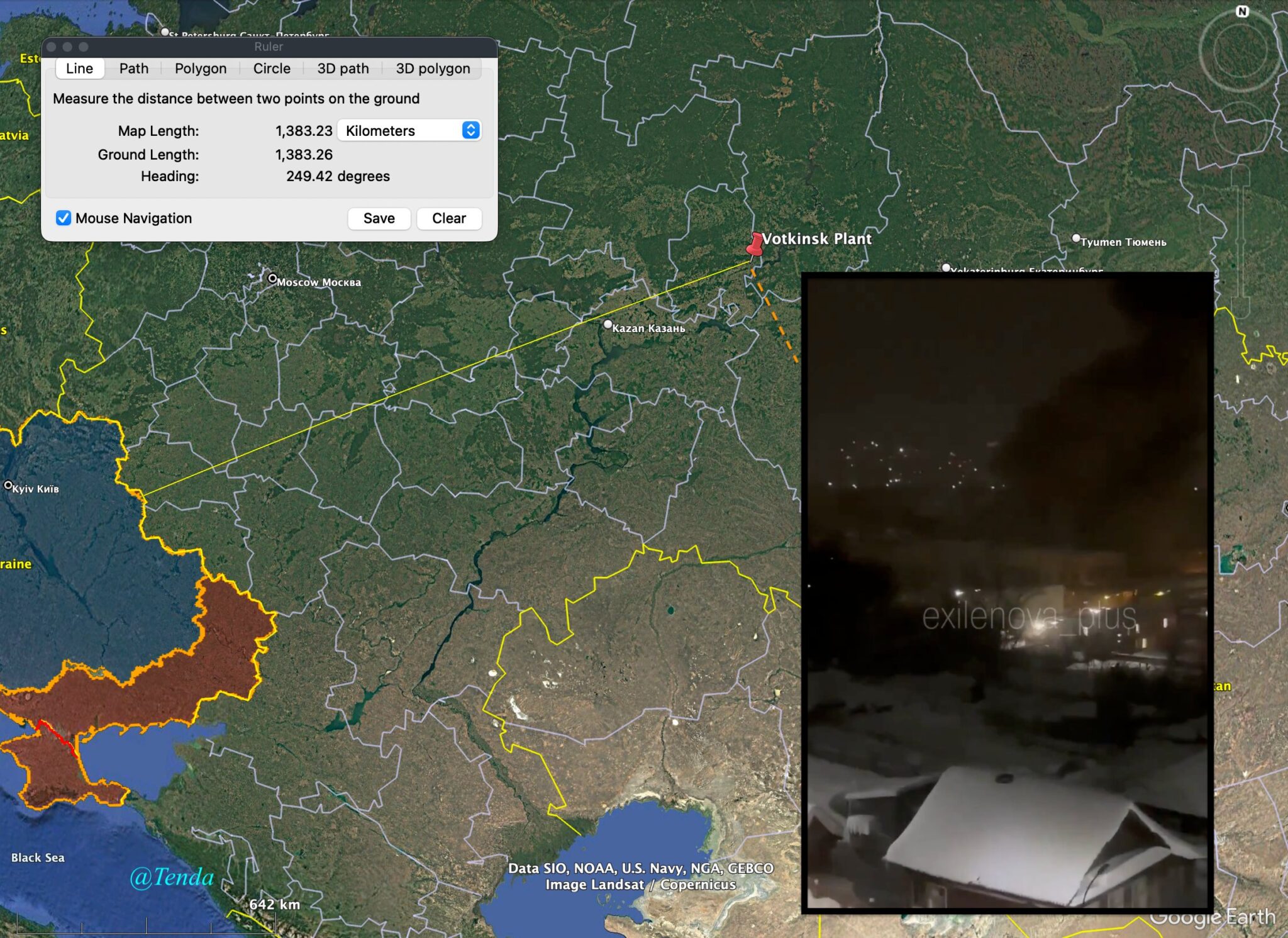
Finally, what we’ve been waiting for so long has happened. Since early morning, information has been flowing in: for the first time, a strike hit an enemy military plant that is unquestionably strategic. Crucially, this is one where final products are assembled, not just components or materials like just the day before. That’s when another strike hit the Progress plant producing, among other things, the Kometa communications modules notorious for bypassing our EW systems. No, this time heavy strike assets reached the Votkinsk plant in Udmurtia, located more than 1,500 km from any possible launch point. What arrived there weren’t light drones like before — it was something substantially heavier. The strike on Votkinsk missile plant marks a new phase in Ukraine’s capability to reach deep into enemy territory.
What We Know — And What We’re Waiting to Confirm
Our segment of the Net is already calling this strike asset by name. But we’ll hold off for now until there’s official confirmation. That’s because this particular name is tied to many different stories — often negative ones. So we won’t imitate that certain “journalist” who changes her shoes mid-flight and makes disgraceful statements. It happens with her constantly, and we just won’t take away her “bread.”
However, it makes sense to focus on the target that got hit. Here’s what open sources say about it:
Main Military Production at Votkinsk Plant:
- Intercontinental Ballistic Missiles (ICBMs);
- RS-24 “Yars” — next-generation mobile and silo-based ICBM;
- “Topol-M” — sections and warhead platforms;
- Prospective ICBM “Oreshnik” — reportedly produced at the plant (unofficially);
- Submarine-Launched Ballistic Missiles (SLBMs);
- 9M723 for the “Iskander-M” complex — missile bodies and key structural elements;
According to local publics and OSINT researchers, workshops #22 and #36 took the hit. That’s where final assembly of missile equipment takes place. As you can see, the strike hit one of several enterprises that form the foundation of the enemy military-industrial complex.
Fortress Protection Didn’t Help
There’s no doubt the plant is covered from all sides by the most serious air defense systems. Colleagues write that the enterprise looks unusual. It’s surrounded by a moat around the perimeter, and behind it are actual fortifications with firing points — creating an analogy with a fortress. Obviously, the enterprise was also properly covered from the air. If something still got through, that already says a lot.
It’s appropriate to assume that, unlike the large location that moscow certainly represents, the plant has a much more compact footprint. Most likely, air defense coverage there is organized approximately like around pootin’s “Valdai” residence. The Orcs¹ typically use identical approaches to organize defense of key objects according to their importance. Undoubtedly, both “Valdai” and this plant belong to the highest importance category. They most likely have some completely secret documents. These clearly describe the quantity and quality of forces and means involved in ensuring defense of objects that fall into each category. This set will be plus-or-minus identical for all objects belonging to the same importance rank.
The Strike on Votkinsk Missile Plant Changes the Calculus
Overall, we’re waiting for official confirmation. But if everything is truly as stated in the first reports, Ukraine’s Defense Forces have finally started to demolish the foundation of their war machine.
Beyond the Votkinsk rocket plant, good birds today continued the cycle of gift flights to enemy oil industry enterprises. Moreover, they hit plants that for a long time somehow weren’t covered by attention. The strike on Votkinsk missile plant grabbed headlines, but the refinery hits signal something equally important: Ukraine’s ability to sustain pressure across multiple strategic sectors simultaneously. By the way, the new geography of such enterprises shows something interesting. It reveals how heavily Pootin planted his country on the gas and oil pipes. Wherever you spit there — everything is connected to oil. But on the other hand, when a plant manipulates something flammable or explosive, any arrival of good birds very quickly turns into a bright festive show.
Two Facilities in One Strike Package
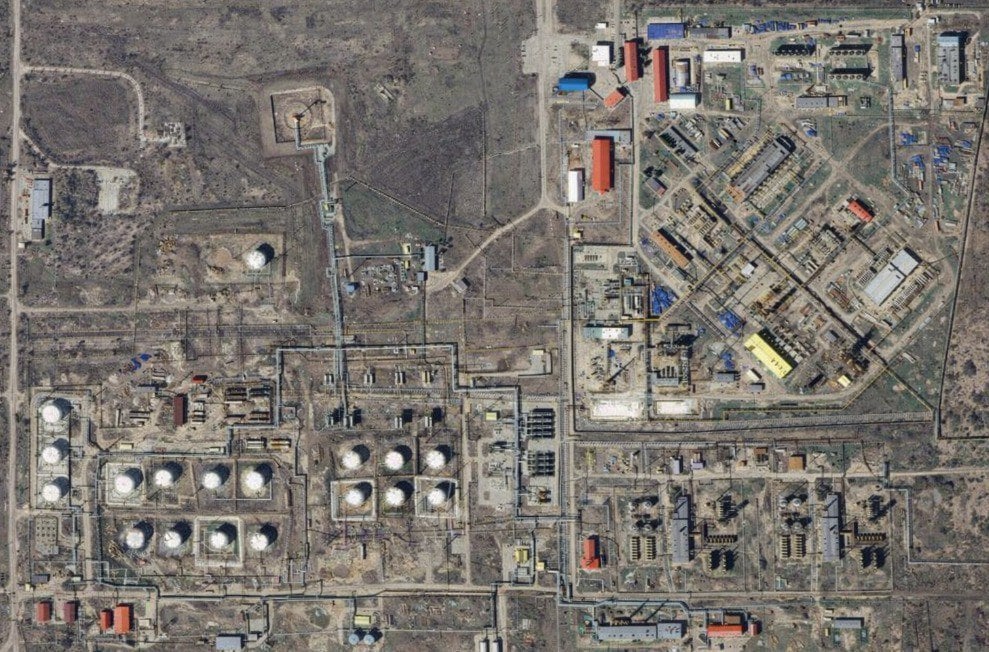
This was the case this time — strikes hit two plants simultaneously, located close to each other in the city of Neftegorsk. Open sources provide this information about the first enterprise, called “Oil Stabilization Production”:
- Oil stabilization — removal of light fractions and gases so the oil becomes safe for storage and transportation;
- Associated petroleum gas preparation — its purification and separation;
- Flare facilities — burning excess gas (visible in Reuters photos);
- Shipment of stabilized oil for processing or into the pipeline;
Overall, this description shows the enterprise converts sludge extracted from the depths into commodity oil, from which everything we know about oil can be done — namely, transport it all the way to export oil terminals or feed it for processing to refineries.
Why Every Refinery Matters
The second enterprise that drones visited in the same sity processes natural gas. That is, it works on the second of the “skreps” in pipe form that represent the foundation of the Swamps². Here’s a description of what the Neftegorsk gas processing plant produces:
“According to Rosneft data and industry sources, Neftegorsk GPP processes associated petroleum gas (APG) and natural gas, producing these types of products:
Dry stripped gas (lean dry gas) — prepared gas fed into Gazprom’s main gas pipeline system
Light hydrocarbon fractions (SHFLU/NGL) — mixture of propane, butane, and heavier fractions used as raw material for petrochemistry
Ethane fraction — raw material for polyethylene production and other petrochemical products
Technical sulfur — byproduct of sulfur-containing gas processing”
Perhaps this isn’t as important an event as the strike on Votkinsk missile plant, but these little plants still produce fuel that ultimately gets poured into combat vehicles or goes for export, providing funds to purchase everything from which the lapti cobble together their weapons, as well as other products that turn into explosives and ammunition. But the main thing here is that the Defense Forces have restored the continuous chain of taking out enterprises in this sector. As stated above, Pootin tightly planted the country on oil and gas pipes — and the more damaged they get, the faster the Swamps will reach a state of collapse. And without that — there’s no way.
¹Orcs – a common term for Russians who support or participate in the armed aggression against Ukraine. Dehumanizing? Yes. Accurate? Also yes.
²Swamps – an ironic name for Russia, emphasizing decay, stagnation, and filth. The Commander of the USF, Robert Browdie, and most soldiers use this word.
Related posts:

Ukraine Has Resumed Deep Strikes: Arsenal, Oil, and Military Plant
It seems that Ukraine has resumed deep strikes. TToday there was news that the good birds are visiting enemy arsenals, oil refineries and military facilities. But let’s get [...]
Strike on Redkino Chemical Plant: Missile Fuel Production Halted
We’re observing consequences of the enemy strike on Ukraine’s energy system with our own eyes right now. Something similar was expected precisely last night, about which we wrote [...]