
Ukraine Has Resumed Deep Strikes: Arsenal, Oil, and Military Plant

It seems that Ukraine has resumed deep strikes. TToday there was news that the good birds are visiting enemy arsenals, oil refineries and military facilities. But let’s get to the point.
The most interesting news was probably that good birds reached the settlement of Ukhta in the Komi Republic. What makes this episode particularly interesting is that Ukhta sits roughly two thousand kilometers from the likely drone launch point. That puts it not far at all from the Yamalo-Nenets Autonomous District — the region that supplies gas to the entire European part of the Swamps¹. If something flies there, the blackout in Belgorod will look like a joke by comparison. However, today the strike hit another refinery, and the enemy press reports the following:
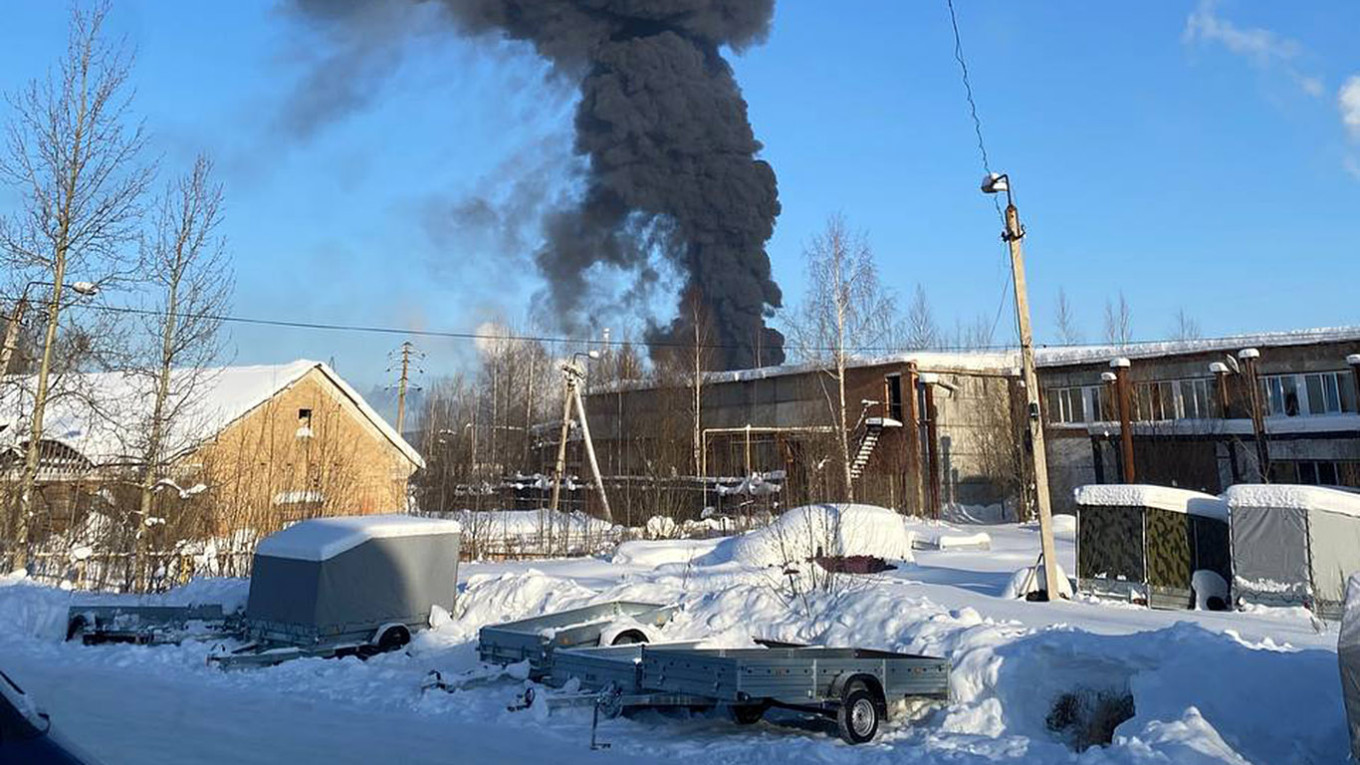
Ukrainian drones struck the Lukoil oil refinery in the city of Ukhta, Komi Republic, on the afternoon of February 12. This is already the second attack on the plant — which plays a critical role in fuel supply to Russia’s northern regions — since August 2025. A fire broke out on the facility’s premises as a result of the strike.
According to local residents, at least two good birds paid a visit to the refinery. As visible in the photo, they didn’t come just to peck seeds. The smoke is a rich black color, and the size of the column suggests the repair crews will be earning serious bonuses. These are remote and isolated places. Delivering everything necessary to such distant locations comes with enormous costs. So local fuel production carries massive importance for consumers in the Far North. In short, we’ll find out later just how badly this refinery is mourning. For now, we note that Ukraine’s Defense Forces are now seriously weeding the Swamps’ garden patches at a distance of nearly two thousand kilometers.
Deep Strikes on Oil Infrastructure
Ukraine has resumed deep strikes on oil infrastructure — it appears the Defense Forces have returned to the practice of daily mowing. Yesterday brought a strike on the Volgograd refinery. Today, the General Staff of the Armed Forces of Ukraine officially confirmed that strike and reported damage to the primary crude distillation unit ELOU-AVT-1. Elements of the AVT-3 unit were also knocked out, along with strikes on other components of the facility. Local residents counted 11 good birds that visited the Volgograd plant — and they almost certainly mowed more than just the usual primary distillation units.
Then today, another refinery got hit. Here’s what’s interesting. The previous wave of strikes mostly targeted Rosneft refineries. There was probably some reasoning behind that, invisible from the outside. But according to annual data, Rosneft lost the largest share of its refining capacity compared to other oil companies. The Volgograd and Ukhta refineries, however, belong to Lukoil. As we know, Lukoil has essentially lost its foreign assets and shifted its focus entirely to domestic resources — extraction and refining. As we can see, serious problems with refining are now beginning.
The Michurinsk Strike: Hitting the Brain of Russian Missiles
That same night, another large flock of birds visited the Tambov region and hit the Progress plant, part of the Rostec defense industrial complex. The General Staff describes it briefly and dryly:
In the settlement of Michurinsk (Tambov region, Russian Federation), a strike hit an enterprise producing high-tech equipment for aviation and missile systems — the Michurinsk Progress Plant. The enterprise supports the Russian army.
This factory is very interesting. Open data about its products is not easy to find. But there is no doubt that our intelligence holds complete information on the plant’s production profile — which is exactly why it received special attention today. To understand just how fat a target came under fire, here are descriptions of what they produce, from two sources.
First version, from the Orcs²:
- Artillery ammunition (calibers not specified in open data);
- Components for reactive projectiles;
- Parts for multiple launch rocket systems;
- Special-purpose pyrotechnic products;
- Fuze and detonation system components (in general terms);
Second version, from the General Staff of the Armed Forces of Ukraine:
- Gyroscopic instruments for stabilization and guidance (including gyromotors, gyro units, gyroelectric motors);
- Angular velocity sensors (such as DUSVCH2-30AI and similar);
- Course indicators and autopilots (elements of flight navigation systems);
- Automated onboard control system (ABSU) units for aircraft autopilots;
- Sensors and transformers (such as MP-95 sensors for missile system testing and monitoring);
- Other precision gyroscopic and navigation devices;
As is easy to see, this plant produces key components for high-tech military products — primarily missiles. If striking the final assembly plant is not possible for some reason, or is currently too costly, then the alternative is to cut off its components supply. Without those parts, production either stops or gets replaced with Chinese analogs. That gives plenty to think about.
Arsenal at Kotluban: Something Like Oresnik Was Stored There
The final item in today’s General Staff summary is the GRAU arsenal in Kotluban, Volgograd region. Various sources report not just drone strikes on the location, but powerful secondary detonations — meaning what was stored there is now exploding. It’s worth noting that several enemy arsenals sit closer than Kotluban. Yet after a long pause in striking such targets, this is exactly where Ukraine has resumed deep strikes. Most likely, this comes down to geography: two critically important enemy test ranges sit nearby — Ashuluk, where the latest air defense systems are tested, and Kapustin Yar, from which the enemy launches ballistic missiles. Here is what open sources reveal:
- This is a major combined storage arsenal of the Main Missile and Artillery Directorate (GRAU) of the Russian Ministry of Defense — one of the key logistics hubs in the southern part of European Russia.
- Geographically, it sits in an ideal location: Volgograd region provides a direct rail and road route to the Astrakhan region, where both test ranges — Ashuluk and Kapustin Yar — are located. This is far closer and more logical than hauling everything from the Moscow region, where the classic Arsenal No. 51 GRAU is based.
- The Kotluban arsenal stores missiles, ammunition, and explosives — exactly what is needed for testing and live-fire exercises at those ranges (surface-to-air missiles for air defense at Ashuluk, ballistic and reactive components at Kapustin Yar).
Flamingo debut
In simple terms, there is a strong likelihood that something like Oresnik was stored there. The moment that information was confirmed, the birds flew — and from the first reports, they flew well. One important detail regarding the strikes on the plant and the arsenal: the General Staff reports that Flamingo cruise missiles were used. This may mean the missiles are gradually outgrowing their early problems and becoming real workhorses. Indeed, a one-ton warhead is exactly what these targets require.
If everything unfolded as our sources and the enemy press describe, then Ukraine has resumed deep strikes at a new level — and the enemy now faces far more interesting prospects than before.
¹Swamps – an ironic name for Russia, emphasizing decay, stagnation, and filth. The Commander of the USF, Robert Browdie, and most soldiers use this word.
²Orcs – a common term for Russians who support or participate in the armed aggression against Ukraine. Dehumanizing? Yes. Accurate? Also yes.
Related posts:

Tanker war escalates: Shadow fleet under attack
Russian tankers face a new reality. The tanker war escalates as arrests apply not only to tankers trying to illegally export oil from Venezuela but also to those [...]
GRAU Arsenal Hit: Concrete Shelters No Longer Safe
Since the beginning of the year, our military has demonstrated readiness to take out oil and gas sector facilities daily. Every morning brings new data that strikes hit [...]