
War Against Iran Results: A Shahed Hunter’s Perspective

The preliminary results of war against Iran don’t match the ambitious goals announced on day one. A masterclass is happening right now that clearly shows how mass consciousness works. It doesn’t matter where a major event takes place or who participates. Only the fifth day of Israel and the US war in Iran passes, and the focus of attention already shifted substantially from where it stood on day one. Even Israeli and American press provide less and less data about events happening in Iran. And this despite the fact that it’s still not very clear how much they managed to achieve strategic goals after spending considerable funds on war.
The States already declared the de facto elimination of Iran’s aviation and fleet and the destruction of military objects. But the question of how much they managed to approach achieving set goals remains as open as it was. Recall: the States articulated several goals facing the military during the war against Iran — namely, liquidation of the nuclear program, destruction of missile production, cessation of financing terrorist organizations in the region, and optionally — replacing the theocratic regime with something else. Right now, you can notice how official Washington shifts the point of composing the whole picture.
The Attention Span Problem
Now stories go about anything except progress in achieving these goals. Public attention shifted toward energy prices. News feeds again started layouts about sports, weather, and other things that seemingly disappeared after the operation began. And this is only five days of fighting. We’re in our fifth year, so this habituation effect works like a steamroller. But this event is loud and dubious from the viewpoint of both international law and US legislation. I think this “little victorious war” will come back to bite old Donny, and therefore his administration makes maximum efforts to provide an acceptable picture of events, giving them the appearance of grandeur.
What the US Actually Destroyed
The States together with Israel achieved complete superiority in the air and at sea. But Iran never boasted either any serious aviation or fleet. By and large, precisely these components of the Iranian military machine couldn’t pose a real threat or be a deterrent factor. The aviation park consisted of vintage and antique aeroplanes diluted with several russian aircraft that in real combat conditions proved themselves as excellent targets for modern strike means. The military fleet of towelheads¹ is such that you can tell either fairy tales or jokes about it. You can only mold combat ships from container ships or tankers by using some very serious drugs. No wonder all this already lies on the bottom. But did this strongly influence the situation?
Iran continues, albeit not as intensively as on the first day, shelling neighboring countries and of course Israel with missiles and Shaheds. Continued shelling keeps the entire region tense, which led to suspension of LNG and oil shipments. Note that to attack ships in the Strait of Hormuz, Iran needs neither fleet nor aircraft — the shelling itself happens from shore. In general, it’s appropriate here to recall the Houthis, who with low-intensity shelling practically paralyzed shipping in the Red Sea.
Speaking in simple words, the destruction of aviation and fleet didn’t fundamentally influence the situation. And didn’t bring closer to achieving set goals.
The Nuclear Question Nobody Answers
What’s there with the nuclear program remains unknown to this day. According to Witkoff, the bearded ones themselves confessed to having enriched uranium sufficient to produce a dozen nuclear warheads. One should assume that in the half year since the previous attack, they brought uranium to a state allowing them to hang appropriate nodes and units on it to get a working device. All this can be done already in any protected place.
With the missile program — the same story. If Hamas and Hezbollah managed to rivet missiles in their tunnels, Iran for decades created infrastructure in solid rock so these assets would be impossible to reach with conventional weapons. Yes, it won’t be as productive as happens at enterprises in normal format. However, completely destroying such is extremely difficult. If such production gives enough missiles to shell neighbors with minimal intensity — that will be cheap and angry. That is, means spent on attempts to dig all this out of rocks will be too expensive and ineffective.
Regarding financing terrorist movements like Hezbollah or Houthis — here the effect may be greater, but not due to Israel and US actions. This became a consequence of Iran’s own actions. After the summer campaign, financing of indicated groups already decreased. After Iran shelled all its neighbors, financial flows will decrease also for the reason that usually finances went in transit through these countries — and now they’ll start stopping this.
Regime Change: The Impossible Goal
The last goal — regime overthrow — stands under a very big question. Anyone analyzing war against Iran results objectively sees this goal as the unrealistic. If the States started this campaign at the peak of protests, perhaps situation development would have gone another way. But considering towelheads destroyed a huge part of society’s active layer, raising a new wave may turn out problematic. That locals hate the bearded ones doesn’t say anything yet. This hatred needs to grow into active and thought-out actions — but so far this isn’t observed.
From all the above follows a simple conclusion. Solving all key questions requires a powerful ground operation — which the States will hardly undertake because the casualty level will fly into space. Using Kurdish proxies is possible, but in Iran itself they aren’t the most numerous population group, so the effect may turn out opposite. That is, achieving this goal so far looks very ghostly. From this follows that either intervention must start, or hope that the bearded ones themselves capitulate. But there are no signs of ground operation preparation. Let’s simply recall that to start the second war with Iraq, the US involved about 150 thousand personnel — and now transfer of a comparable number of troops isn’t observed.
Moreover, old Donny won’t manage to organize precisely this format operation in principle. In such case, he’s already obligated to obtain Congress support, and preferably US population support too. But as of now, Donny has neither the first nor second. Regarding voter approval, this war looks like this:
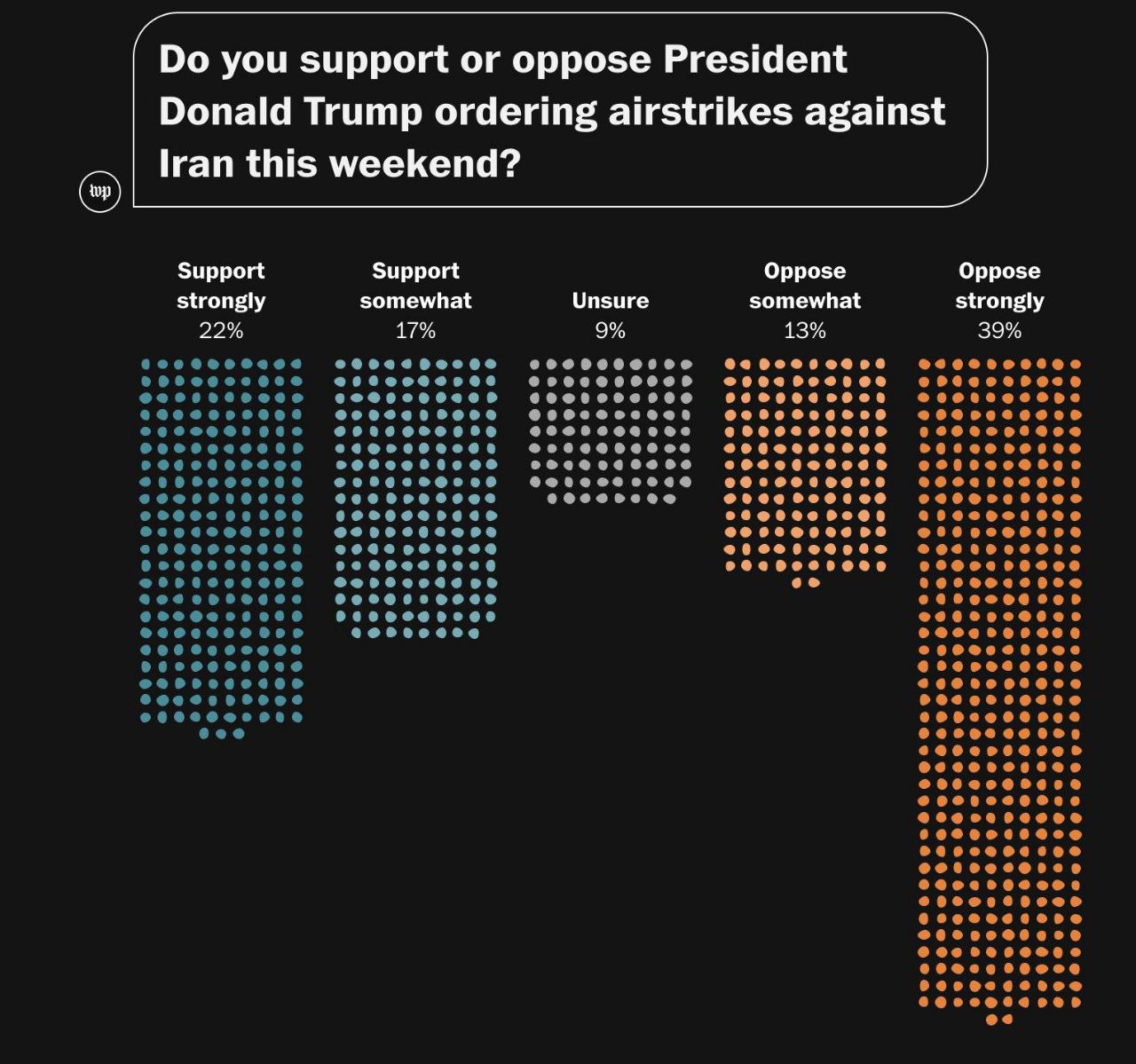
If the reality of conducting a ground operation tends toward zero, then achieving goals set at its beginning also tends toward zero. Moreover, everyone understands that a war of attrition, as happened for pootin in Ukraine, won’t work here. Blocking oil and gas supply from this region suits no one.
When the Bill Comes Due
Therefore soon they’ll start asking Donny how long this disco will last and who will pay for all this. When the moment of summing up comes more seriously and substantively, then hardly anyone will be interested that U.S. managed to sink 17 towelheads’ warships. Looking at the war against Iran results so far, the picture is grim: enormous costs, unclear progress on strategic goals, and a Middle East more destabilized than before.
Also the problem of power change in Iran will arise. If someone adequate doesn’t come, bearded fanatics will recover very quickly. Orcs² and China will undoubtedly help them do this — both need an ally who isn’t afraid to enter military conflict with the US.
One of three variants can happen in Iran. First — Libyan, when war of all against all begins. Considering there are very large non-Persian communities there, this is more than probable. Second variant — Syrian, when religious fanatics take power but try to look decent. Third variant — Iraqi and Afghan, when over ten-plus years of occupation, they still didn’t manage to create something sensible and healthy. In other words, a variant can happen when solving one problem, you create another — and possibly no less serious.
The Shahed Reality Check
But right now, old Donny puffs his cheeks and tries to imagine himself either Napoleon Bonaparte or Alexander the Great. Although those characters fought personally, and this one drives balls at Mar-a-Lago or on Epstein’s island. American press now practically stopped publishing materials about the tufted golfer’s adventures and about the island. It’s quite likely that rumors about pedophilia were also one of the main reasons to start fighting right now.
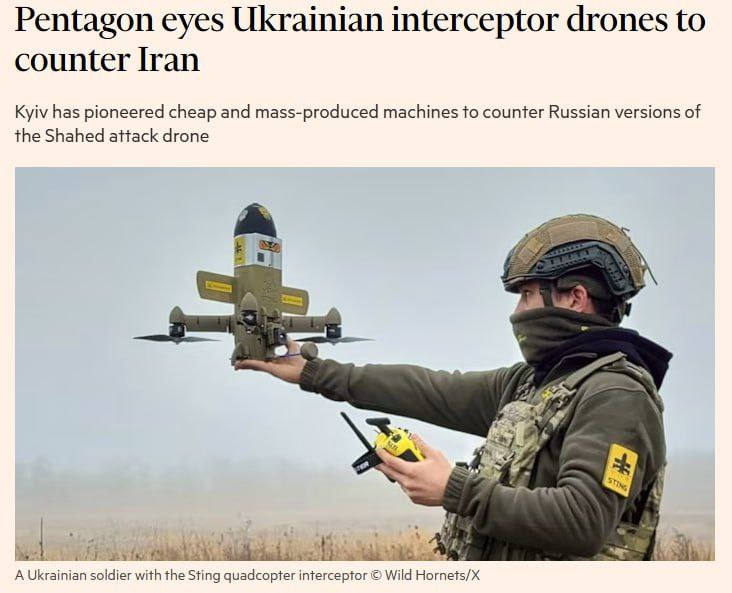
One more moment became completely obvious. Ukraine’s experience only now begins to be perceived as special value. Yes, the day before yesterday, US Secretary of Defense Hegseth told that the Shahed problem turned out more serious than predicted earlier. He didn’t specify what the miscalculation consisted of, but according to first estimates, precise Shahed arrivals turned out more than ballistic arrivals. And it turned out the US couldn’t even cover its own bases with a high degree of hermeticity.
Moreover, Gulf countries do approximately what we did back in fall 2022: during first Shahed attacks, they blast them with heavy anti-aircraft missiles — which categorically shouldn’t be done. I think Ukraine precisely therefore sent specialists in fighting drone attacks there, so these enthusiasts don’t shoot off all their rockets and because of this we don’t remain on starvation rations. This is exactly how awareness of reality comes and return from the world of delusions.
Russian Junk in the Desert
But the most interesting connected with Shaheds happens in Emirates and Qatar. Practically all strikes recorded in these countries got provided by Shaheds and their russian clones. But technically, close-range anti-aircraft means should intercept them. If for intercepting ballistics and cruise missiles, those same Emirates use Patriot and THAAD SAM systems, then to fight Shaheds they purchased… 50+ russian “Pantsirs”(!). Qatar also uses the same ineffective “Pantsirs”. Saudis conducted preliminary negotiations about supplying these complexes, and after them stood Bahrain, Kuwait, and Oman. And now everyone has the opportunity to see with their own eyes how “effectively” russian weapons work against modernized russian-Iranian Shaheds.
How Orcs talked them into purchasing this trash — we don’t know. Well, okay, suppose military from Emirates will hardly find Ukraine on the map. Also suppose they heard nothing about our experience countering Shaheds. But combat operations in Syria, and then in Libya, where Turks destroyed these “Pantsirs” in batches, should have shown how russian SAM systems work against modern strike means. But no. Everyone considers themselves the smartest, and the rake they step on — the most beautiful and useful. Precisely Emirates, who bought “Pantsirs” more than anyone, now receive our military so they organize anti-Shahed defense. The war against Iran results prove once again: russian weapons are junk, and Ukraine’s combat experience is priceless.
¹Towelhead – a derogatory term for supporters of Iran’s regime. Offensive? Yes. Context matters when the same people supply Shahed drones used to kill civilians.
²Orcs – a common term for Russians who support or participate in the armed aggression against Ukraine. Dehumanizing? Yes. Accurate? Also yes.
Related posts:

Military Operation Against Iran — What It Means for Ukraine
Today at 8 AM local time, Israel and the US launched a military operation against Iran — the one you’ve been reading about all day. As far as [...]
February 22 Massive Strike: Nearly 300 Drones & 50 Missiles
As of 10:00 AM, our Air Force reported on the February 22 massive strike — a combined attack the enemy executed on Ukrainian territory overnight. The enemy attacked [...]