
Drone Strike on Kirishi Refinery Completes the Trifecta
No filters. Just war as it is. Reader-supported.
Support →
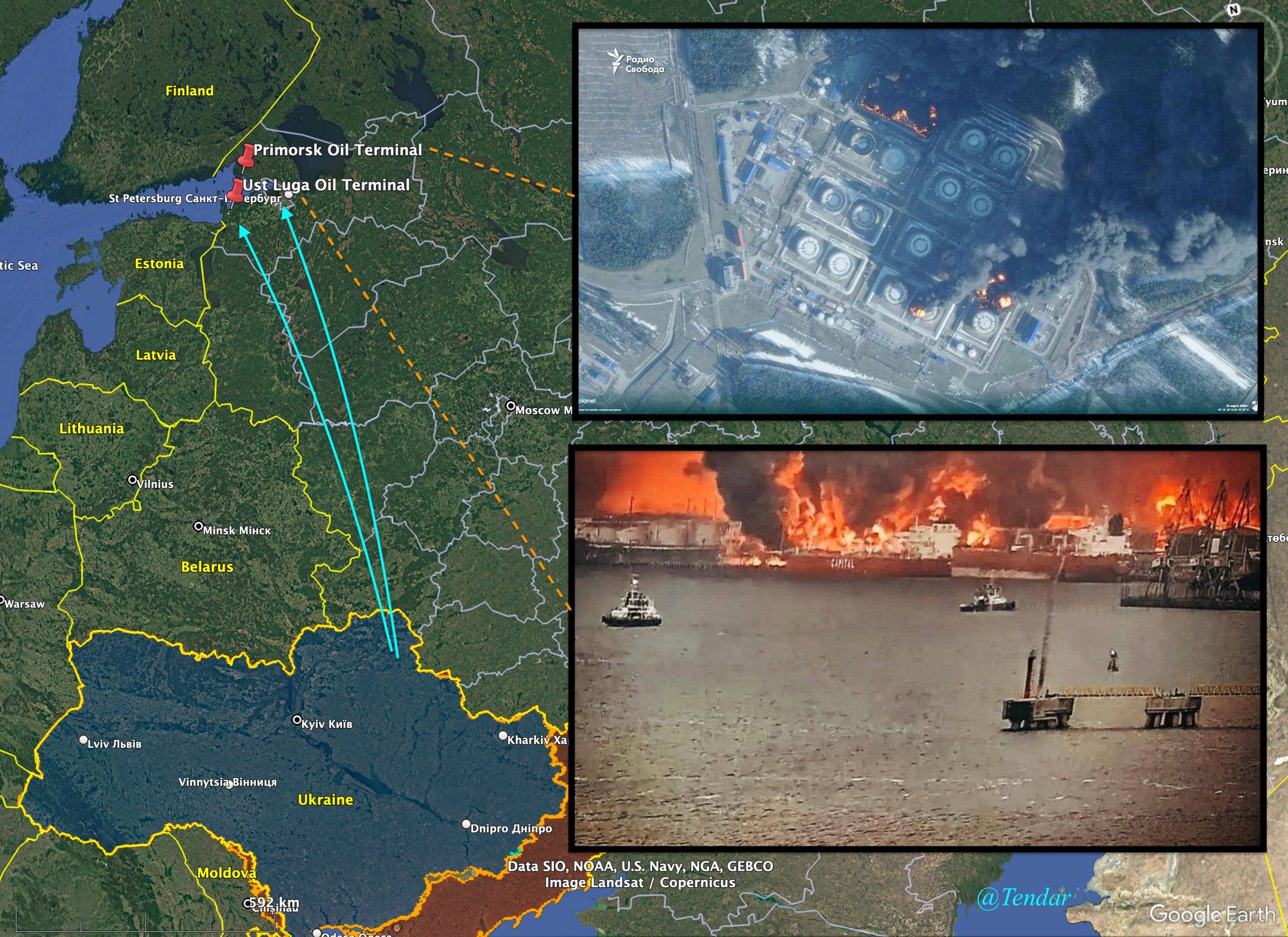
Before we get to today’s drone strike on Kirishi refinery, a few thoughts worth sharing. Details are coming in about what exactly was burning so spectacularly in Ust-Luga after Ukraine’s Defense Forces dropped bombs on the port infrastructure. Reports say the biggest fire broke out at the gas processing plant right next to the port. According to multiple sources, the fire spread across virtually the entire facility — and at some point the firefighters apparently decided their presence there was more ceremonial than practical and stopped trying. If that holds up, there’s nothing left to repair. They’ll need to build a new plant. Possibly somewhere else.
How many oil and petroleum tanks joined the party remains unclear. What is clear is that at least one tanker docked at the pier couldn’t resist and volunteered to contribute to the light-and-warmth festival. Either way, it was quite a sight — the St. Petersburg area hadn’t seen bombs dropping from the sky since World War II.
Worth noting that all of this, presumably, fits perfectly into the Führer’s plans. He has always said the war is going exactly as planned, and nobody has ever heard him say otherwise. Hard to imagine Putin announcing something like “the plan has been disrupted”. This is, after all, the same plan where “Kyiv in three days” is now entering its fifth year, and the disposal of the “world’s second army” has long since reached industrial scale. Yet the führer maintains the look of a man who knew all along — holding some diabolically clever plan that nobody else can figure out.
The Part That Made Everyone Pay Attention
There’s one detail here that deserves its own paragraph. The drones flew roughly 1,000 kilometers to their targets — crossing the entire European part of the Swamps¹ from south to north — and encountered no meaningful air defense the whole way. That conclusion follows from the weapons used. Part of the strikes weren’t carried out by standard kamikaze drones. They used something rarer: FAB-250 bombs dropped from converted light aircraft drones called “Flying Fox”. Those bombs hit the oil infrastructure at Ust-Luga and also worked over the shipyard in nearby Vyborg, where they did serious damage to the nearly-completed patrol icebreaker Purga, Project 23550 and It’s now listing badly at the pier (sailors have a much colorful phrase for that posture).
Until now, “Flying Foxes” were packed with explosives and sent in kamikaze mode. But a steel bomb casing punches harder, so for certain targets — like ships — it’s simply the better tool. The interesting part isn’t the bomb, though, it’s what carried it.
Think about what actually happened. Several light aircraft — unmanned, yes, but light aircraft — flew 1,000 kilometers over Swamps territory and nobody detected them. These aren’t low-observable drones engineered to scatter radar signals. These are light planes whose shape and materials were never designed to evade air defense systems. And they got through anyway, and dropped bombs.
If that’s possible — and apparently it is — then the same platform could fly the same thousand kilometers, just further east. Swap the FAB-250s for AIM-9 Sidewinder missiles. Route a few of those drones along the path Tu-95 bombers fly from Olenya air base to their cruise missile launch points. When the bombers show up, the drones launch their missiles. Strategic aviation of the Orcs² gets a chainsaw surprise in their own sky.
The Trifecta
After the Ust-Luga strike, one question hung in the air: would this be a double with Primorsk, or would Ukraine’s Defense Forces go for the full set and add the Kirishi refinery — also located nearby — to the list?
Now we know. Another flock of Good Birds³ reached Kirishi, and the refinery joined the fire show that’s been running across the region since the start of the week. Robert “Magyar” Broody, commander of the Unmanned Systems Forces (USF), confirmed the drone strike on Kirishi refinery — in his characteristically sarcastic style:
The Bermuda-like Leningrad oil triangle of Primorsk–Ust-Luga–Kirishi does exist, or: how the BALTIC export oil artery worked (version 3.0, not final).
Birds of the USF report:
Siberian crude, politely arriving at the Kinef refinery in Kirishi, then moving as diesel or raw crude through Transneft’s ports at Primorsk and Ust-Luga for tanker export — feeding the bunker grandpa’s bloody petro-profits — has, over the past three days (March 23–26), been somewhat disrupted with the assistance of freedom-loving Ukrainian Birds and their pyrotechnic shows. The oil logistics clot that formed has been torching soulfully for several days now, lightly fumigating the Finnish Gulf with smoke and soot, while the aforementioned ports wrap up their fire show in open-flame mode.
So, the fuckdown timeline:
Monday, March 23 — Transneft-Primorsk terminal operations halted; ironically, the alternative Ust-Luga terminal — previously shut after Ukrainian drone courtesy visits — resumed operations that same day.
Wednesday, March 25 — Ust-Luga caught its hit, is burning, the smoke already blocking the view for Martians watching with popcorn.
Thursday, March 26 — Kirishi refinery — the region’s largest, receiving Siberian crude by pipeline for processing and onward pumping to the ports — lights up.The trifecta defines the perimeter.
The full tour was carried out by deep-strike units of Ukraine’s Defense Forces, including USF Birds.
Today’s trip to Kinef (Kirishi refinery) was executed by Birds of the 1st USF Assault Corps jointly with SBU assets.
The USF crews put together a video compiling all three strikes. Here it is:
On the Swamps side, the local gauleiter Drozdenko humbly confirmed the attack. Official statement:
Air defense operations are underway over Kirishi district. There is damage in the industrial zone. No casualties reported at this time.
You can safely predict what comes next: how many specialized vehicles arrived on scene, how many personnel are fighting the fire, and — if things look really bad — how many square meters the fire has covered. Maximally unimportant information, delivered with maximum seriousness. What he will never mention is what connects all three targeted locations, even though it’s sitting right there in plain sight.
Putin’s Personal Wallet, on Fire
The Kinef refinery has now been struck for the fourth time. First hit: March 2024. Second: March 2025. Third: October 2025. And now March 2026. The facility is 100% owned by Surgutneftegas, whose ownership structure is almost entirely opaque. According to multiple sources, the controlling stake belongs to the Putin clan — directly and through proxies. In plain language: this is the tsar’s personal money factory. The ports at Primorsk and Ust-Luga are its export arm. The refined products get loaded onto tankers practically next door. The whole thing functions as Putin’s private wallet. And that wallet just got burned three times in a row.
Putin’s inner circle knows exactly how this scheme works — that’s precisely why no regulatory body has ever been allowed near it. But that privileged status has a flip side. Everyone who’s in the know is now watching Ukraine’s Defense Forces methodically torch the führer’s personal assets over three consecutive days, while he sits in his bunker quietly fouling the air.
Uncomfortable questions are starting to circulate. If Putin can’t protect his own property, what exactly can he protect? His entire reign was built on the image of a man you simply don’t challenge — where strength isn’t just advisable, it’s survival. But the good birds just ran that image through a shredder, three times in a row. For the ruler of the Swamps, that’s not just an embarrassment. That kind of thing starts a countdown — to losing power, one way or another.
What’s Still Waiting
Meanwhile, the Yamal Cross is still waiting for its moment. And so is everything sitting on the northern tip of the Kola Peninsula — the Northern Fleet base, which sooner or later follows the Black Sea Fleet into history, and of course Olenya air base, cursed by every Ukrainian who’s ever lived through a missile strike it launched. It’s much further away than St. Petersburg, sure. But then again — could anyone in 2022 have imagined a drone strike on Kirishi refinery?
¹Swamps – an ironic name for Russia, emphasizing decay, stagnation, and filth. The Commander of the USF, Robert Browdie, and most soldiers use this word.
²Orcs – a common term for Russians who support or participate in the armed aggression against Ukraine. Dehumanizing? Yes. Accurate? Also yes.
³Good Birds – slang for strike drones. Why “good”? Because they bring “warmth and light” to enemy military factories, ammunition depots, and oil refineries. Sarcastic? Of course. Effective? Even more so.
Related posts:

General Staff Confirms Strike on Primorsk Oil Terminal
The strike on Primorsk oil terminal made it into the General Staff’s official report by midday — unusually fast. Normally, there’s a gap between a high-profile strike and [...]
Drone Strike on Almaz-Antey Plant: Impact on Enemy Air Defense
A few hours ago, video of the drone strike on Almaz-Antey plant. Our good birds visited temporarily occupied Sevastopol with an unofficial and definitely unfriendly visit. Actually, the [...]