

Novorossiysk Port Strike: Oil Terminal Sheskharis and a Frigate
No filters. Just war as it is. Reader-supported.
Support →

The strikes on Russian oil infrastructure are picking up an avalanche-like momentum, and Ukraine’s Defense Forces have developed a recognizable signature. The pattern alternates between hitting oil terminals at seaports and refinery facilities. Over the past few days, that’s exactly the rhythm playing out. A follow-up strike hit the Primorsk oil port — this time targeting not the storage tanks but the pipeline infrastructure feeding oil into the terminal. And this night came the Novorossiysk port strike — and it hit hard.
Local residents say they’ve never seen anything like it, and their social media channels filled up with Pearl Harbor comparisons. They noted the unusual sound of the incoming munitions and the explosions — and then the glow that appeared at multiple points across the port held them completely transfixed.
“Everything Was Shot Down”?
People simply couldn’t stop filming. The internet is now full of videos showing what’s burning — and, presumably, the scramble happening on the ground. All this despite the local gauleiter issuing a strict ban on filming any of it, let alone posting it online. Understandable — he knew that his standard line of “everything was intercepted, but some debris landed here and there” would look absolutely ridiculous next to those videos.
What actually burned is described by specialist observers as follows:
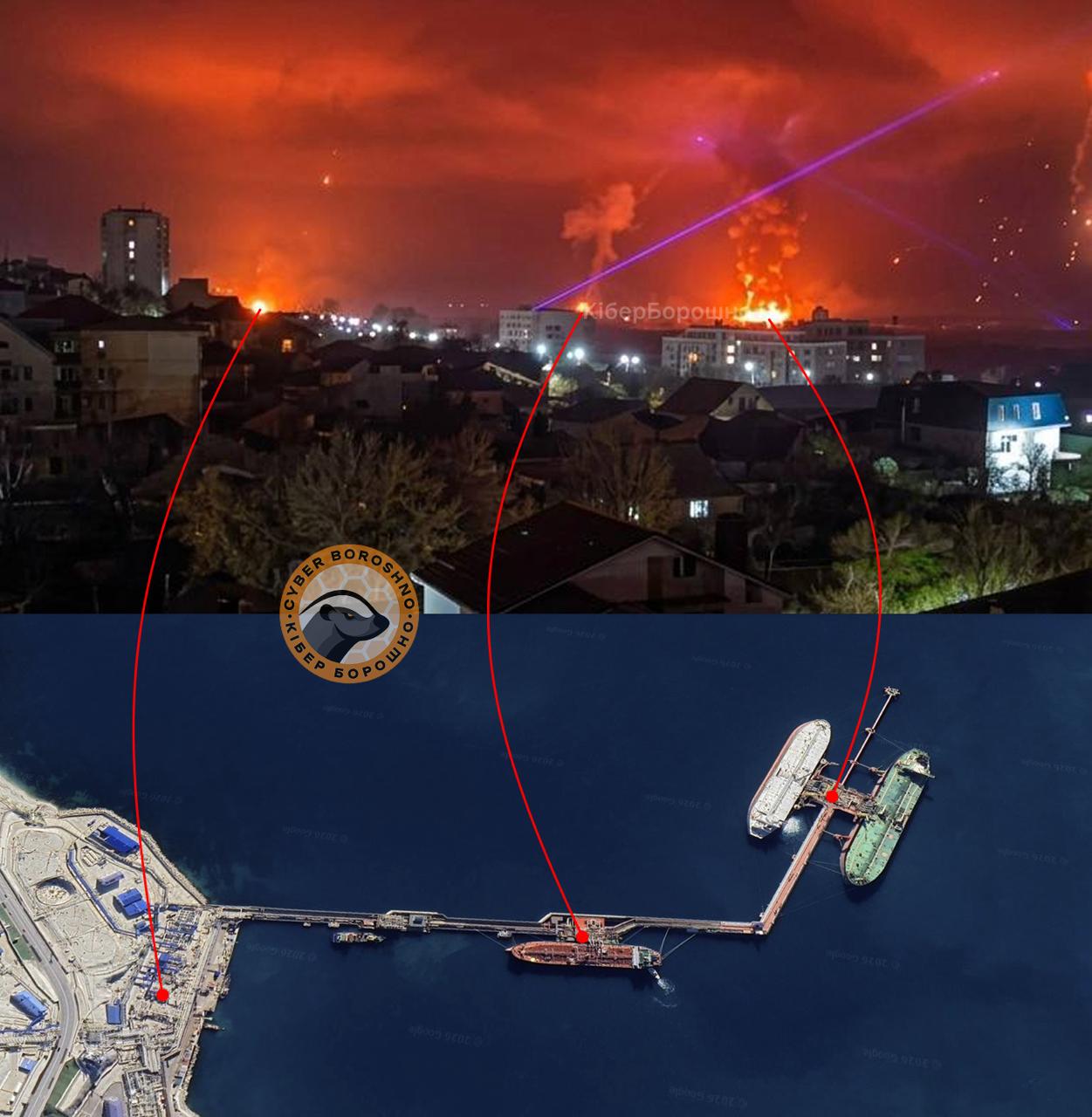
According to the OSINT community “Cyberboroshno”, the overnight attack hit three targets:
▪️ Berth No. 1 — a major fire caused by an oil spill.
▪️ Berth No. 2.
▪️ SIKN metering nodes (automated oil quantity and quality measurement system) and pipeline shutoff valves — the key infrastructure for oil accounting and distribution.
Simultaneous damage to both main berths and the SIKN nodes effectively blocks oil loading operations.
The New Strategy: Don’t Damage — Disable
Judging by how these port strikes are being executed, the concept has shifted. The goal is no longer to cause maximum damage — it’s to take the entire port infrastructure completely offline. When the Orcs* announced that exports from Ust-Luga had resumed, they quietly omitted the key detail: the pipelines used to fill the port’s storage tanks sustained critical damage. Any meaningful resumption of loading — even partial — is simply not happening.
By now, everyone understands this wasn’t the last strike — Ukraine’s forces will be back. So the priority becomes offloading whatever’s left in the surviving tanks — anywhere, fast. Losing an empty tank is a problem. Losing one containing 30,000 or 50,000 cubic meters of burning fuel is a completely different story.
Port targets
Port targets can be broken into three tiers.
First — the loading terminals. That’s what got hit in Novorossiysk last night. Without functioning terminal equipment, you cannot load oil or petroleum products into a tanker — even if you have a million cubic meters of it sitting in the port’s tank farm.
Second — the tank farm itself, which must stay filled at a level that guarantees continuous loading for incoming tankers.
Third — the infrastructure connecting the tank farm to the main pipeline.
The most visually spectacular strikes are on fuel storage. At night they blaze brightly; during the day the smoke is so thick it’s visible from space. But the most effective sequence, as far as can be understood, is exactly this order of priority. The moment loading stops due to terminal damage, oil and petroleum products keep flowing in and the tanks fill to capacity. You can’t pump it back into the pipeline, and you can’t load it onto a tanker. And if the third tier gets targeted, it means the port is being cut out of the export chain. Not necessarily forever, but for a very long time.
The Frigate and the Drone That Wouldn’t Stop
Ukraine’s General Staff officially confirmed a successful strike on the Sheskharis oil terminal at Novorossiysk port. The Orcs are trying to squeeze sympathy from “the international community”, claiming Ukraine went after the nearby CPC pipeline terminal — which exports Kazakhstani oil. Ukraine’s military clearly identified russian own terminal as the strike objective, though one other episode of this operation still needs clarification.
At least one good bird paid a visit to the military vessel anchorage and hit a frigate — a Kalibr cruise missile carrier. Ukraine’s Unmanned Systems Forces published video of the strike:
It clearly shows the enemy launching a surface-to-air missile — where it went is unknown, because the drone kept flying straight toward its target. The video cuts out a few meters from the frigate’s hull.
How Drone Swarms Actually Work
Operations like the Novorossiysk port strike are almost certainly planned with primary and secondary targets. Primary targets are the priority; secondary targets are backup. The drones fly one way — they don’t come back — so every single one needs to hit something, regardless of how the mission unfolds.
There are two main scenarios worth considering. In the first, something prevents the strike on the primary target — not necessarily dense air defenses, but any unexpected obstacle in the operational area. All drones then get redirected to the secondary target.
The second scenario involves the math of attrition. Without speculating on exact numbers, consider a simplified example: three targets, one drone needed to destroy each. Based on experience, commanders decide to send three drones per target to guarantee the hit — one might fail mechanically, one might get shot down, but one will get through. So nine drones go out for three targets in one location.
Now imagine all three primary targets go down on the first attempt, and drones are still in the air. Mission accomplished — but with hardware to spare. Commanders redirect the remaining birds to secondary targets. That’s likely exactly what happened here: the port infrastructure collapsed faster than planned, which freed up drones for the warships.
*Orcs – a common term for Russians who support or participate in the armed aggression against Ukraine. Dehumanizing? Yes. Accurate? Also yes.
Related posts:

Russian Propaganda Claims Drone Route to Ust-Luga via Poland
On the night against Saturday, Ukraine’s Defense Forces put strikes on enemy ports Primorsk and Ust-Luga on pause. But the topic that already started spinning up in enemy [...]
Ukraine Delivered Repeated Strikes on Primorsk and Ust-Luga
This night, St. Petersburg’s outskirts somewhat resembled Brazil during carnival. Mass of fires, loud sounds, and incendiary pictures were present. As we remember, this week Ukraine’s Defense Forces [...]