

Strikes on Enemy Assets Expose Pantsir Air Defense Flaws
The unfiltered truth from Ukrainian soldiers and volunteers. Just war as it is. Reader-supported.
Support →

Today the General Staff of the Armed Forces of Ukraine confirmed successful strikes deep in enemy territory — both in the occupied part of Ukraine and on the internationally recognized territory of the Rabid Federation. Among the confirmed hits: the Yaroslavl refinery, a Kasta-2E1 radar system in the occupied part of Zaporizhzhia Oblast, a Pantsir-S1 air defense system in Mariupol, and a railway train carrying military cargo. The cargo itself was not specified, so we will leave that aside — but the first two items on that list deserve a closer look. Also deserve a closer look the Pantsir air defense flaws, which are becoming impossible to ignore.
The Yaroslavl refinery has now been hit at least four times since the full-scale invasion began. Yet this strike felt different — fresher, more colorful. Locals posted social media with videos showing the fire burning for a notably long time. If you don’t count the Tuapse refinery, fires after strikes on such facilities usually lasted few hours and that was it. In Yaroslavl it burned much longer. No precise data yet on what exactly got hit, but it was clearly fun there. Worth noting: the Orc¹ capital gets the bulk of its fuel from two refineries — the Ryazan and the Yaroslavl plants.
The Ryazan plant was already badly damaged earlier and has been unable to reach full capacity since, limping along with ongoing repairs. And now the Yaroslavl refinery has gone dark too. Moscow will not run out of fuel, but it will now need to ship it in by rail — eating up capacity on a network where military trains are already an established target. The dear Muscovites are about to discover a new normal, and the Good Birds² are full of surprises.
Feodosia: Almost Finished
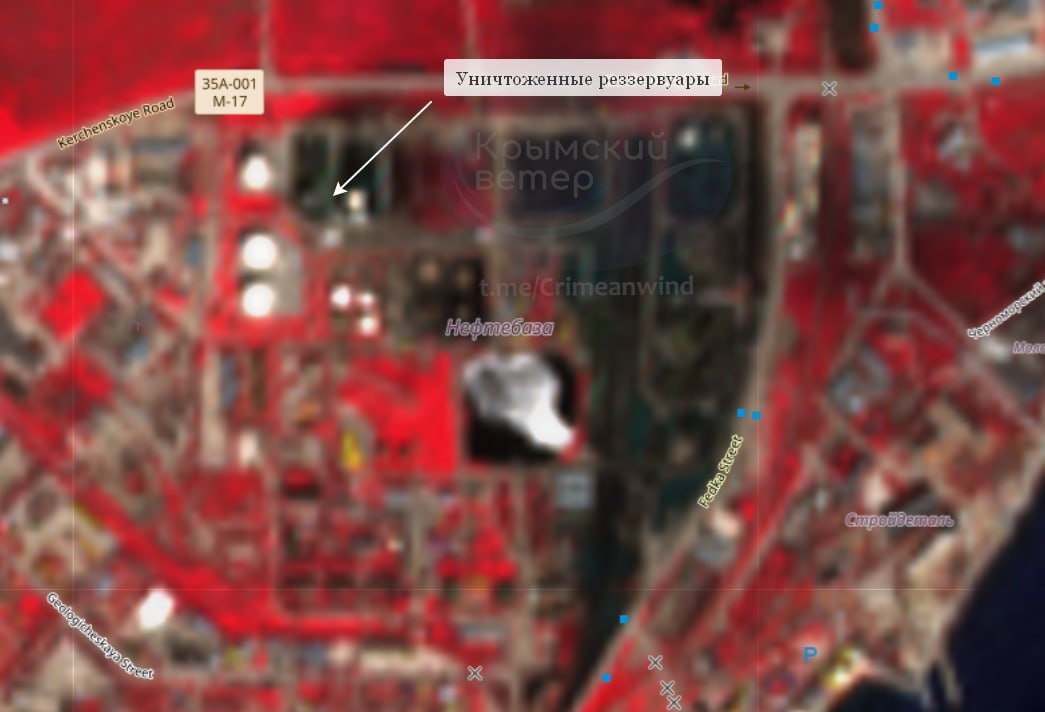
Meanwhile, the smoke over the Feodosia fuel depot has cleared — and the scale of the damage is now visible. Three large reservoirs remained intact, probably 10,000 cubic meters each, plus four smaller ones. So a bit of work remains to close this base for good. But the most interesting thing about the latest strike on this location is not the tanks — it is what else burned. A Pantsir-S1 air defense system was also destroyed in the attack. Video circulating online clearly showed the remains of the unit sitting on an artificial mound right in the middle of the base.
Today’s General Staff report confirmed the destruction of yet another Pantsir. Previous reports covering strikes on the ports of Primorsk and Ust-Luga also mentioned similar systems being destroyed — systems that had been protecting especially high-value targets. So a very reasonable question keeps coming up: how did these machines turn out to be so catastrophically bad in actual combat?
Let us also not forget that the Pantsir holds an champion title in a separate category — “Striking Russian Homes”. Because Pantsir uses a specific missile produced exclusively for it, missile remains directly indicate who launched it. Yet 26 of these complexes stand in circles around pootin’s “Valdai” residence.


The Air Defense That Doesn’t Hold
The Orcs themselves have started explaining Pantsir air defense flaws: the system reportedly struggles with low-flying targets. And that is a spectacular problem for a system specifically designed to intercept exactly those targets.
A strange impression forms about designers’ ideas of how targets fly. It looks like they assumed the target would fly high, making it easy to shoot down. But if it flies low, they can’t shoot it down. Worse — the target itself can destroy the air defense installation. We observe this almost daily. This means designers got the wrong task.
Such thoughts arise every time another report comes that another drone hit a Pantsir, like today. Because however you spin it, Pantsir is a last-mile strike weapon, or last-line defense that shouldn’t let an enemy target through after passing all defense echelons, including using low-altitude flight. This means problems with low-altitude targets can arise only and exclusively due to “Earth’s curvature”, when the installation’s radar simply doesn’t see the target beyond the horizon. But in that case, attention should turn to mathematics, which will put everything in its place.
The Pantsir-S1’s published specs give it a maximum target detection range of 30 km, engagement range of 24 km, and a strike range of 20 km. That is its working envelope. Now let us look at what geometry actually says about low-altitude threats and the horizon.
At average human eye height of 1.7 meters, the horizon sits at roughly 4.7–5 km. From 2 meters height, horizon is at 5+ km. From 3 meters height, horizon is at 6.8 km. At 10 meters — say, from a mound or a rise — the horizon extends to around 11.3 km.
The Math Does Not Lie
Therefore, for Pantsir’s onboard radar, the horizon will be in the 6-11 kilometer range. This depends on whether it stands on an embankment or flat terrain. Considering the drone flies at some height from ground surface — let’s say 10 meters — it will emerge from beyond the horizon exactly at 20 km distance from Pantsir. Simple calculation shows the math. If a drone flies directly at Pantsir at 200 km/h speed, it appears in the complex’s “kill zone”. It will move for about 6 minutes. Accordingly, the drone will fly several minutes to the target Pantsir covers. During this time, Pantsir must intercept the target. At minimum, it shouldn’t let itself get hit.
However, real combat conditions continue to expose Pantsir Air Defense Flaws. The system cannot reliably engage the slow, small drones it was built to stop. If that is true, then the Orcs have produced yet another piece of junk they inexplicably treat as the ultimate air defense solution. The designers were handed the wrong requirements — and they delivered a system built for a different war entirely.
Because, at its core, the Pantsir is meant to be the last line of defense — the system that catches whatever slips through every other layer, including targets flying low. Meanwhile, for hitting Russian apartment buildings, the Pantsir scores a solid excellent — and that, apparently, is where its real talent lies.
¹Orcs – a common term for Russians who support or participate in the armed aggression against Ukraine. Dehumanizing? Yes. Accurate? Also yes.
²Good Birds – slang for strike drones. Why “good”? Because they bring “warmth and light” to enemy military factories, ammunition depots, and oil refineries. Sarcastic? Of course. Effective? Even more so.
Related posts:

Russian Air Defense Collapse: Path to Hell Like Black Sea Fleet
Still cautiously, but nevertheless it’s possible to state that enemy air defense started the same path that russian tanks and the russian Black Sea Fleet previously traveled. The [...]
Fighting for Light: Ukraine Survived the Hardest Winter
How did Ukraine survived the hardest winter of the full-scale invasion? This time there will be no personal emotions or analysis from us. Instead, we want to present [...]