

Russian Ground Robots: Origins, Failures, and a Growing Threat
The unfiltered truth from Ukrainian soldiers and volunteers. Just war as it is. Reader-supported.
Support →
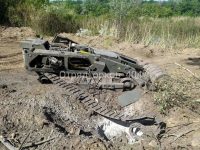
Ukraine’s Ministry of Defense plans to shift 100% of frontline logistics to NRKs¹. But where does the enemy stand on this technology? How are Russian ground robots developing — and who is actually ahead?
Ukrainian specialists regularly monitor enemy developments, including their use of unmanned ground vehicles on the battlefield. Here is how it works on their side, and why we believe Ukraine’s Defense Forces currently hold the lead.
From Soviet Ideas to Syrian Failures
Russians started thinking about military robots long before the full-scale invasion. Back then, the topic was mostly propaganda — window dressing for the image of a “army of future” — rather than any real battlefield capability.
Russian design bureaus pursued two directions. Some tried to revive the old Soviet concept of a remote-controlled tank or IFV. Others developed what they called ground robotic systems, or NRTK² (rus. “Наземный РоботоТехнический Комплекс”), capable of performing various battlefield tasks.
The remote-controlled tank projects went nowhere. An IFV prototype failed badly in urban combat trials in Syria. The only “unmanned tank” they actually deployed was a T-55 stuffed with explosives and used as a kamikaze.
The NRTK direction, however, produced more results. The best-known example is the Uran-9, unveiled in 2016 and presented by Russian propaganda as a breakthrough in ground robotics. It carried a 30mm cannon, a machine gun, anti-tank missiles, and flamethrowers. During testing in Syria, the complex revealed a number of critical problems. In urban conditions, the Uran-9 maintained a stable connection only within 300–500 meters — and even that came with constant outages lasting anywhere from one minute to an hour and a half. The drivetrain and weapons systems failed regularly, and the optics were too poor to reliably identify targets. Russia’s own engineers concluded that systems like this would not be combat-ready for another 10–15 years.
Cheap, Simple, and Deployed
After 2023, the battlefield became far more dangerous to move across. So Russian engineers, shifted toward smaller, simpler unmanned ground vehicles. Just like Ukraine did.
The most widely produced Russian NRTK is the Kuryer, available in multiple configurations and already deployed at the front. It was originally developed by volunteers and later handed to an industrial company for mass production. The broader trend in Russian ground robots has been a deliberate shift away from expensive prewar systems toward cheap, simple, high-volume platforms. For context: the Uran-9 costs millions of dollars. The Kuryer, without weapons, costs around $11,000.
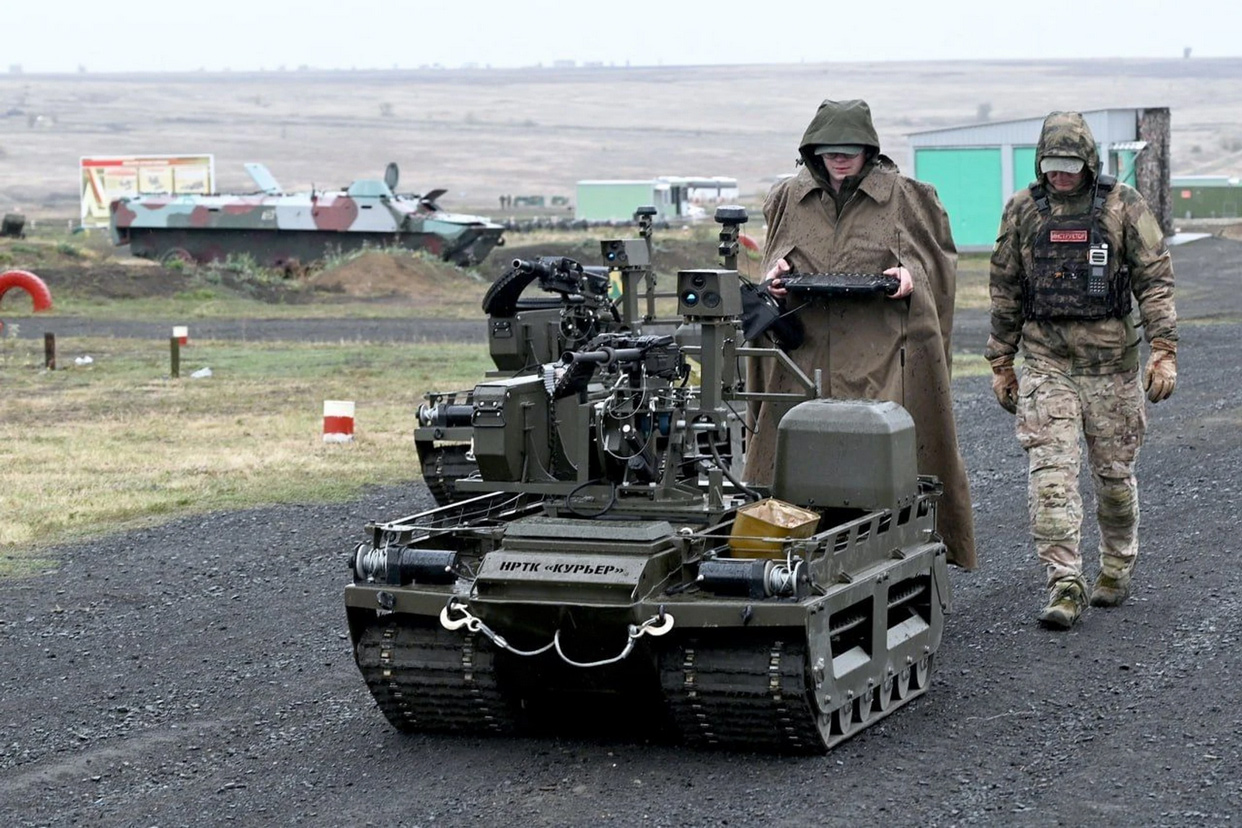
Since then, dozens of models have appeared on the Russian market. The StateWatch analytical center identified at least 20 companies producing 32 NRTK models. Notably, only half of them are under sanctions. The rest continue to source components freely. You can download and read the full report at the link: https://trap.org.ua/wp-content/uploads/2026/04/NRK-Zvit-.pdf
Ukraine has significantly more manufacturers, but measuring only by the number of companies is not a very good idea. What matters is scale of deployment, availability of trained specialists, and actual battlefield effectiveness.
Who Is Really Ahead?
On scale, Ukraine appears to lead — and several indirect indicators support that conclusion. First, the Oryx portal has visually confirmed that Russia has lost four times fewer robots on the battlefield, which suggests lower deployment numbers rather than better survivability. Second, Russian forces are still widely using motorcycles, ATVs, improvised buggies, and even pack animals for front-edge logistics — a clear sign of insufficient technical solutions. Third, Ukrainian military personnel report no systematic or large-scale enemy use of this technology.
So perhaps Russian NRTK compensate through quality? That also seems unlikely. The Telegram channel “Oboronka” obtained and analyzed internal enemy documents, noting that Russians do collect battlefield feedback on new technologies in a structured and methodical way. Yet Russian NRTKs suffer from the same early-stage problems as Ukrainian ones. Enemy troops reported drivetrain failures in the Kuryer and Bogomol models, leading to overheating and electronics burnout. The vehicles struggle with mobility in rain, and both cameras and batteries malfunction regularly. Some issues get fixed on-site; others require sending the unit back to the manufacturer.
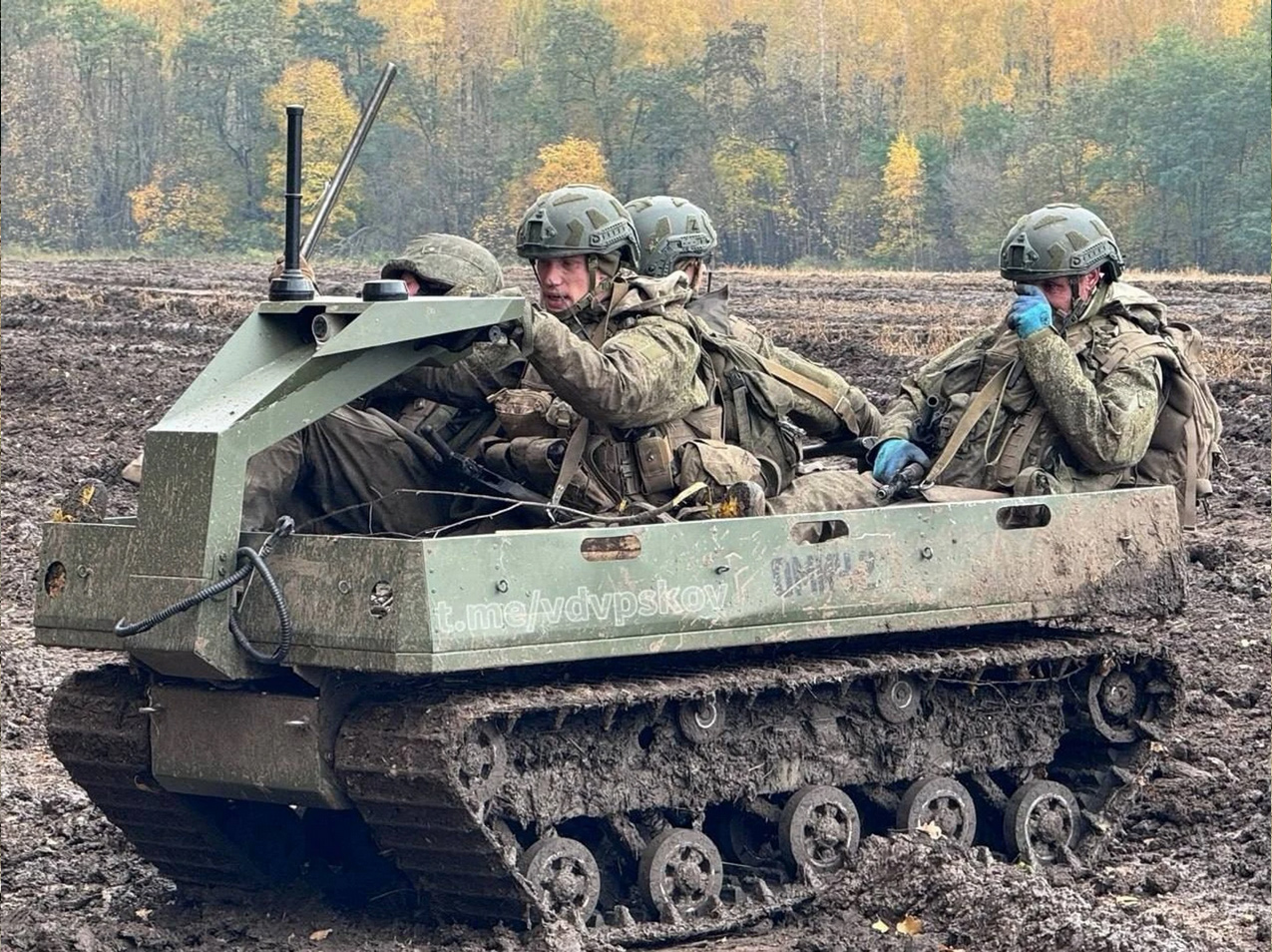
The most painful problem for Russia, however, is communications. Ukraine relies heavily on Starlink, which underpins much of its NRK. Russia cannot do the same. Instead, Russian engineers are forced to work around this with relay systems and MESH networks — solutions that fall well short of satellite internet available anywhere on the battlefield. Fiber-optic connections are used in some cases, despite the obvious risk of cable damage. In certain situations, operators are forced to control NRTK from inside the platform itself — which defeats the entire point of a robotic system:
Do Not Underestimate the Enemy
Does all of this mean Ukraine has won the ground robotics race? No. Russian engineers will eventually solve their teething problems. Finding a communications alternative will be harder — but the Shahed program shows that Russia invests seriously in working around technical limitations when it needs to.
Right now, Russian command is actively expanding its unmanned forces. As of April, the plan was to grow the number of drone operators to 101,000 — and to 165,500 by year’s end. Ground robot operators are part of that count, and Russia is moving toward that target steadily.
University recruitment campaigns in Russian liberal media illustrate the approach: they specifically target young people who are comfortable with computers but struggling academically. Some are offered money. Others get their exams signed off. In some universities, faculty conduct “educational conversations.” Drone exhibitions are staged on campuses, and in some cases recruitment happens under the implicit threat of expulsion.
Russia is also investing in its own satellite constellation called Rassvet, intended as a Starlink equivalent. The Foundation for Advanced Research (Russia’s DARPA analog) funds technical development and new model production through pro-government volunteer structures like the “Kulibin Club” and “the People’s Front”. State civilian and military universities contribute engineering work as well.
The Role of China and Sanctions
Russia’s entire drone industry depends critically on Chinese components, and ground robot production is no exception. The supply chain behind Russian ground robots is effectively a subset of the UAV supply chain — both types of systems share motors, batteries, controllers, cameras, and communication modules. Many manufacturers produce both aerial and ground drones as a result.
What is striking is that sanctions have largely targeted older military factories whose products either never reached the front or see only limited use. The US has sanctioned 10 of the 20 identified manufacturers. Ukraine has sanctioned 9. The EU — only 3. Meanwhile, the largest serial producers of new-generation NRTKs that are actually supplying the front remain outside meaningful restrictions. Critical gaps in existing sanctions regimes allow key manufacturers to freely source components abroad.
Underestimating the enemy is a mistake. Two things need to happen in parallel, and neither can wait. First: scale Ukrainian NRKs at the front systematically and consistently. They have already proven their effectiveness — not just at preserving lives, but at preserving lives inside the kill zone. Second: coordinate sectoral export restrictions on strategic components that feed Russian NRTK production. Timely sanctions now will have far greater impact than a delayed response after Russia’s production scales up further.
¹NRK – (Ukrainian abbreviation for “Наземний роботизований комплекс”, НРК, literally “ground robotic complex”). A Ukrainian combat ground drone. Unlike typical UGVs, NRKs are capable of firing, mining, demining, and launching other drones.
²NRTK – the Russian analogue of Ukrainian NRKs. Similar to our robotic complexes, it can fire or lay mines, so using the term UGV is inappropriate.
Related posts:

Strike on Voronezh — Unknown Weapon, Undeniable Results
On June 22 the Ukrainian Defense Forces landed a solid hit on one of the enemy’s military-industrial facilities — JSC VZPP-Sborka. The Strike on Voronezh was timed perfectly [...]
Why Russia Uses Small Group Tactics and How to Counter
It looks like Russia’s top military command has concluded that the tactics its occupation army used before no longer deliver the results Pootin keeps demanding. So they changed [...]