

Zaluzhny Conversation with Students: World Order and Wars
The unfiltered truth from Ukrainian soldiers and volunteers. Just war as it is. Reader-supported.
Support →
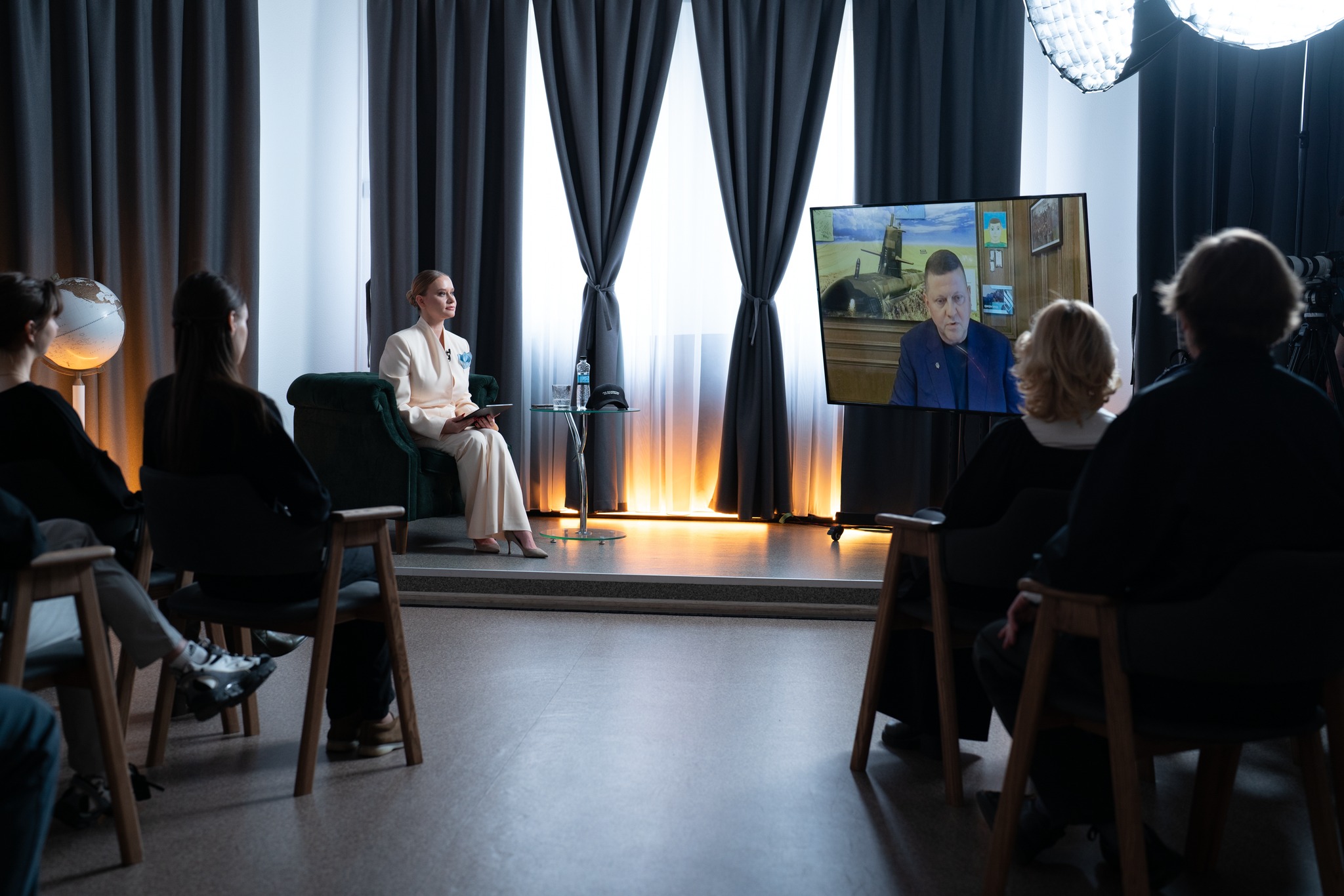
Valerii Zaluzhny is one of those rare people who become legends while still alive. This conversation between General Zaluzhny and students from universities across Ukraine was organized by the Kyiv School of Public Administration named after S. Nyzhnyi. In Zaluzhny conversation with students, nothing is softened and nothing is left unsaid.
Zaluzhny gives direct answers to deeply difficult philosophical questions — ones that trouble both Ukraine and the world. The discussion was recorded and structured in a question-and-answer format, essentially as an interview.
The Rules Exist. The Enforcement Does Not.
Observing what is happening in the world today, do you think we are living through a global breakdown, or is this just temporary turbulence?
The world today is in a state that is hard to call mere turbulence. What we are witnessing points to the systematic dismantling of an order that took decades to build.
The world order is not an abstraction. It is a specific set of rules — political, economic, trade, cultural — agreed upon by 193 countries under the UN and other international institutions. But rules without enforcement are meaningless. International law becomes fiction the moment there is no force capable of stopping those who break it.
Formally, the rules still exist. They are still taught in universities. Yet physically, they no longer function. The world order built on agreements has been destroyed — because the force that was supposed to uphold it turned out to be paralyzed.
Many believe this crisis began recently. In reality, the degradation of the old system has been underway for 18 years. The turbulence started in 2008 — and today it has not simply continued. It has concluded in the complete collapse of the old foundations.
Russia began breaking the rules with its attack on Georgia in 2008. Then came 2014 — the attack on Ukraine, the seizure of Crimea, and parts of Donbas. In 2022, the aggression escalated into full-scale war. In every one of these cases, international law existed on paper. Yet no force was found that could actually stop what was happening.
And this crisis did not touch only dictatorships. US actions in Venezuela. The use of force bypassing international norms also erodes the foundations of sovereignty and respect for borders. We see analogous processes in the confrontation with Iran across the Middle East, where the law of force consistently overrides legal norms.
The break did not happen only on the battlefield. The Trump administration launched trade conflicts even with its closest allies — a clear signal that the rules-based free trade order is no longer a priority for the world’s main player.
The Order of the Strong
What we see today is a world where the “order of the strong” prevails. If you have power, you can ignore the rules. That sets a dangerous precedent for all of humanity. Europe, which grew accustomed to living under the American security umbrella, is now receiving direct signals: the US is no longer an unconditional guarantor, and Europeans will have to take responsibility for their own security.
Ukraine, in this context, is the most vivid and most tragic example. We have been fighting a war in the center of Europe for 13 years — a war on a scale the world has not seen since WWII. The fact that this conflict finds no resolution within existing international structures is the clearest proof that those structures do not work.
The absence of an effective world order means that any war tends to become chronic — or triggers a chain reaction. If aggression against Ukraine is not stopped by the international community, a similar explosion becomes inevitable somewhere else.
We have already seen the Middle East. Because the old rules no longer apply, that war may never end — there is no force capable of imposing a peaceful settlement. Therefore we should expect a third conflict, a fourth, a fifth, in different corners of the planet. This will continue until humanity passes through this painful breaking point and builds a new system.
We are in a transition. The old world is gone. The new one has not yet been born. What it will look like depends on the outcomes of today’s wars. The future world order will require two basic things: new rules suited to present-day realities — not those of the mid-twentieth century — and a new force, a mechanism capable of actually upholding those rules and punishing those who violate them. Until both exist, we will remain in a state of world war that simply shifts its geographic centers. Ukraine today stands at the front edge of this breaking point, and how firmly we hold will shape the foundation of whatever comes next.
World War III?
Do you believe we are approaching a Third World War, or are these simply ongoing regional conflicts?
Whether current events constitute the beginning of WWIII or merely a series of regional conflicts is an extraordinarily difficult and contested question. Historians will give a definitive assessment in 50 or even 100 years. For now, we are only witnesses to a process unfolding in real time.
As witnesses, we see a concrete picture. A large-scale war continues in Ukraine. A war continues in the Middle East. And there are no functioning international mechanisms capable of preventing new conflicts from igniting in a third, fourth, or fifth location.
In that situation, each person must answer for themselves: is this already a WWIII — simply scattered geographically across the globe — or is it a collection of conflicts that emerged from the complete absence of a stable world order?
A classic world war implies clearly formed coalitions fighting one another. That picture does not exist today. Around 55 countries support Ukraine, but they provide assistance rather than entering the war directly. Some 17–18 countries support Russia, yet they are also not physically engaged in combat — setting aside the limited units of the North Korean dictator. Theoretically these numbers can be framed as two opposing forces, but in practice these groups of states are not sufficiently united — neither ideologically nor materially. Their alignment is at most partial, financial or technical, which does not qualify them as full military coalitions on a global scale.
On the other hand, if we understand world war not as the direct clash of two monolithic blocs but as a continuous series of conflicts unfolding amid the collapse of the old world order — then that reading has merit. Conflicts ignite and do not stop, creating the sense of a permanent war that has engulfed the great house we call Earth.
What we observe is the formation of a loose “axis of evil” and an opposing force we associate with an “axis of good.” Since we stand with those who defend democratic values and their own sovereignty, we identify ourselves unambiguously with the side of good.
So we are at a unique historical moment. Either this is a transitional period toward a new world order — passing through a series of exhausting wars — or the very form of world war has evolved and now looks exactly like this: a network of separate but interconnected fronts, where neither side has yet dared to push toward a total global confrontation. The question remains open. And the answer is being written every day on the battlefield.
AI and Techno-Fascism
In your view, what will the world order look like after the conditional global crisis of 2050–2060 ends and humanity rethinks it? What is this new world order for the entire planet?
Historically, every new world order was built on the foundation of a major technological revolution. The emergence of genuinely new technologies has always forced humanity to rewrite the rules of the game. Today we are witnessing the same process — and the main game-changer is AI.
It is difficult to predict exactly what the future order will look like, since no clear leader of this technological race has yet emerged. However, dangerous theories are already circulating — among them the idea of “techno-fascism”, which Elon Musk has spoken about.
Under that model, the foundation of the future order could be a small number of enormously powerful technology companies controlling the entire world. In the military sphere, this could translate into the dominance of two or three private military companies capable of maintaining order in both the digital and physical spaces. The new world order will depend on how countries and societies navigate this technological leap.
For Ukraine — or any other state — to remain a subject rather than an object in the future digital space, three critical areas demand focus.
First: resource base. The technological revolution is impossible without physical resources. Today those resources are concentrated in China and the Arctic. The Arctic may become the primary object of struggle during this period of turbulence — control over those resources means access to the production of the future.
Second: engineering as the foundation of survival. The future will not be built by lawyers or sales managers. A digital breakthrough requires a powerful engineering culture. Building the future world order demands immediate investment in human capital.
Third: education and the hunt for talent. We need to literally hunt for gifted children starting from seventh grade. Those with aptitude for physics and mathematics must be protected and steered toward engineering. This is a strategic question of national security: if we do not cultivate our own technology creators, we will be left on the margins of the new world order.
The future world order is a direct consequence of the current technological revolution. Those who win will be the ones who combine control over rare-earth resources with the intellectual potential of their own engineers. For Ukraine, this is a chance to stop being the country it was for the past 30 years — and to become part of a new, high-technology world. The essence of the future order lies not in paper agreements but in technological advantage and the capacity to sustain it.
Unity Under Pressure
Very often now, against the backdrop of events in the White House and in Europe, ideas about creating new alliances based on different interests are voiced. Do you think the collective West will preserve its unity?
Whether the collective West will hold together amid the global crisis is one of the hardest questions to answer. Despite the official statements of political leaders, there are serious fault lines at the foundation of that unity — fault lines that become more visible the further the world order breaks down. To understand whether the old alliances will hold, you need to look not at signed documents but at the state of society inside Western countries.
Western unity is not merely shared economic interests. Above all, it is the readiness of society to unite around shared values — and to take risks for them. Is today’s Western society prepared for real sacrifice?
Consider a hypothetical: if Poland faced a direct threat, would citizens of Spain, Cyprus, or Portugal feel solidarity? Would they want their governments to enter an open confrontation to defend the eastern flank of the Western world? The answer to that question lives in the realm of sociology and demography.
The Western world today is an entirely different society from the one that built NATO and the EU in the mid-twentieth century. Deep demographic and cultural changes inside leading countries — like the United Kingdom — significantly affect voter priorities. When “Muhammad” becomes the most common name for newborns in London, it reflects a shift in social identity. The question that follows is legitimate: will a society that has transformed in this way consider the fight for the territorial integrity of a distant European country its vital priority?
In practice, Western unity is already under serious strain. Support for Ukraine exists, but it often comes as the result of difficult compromises rather than spontaneous social solidarity. Events around Israel and Gaza provided an even sharper indicator: there we saw deep divisions not just between governments, but within Western nations themselves.
The old world order is collapsing — and with it, the former unconditional unity is weakening. Most likely, we will see the formation of new alliances built around narrower regional or technological interests. The monolithic West as we knew it is facing a crisis of identity, where internal social processes outweigh geopolitical strategy. Future unity, therefore, will depend not on the White House but on how well Western civilization can preserve a common value base amid demographic change.
The Last Chance Before the Abyss
In your opinion, could Ukraine have avoided the full‑scale war, both from a military and diplomatic perspective?
Understanding whether Ukraine could have avoided the full-scale invasion requires understanding escalation. It is the last step before the edge — and it is exactly at this stage that state leadership has the widest room for diplomatic maneuver and strategic planning.
Escalation is the period when the logic of a coming conflict becomes clear, but can still be influenced. However, for effective prevention of catastrophe, that escalation must be managed. Ideally it would have stretched over years, giving diplomats time to find paths toward de-escalation or to build international safeguards.
As a military professional, I watched an enormous gap open up between our forces and the Russian grouping on the border during the period of rising tension. In 2020, for example, on the northern axis, our 118 servicemembers faced 9 enemy battalion tactical groups — roughly 9,000 people. At that moment it seemed as though the state had some hidden cards or diplomatic guarantees, since no visible military preparations adequate to the threat were being made.
By 2021, escalation had reached a critical threshold where diplomatic measures had effectively exhausted their usefulness. At that point, the only correct step was to shift the country onto a war footing. Urgent mobilization was needed. Rapid reserve buildup. Preparation of defenses. Expansion of military capabilities — so that when the enemy came, we were ready. Unfortunately, none of those steps were taken — neither diplomatically nor militarily. We entered the war without having rolled up our sleeves before the fight.
The situation Ukraine found itself in is not unique. Analogous failures of escalation management are being made today by major world players, including the US in the Middle East. When one side ignores or fails to respond properly to escalation signals, conflict inevitably moves into the war phase. And stopping a war machine once it is running is extraordinarily difficult.
Escalation is the last chance to avoid mass death. A state leader is obligated to apply maximum effort at exactly that stage. If diplomacy produces no results, the state must immediately prepare for the worst-case scenario. Ignoring escalation — or hoping the conflict will dissolve on its own — produces the catastrophes we are witnessing today.
Historians will eventually assess each decision in detail. But even now it is clear: war can only be avoided through extraordinary concentration of effort and a willingness to fight before the first shot is fired.
From Desert Storm to Today: A Different War
Would you agree with the thesis that Operation Desert Storm in 1991 created a united West, while today’s U.S. war against Iran has buried it? During Operation Desert Storm, nearly 50 states united around the U.S., while today almost all NATO countries have refused to fight alongside the U.S.
The comparison between Desert Storm and today’s US conflicts points to fundamental changes in the very nature of war and world order. We are living through a transitional model of warfare — one that no longer resembles the lightning operations of the past but has not yet reached the technological peak of the future.
Desert Storm was the benchmark of the old type of war: short, highly technological, and extraordinarily expensive. It was a war for the “chosen” wealthy nations, built on the dominance of precision weapons and space-based technologies. In 1991, that demonstration of force naturally united a massive coalition around the US — because the result was technologically predetermined.
Today the situation is different. Scientific and technological progress has changed not just weapons but the entire range of military capability. The old symbols of power — tanks, armored vehicles — lose their meaning in modern war without the latest support systems.
Then there is resource exhaustion. Germany, for example, which relied on the American security umbrella for decades, has transferred significant portions of its stockpiles to Ukraine. European armies today often have empty warehouses — which makes their physical participation in new coalitions technically difficult.
And there are new players. From a technical standpoint, the only countries capable of being a full partner in a coalition with the US are those with a powerful defense industry and mobilization capacity — Ukraine, or theoretically Russia or China. Everyone else risks being left as a spectator.
Beyond the technical dimension, there is a critical political obstacle: the dependence of military decisions on the electoral cycle. In 1991, the world was unipolar and Western societies were more consolidated around the idea of global leadership. Today, the involvement of any European country in a military coalition — even within NATO — has become nearly impossible without the direct consent of voters. And the people of modern Europe are often not prepared to give their governments that consent, which makes building coalitions of the 1991 format extremely difficult.
Modern war demands not only new technical solutions — drones, electronic warfare, AI — but also long, careful work with the peoples of the world. Rebuilding the value and psychological foundation of unity — so that societies are genuinely ready to support one another — is a project that cannot be rushed.
The world of 2026 is not the world of 1991. Coalitions no longer assemble automatically under the banner of the strongest. Victory now requires a complex combination of cutting-edge technology, internal social resilience, and the capacity to sustain a prolonged war of attrition — for which most Western countries have proven unprepared, technically and mentally alike.
Goal — Strategy — Action
A question about the pace of military aid to Ukraine. We understand that, unfortunately, it is decreasing, but we also understand that we desperately need it. In your view, what could change this situation?
To understand why military aid is shrinking, it helps to apply the classic management triangle: Goal — Strategy — Action. Every state decision must pass through that filter.
The core problem is this: neither Ukraine nor its partners currently have an officially stated and fixed political goal for the war.
We know with certainty that the current goal of the US and the West is not “Ukrainian victory and Russian defeat.” Until that point of the triangle has a clear definition of victory, nothing further is possible.
Inside Ukraine itself, the goal remains blurred. Statements in the information space about “1991 borders” are not backed by a single state document describing the political end of the conflict.
A strategy of military support must be built on a goal. If the goal does not include the defeat of the aggressor, the support strategy will be either weak or nonexistent. As a consequence, at the “Action” point we observe chaotic processes: volumes of aid, types of weapons, and financing do not add up to a coherent picture — because they are not directed toward a specific, pre-defined outcome.
For the situation to change, the US and Europe need political elites who actually want to see Russia defeated. Only then will a strategy emerge — one built not on “sales volumes” or warehouse leftovers, but on what is actually needed to achieve victory.
While the search for a political goal continues, Ukraine’s ability to stay on its feet and keep fighting depends on four fundamental factors — four pillars.
The first is the will of the people to resist. This is the most important factor. War is sustained by people’s capacity and commitment to fight for their own home. The second is international support — without which fighting a prolonged high-intensity war is impossible. The third is adequate military leadership — professional management of the defense forces in the field. The fourth is unified state policy: all three previous factors must be held together by honest, clear, and competent state leadership.
The reduction in aid is not simply a matter of elections or empty warehouses. It is the consequence of the fact that neither the world nor we ourselves have yet given an honest answer to the question: what exactly is this war supposed to end with? Until the goal is defined, partners’ actions will remain inconsistent — and the main burden of the war will continue to rest on the Ukrainian people’s will to live in their own free country.
Stably Bad
How do you assess the current situation on the battlefield? You are certainly following it closely, and you understand what is happening better than anyone.
The situation on the front can be described as stably bad. This is no longer the war we saw in 2022 or early 2023. Technological progress has put an end to classic military operations of the WWII type. Today, executing operational tasks — large-scale breakthroughs of 150–200 km in a short timeframe — has become technically impossible. The battlefield has become completely transparent: any concentration of forces is instantly detected and destroyed. Because of strikes on logistics and total surveillance, neither Ukraine nor Russia can assemble a strike force capable of a deep breakthrough.
The Muscovites are using human beings as meat — sending them to slaughter against our technical means. Their tactical gains exist, but they are dubious and extraordinarily bloody.
What we observe now is so-called “infiltration”. On maps the front line may appear stable, but through the enormous gaps between positions, small enemy groups seep into the rear.
The central catastrophe is drone dominance. Robots — operated either by humans or AI — make being at the front lethally dangerous. A drone at 120 km/h can catch any target, and no effective defense against it currently exists.
The war has entered a phase of zugzwang — a situation where every move is difficult and none leads to a quick victory. Russia is trying to break Ukraine not only at the front but through economic destruction (constant strikes on energy infrastructure), psychological terror (strikes on civilian targets in the rear), and internal destabilization (exploiting social tensions to erode the population’s will to fight).
Ukraine is responding symmetrically: striking Russian energy and economic infrastructure and pushing for stronger sanctions. Pootin has no reason to announce a new mobilization right now — a larger number of people will not change the situation on a battlefield dominated by drones.
The situation at the front is stable but hard. The greatest threat right now is not a shift in the border by a few hundred meters — it is the resilience of society. The key task is to prevent “stably bad” at the front from becoming despair in the rear. If society, through exhaustion and fear, abandons the fight and hopes for the enemy’s mercy, that will be the real catastrophe. Victory in this war of attrition depends on whose resources and whose will prove stronger.
What Victory Actually Means
What, in your opinion, should be Ukraine’s strategy for victory, and what obstacles exist for it at the moment? And what could stand in the way in the future?
The question of a victory strategy is central — because without a clearly defined goal, every action the state takes degrades into chaos. Victory must be understood not as dry military terminology but as a triad of what an ordinary citizen actually feels, combined with concrete political scenarios.
For an average Ukrainian, victory is not just the signing of papers. It is a fundamental change in lived reality.
The first dimension is absolute security — the feeling, fifteen or twenty minutes after victory is declared, that the future is safe. A guarantee that the next generation — children, grandchildren — will not have to pick up a weapon again. That kind of security is only possible through Ukraine’s accession to a powerful security alliance.
The second is unlimited prospects. Victory must give a country exhausted by war the chance to develop. The opportunity for every child to freely choose their path — soldier, musician, scientist — in a country with economic growth and the support of international programs.
The third is the sense of home. This is an intimate, deeply Ukrainian feeling of one’s own land. Even if the aggressor has seized part of the territory as a result of the war, a Ukrainian remains at home — but carries an internal oath: if he cannot reclaim what is his in his lifetime, his children or grandchildren will.
Currently there are four scenarios for ending the war. Each dictates its own strategy.
The first is Russia’s military capitulation — Ukraine defeats the Orcs on the battlefield and dictates its own terms. Today this path is extraordinarily difficult: fighting alone against Russia’s resources and China is nearly impossible.
The second is external compulsion — a third party, an international coalition, forces Russia to stop military operations and guarantees Ukraine’s security and development.
The third is a negotiated process — an attempt to reach an agreement directly with the aggressor to obtain security guarantees and preserve statehood.
The fourth is Ukraine’s capitulation — rejected outright as impossible, since it means the physical destruction of the nation.
Since no ideal option currently exists, Ukraine is compelled to continue a war of attrition — in order to create more favorable conditions for future diplomatic resolution. Our war has entered a phase with no simple military exit. It is zugzwang: the winner will be whoever does not fall first. The main obstacles are three:
1. The United States — Washington currently cannot allow the total defeat of either Ukraine or Russia, which creates a situation of strategic ambiguity.
2. China — Beijing benefits from neither side’s collapse; Ukraine is for China an ideal bridgehead for future economic expansion into Europe.
3. The marketing of victory — the search for strategy today often reduces itself to how to “sell” the current or future difficult situation to the public as a successful outcome. Both sides are looking for a formula that lets resource losses be called victory.
Ukraine’s victory strategy cannot exist without the political will to define a final goal. Whether this becomes a hundred-year war in the Anglo-French mold or a swift diplomatic resolution under allied pressure depends on the model chosen — under which diplomats, the military, and economists must build their specific actions.
Democracy Is Not a Given
What type of leadership do such difficult times require — perhaps more authoritarian, or democratic and values‑oriented? And what type of leadership does Ukraine need?
The choice between authoritarian and democratic governance in wartime is critical. Although authoritarianism may appear attractive for its capacity to mobilize resources quickly and unconditionally, for Ukraine that path is unacceptable.
An authoritarian regime allows the state to instantly mobilize people, finances, and the economy under unified, rigid control. However, the risks are enormous.
First, there are no long-term prospects: mobilization as a feature of authoritarian rule may yield a short-term dividend, but its effectiveness eventually falls to zero — because the pool of people who can be conscripted by force keeps shrinking.
Second, there is a fundamental conflict with the nature of Ukrainian society. Ukrainians are extraordinarily freedom-loving, unconventional, and unpredictable. Any attempt to impose rigid authoritarianism in a country that historically gravitates toward freedom is destined to meet resistance.
Real democracy does not appear on its own. It requires sustained cultivation — beginning in primary school.
Future leadership in Ukraine must be grounded in deep respect for democratic institutions. The British Parliament offers an example: traditions and discipline built over centuries. Without respect for the rules, democracy becomes ungovernable. And in public administration, professionals must operate — not simply “good people” or media personalities.
War is a terrible process, but it has one positive property: it acts as radical surgery. In wartime conditions, the manipulations of political consultants, anonymous Telegram channels, and bought media lose their grip on people. War heals society better than any propaganda. And because thousands of people have given the most precious thing they had — their lives — for the country, this creates a unique moral foundation for building genuine democracy and honoring those heroes.
Ukraine’s future lies in democratic leadership that combines respect for human rights with strict accountability of professionals in their roles. It is a long process — one that requires raising a new generation of citizens who value state institutions above personal connections.
No Number, Only Strategy
How long, in your view, can this terrible war last? More likely a year, five years, ten years — or is this rain here for a long time?
The question of how long the war will last — a year, five, ten — has no precise numerical answer. Any predictions about specific dates are manipulative. A war of this complexity depends on too many factors, and the only real way to define when it ends is through a clear strategy and a detailed plan.
The main obstacle to ending the war is the absence of a unified goal and strategy. Conducting combat operations without understanding the final outcome produces only unjustifiable losses of people and economy.
Unexpected events — the black swan — can change the course of history, but we must be prepared for them in advance.
The US experience in the Second World War offers an example of the right approach: the plan for entering and ending the campaign weighed 16 kilograms of paper. Only that depth of mathematical and scientific preparation made it possible to end the war within a defined timeframe.
Society must also give itself an honest answer: how much more can it endure, and what price is it prepared to pay for a specific outcome — so it does not end up calling a dubious political compromise “victory.”
Future relations with Russia will depend on whether Ukraine can avoid repeating the historical mistakes of 1921 and 1991. The main danger: believing again that 2,600 km of shared border can be a boundary with “sincere friends”. If Ukraine falls for that illusion, the war will inevitably recur.
Finland managed to preserve its independence without becoming part of the USSR — through a policy of being “not anti-Russia.” But Ukraine is unlikely to be able to replicate that path, given its enormous human losses and the singular nature of its people.
Russia’s history over the past 500 years demonstrates a consistent pattern: it voluntarily loses territories, then uses force to try to reclaim them.
Ukraine must build relationships and a security architecture that make a forced Russian return impossible. Victory is not only reaching the borders — it is achieving lasting security, the prospect of development, and the right to live in one’s own home. Building mechanisms that contain the next cycle of Russian expansion is the task for the new generation of Ukrainian leaders and international relations specialists.
In Zaluzhny conversation with students, the general spoke without diplomatic softening — not the way politicians speak, but the way someone speaks who has seen war from the inside and understands exactly what is at stake.
Related posts:

Are There Effective Medicine for Russian Provocations?
Everyone surely remembers how the era of hybrid wars began. The enemy executed things either through other hands or flatly refused to take responsibility. They called the perpetrators [...]
New Year 2024: We Survived. Wishes and Greetings
This year hit hard. You could compare it to a boxing match between fighters from different weight classes. Despite the size difference, the smaller boxer keeps answering the [...]