

Drone Strikes on Strategic Bombers: Stop Russian Air Terror
The unfiltered truth from Ukrainian soldiers and volunteers. Just war as it is. Reader-supported.
Support →
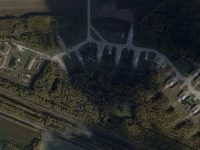
For several weeks running, enemy channels have reported how their air defenses “heroically” repel drone attacks on Rotten Federation territory. It’s become routine — and if you scan the enemy news feed over the past few weeks, a clear pattern emerges. The share of electronic warfare (EW) intercepts keeps climbing, while actual air defense work keeps shrinking. In some cases, according to their own claims, only EW engaged at all. That alone tells you everything you need to know about the real state of affairs.
But sooner or later, something had to happen that would show — directly and unmistakably — what “successful EW and air defense operations” actually look like in practice. That moment arrived after drone strikes on strategic bombers at the Soltsy strategic aviation airfield in the Novgorod region.
“Minor Damage”
As usual, they announced the attack was repelled with 100% efficiency, in brilliant fashion. True, while making that announcement, they mentioned in passing that two aircraft sustained “minor damage” from falling debris of the destroyed drones.
Then a photo surfaced online — taken by someone on base — of one of the “lightly damaged” Tu-22M3 bombers. According to multiple sources, the aircraft in the photo participated in the shameful missile strike on the center of Odesa. Here it is:

Maybe this qualifies as “minor damage” by their standards. But if so, the obvious question is: what does the second “lightly damaged” aircraft look like? If it’s roughly the same — well, we can only wish them many more such light damages. And since the drones have already mapped the route to this airfield, there’s hope this kind of damage becomes a fine tradition.
A New Level of Precision
There’s another critical point here. These drones already carry their warheads over 600 kilometers and hit specific targets with precision. Multiple sources suggest the aircraft turned into shashlik was the same one that bombed Odesa. If true, the operators didn’t just navigate the drone to the target area — they directed it at a specific bomber. The second aircraft still lacks confirmed details, but it’s possible its own “minor damage” also traces back to strikes on Odesa. Out of everything on that airfield, specific aircraft were hit and that’s a completely different level of drone capability.
This means the proof of concept is already done — with at least one strategic bomber destroyed as the result. We can’t intercept Tu-22s in the launch zones where they fire their missiles. But on their bases, sitting as stationary targets with known coordinates — that’s a different story entirely.
The enemy currently has no effective answer to this type of threat. While that window stays open, it needs maximum exploitation. The enemy can replenish cruise missile stocks — observers note that most of those missiles are already freshly produced, some straight off the assembly line. Aircraft are a different matter entirely. The Tu-22, Tu-95, and MiG-31 are no longer in production. The manufacturing base no longer exists.
Shaikovka: Round Two
Today brought several reports that unknown drones struck the notorious Shaikovka airfield in the Kaluga region — another strategic aviation base, home to Tu-22M3 aircraft that participate in missile strikes on Ukrainian cities. Ukraine’s Defence Intelligence confirmed the strike took place but noted the drones were of unknown origin. At least one aircraft sustained damage. The enemy’s statement, predictably, was quieter — and told a slightly different story:
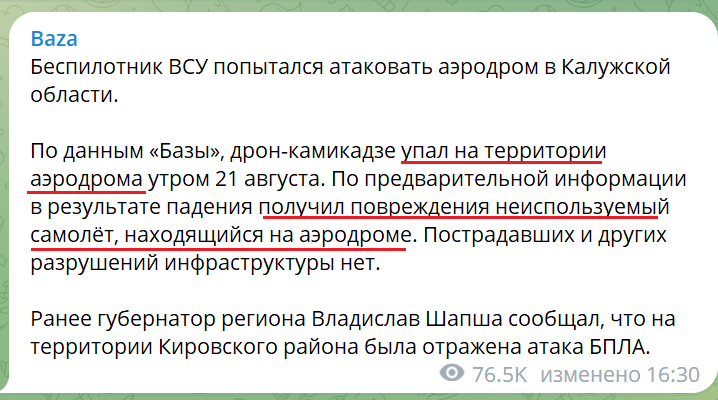
Any airfield housing strategic aviation must by definition carry the best air defense assets the country can field. Because if you can’t protect assets like these, what’s the point of having them? That means any aerial target entering the security perimeter should be destroyed dozens of kilometers away — not directly over the airfield. So by definition, no drone debris should ever reach the runway.
What’s also notable: both official statements — from Novgorod and Kaluga — read like carbon copies. In both cases, the drone was shot down over the airfield. Debris from the destroyed drone caused minor damage to two aircraft. Then a photo appeared online of one of the “damaged” aircraft at Soltsy.
The Jackpot Is Still Out There
The process of eliminating the enemy’s strategic aviation has begun. Part of the “close the sky” problem over Ukraine may get solved not only through air defenses but through exactly these kinds of strikes. Obviously not all threats — ballistic missiles and naval cruise missile carriers remain — but reducing them significantly is both possible and necessary.
And drone strikes on strategic bombers keep delivering. Someday, with a bit of luck, someone will hit the jackpot: an aircraft with full fuel tanks and cruise missiles hanging underneath, each with a warhead weighing a ton.
Related posts:

Another Russian Terror: Massive Attack on Kyiv on July 6
On the night of July 6, the enemy carried out another massive combined attack on Kyiv. Some of it landed elsewhere too, but the capital bore the main [...]
Lessons from the Massive Attack on Kyiv on July 2
The massive attack on Kyiv on July 2 was predictable even without any inside information. The enemy runs this format regularly — sooner or later it was going [...]