

May 30 Missile-Drone Strike: Combined but Not Massive
The unfiltered truth from Ukrainian soldiers and volunteers. Just war as it is. Reader-supported.
Support →
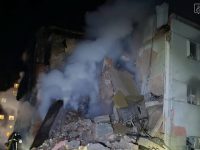
Friday nights usually come with expectations of a large-scale combined missile-drone strike on Ukraine. The May 30 missile-drone strike, however, came in well below average — both in the number of weapons used and their variety.
The enemy launched just 7 missiles: one ballistic Iskander-M from the Bryansk region and six cruise missiles X-101 from the Vologda region. On top of that, 290 strike UAVs were launched. The General Staff report looks like this:
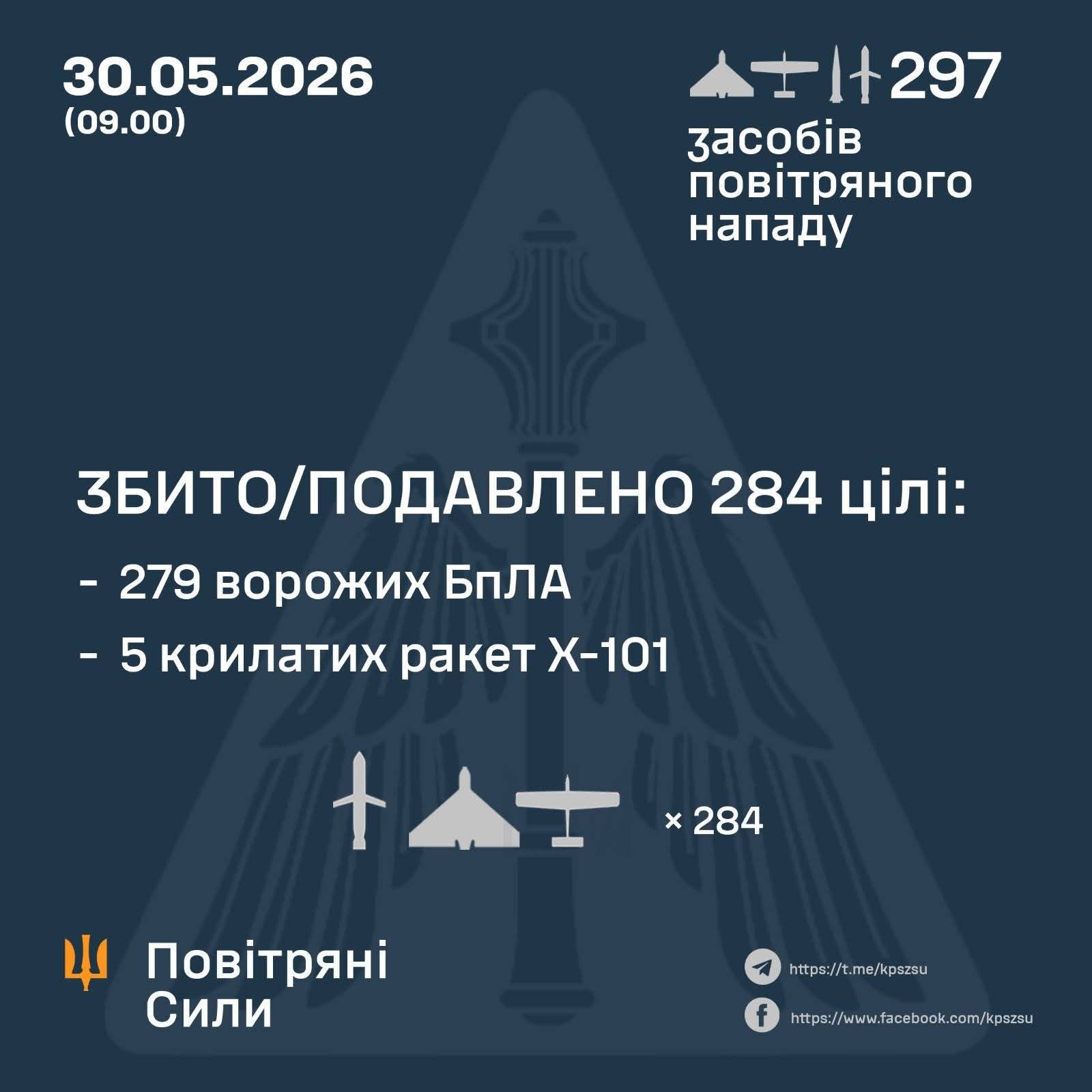
The number of missiles and Shaheds was unusually low — especially against the backdrop of the bald dictator’s announced “revenge strikes”. But there is something else worth paying attention to. The enemy launched the cruise missiles relatively early, before sunset. That suggests they were meant to serve as a warm-up for the main phase of the attack.
Cruise Missiles as a Warm-Up Act
Normally, the warm-up consists of a mass Shahed launch. The logic is straightforward: our air defense systems are highly mobile, so the enemy needs to understand the current layout of Ukraine’s air defense before committing heavier assets. At the same time, the enemy forces our air defense units into certain response patterns. This makes them burn through ammunition and keeps crews under constant stress.
The enemy also tries to catch the operational cycle of our combat aviation, which plays an active role in repelling attacks. Aircraft and helicopters must periodically land to refuel and rearm. Early drone launches help the enemy identify those windows. Cruise missiles typically arrive in the main wave, once the enemy believes it has decoded the movement pattern of our mobile air defense groups and aviation.
But this time the cruise missiles flew early — while it was still light out. That suggests they were serving as the warm-up, with ballistic and aero-ballistic missiles intended to follow as the main strike. Yet only one ballistic missile actually flew, which looks very strange. Given the Kremlin dwarf’s recent threats, it is hard to believe this was the original plan. Something clearly disrupted it — and whatever that something was, it happened after the attack had already begun rolling out according to a pre-approved script.
Déjà Vu: The Missing Missiles
To see something similar, go back two weeks to that large-scale raid where the enemy burned through roughly 1,600 strike assets of various types over 24 hours. At the time, we noted separately that Kalibr sea-based cruise missiles were completely absent from the entire weapons picture. That looked odd — because even after taking heavy hits on the Black Sea Fleet corvettes, the enemy had fired Kalibrs from Caspian Sea corvettes at least once in the preceding month.
The explanation came later: it turned out that before that strike, as the corvettes were moving to their launch positions, the Good Birds¹ paid them a visit. Two corvettes, after receiving such attention, lost all mood and desire to fire — which is a perfectly logical reason why Kalibrs were missing from that enormous missile salvo.
Last night, something similar may have happened — but with Iskanders.
Loitering Drones vs. Ballistic Missiles
Kalibrs long ago demonstrated their extremely low effectiveness, but ballistic missiles remain a serious threat. By ballistic missiles I mean Iskander-M, their North Korean equivalents, the aeroballistic Kinzhal, and the much-advertised Oreshnik — which the enemy also considers an ultimate weapon, one that is either very difficult or impossible to intercept with Ukraine’s current air defense systems.
So if the enemy used cruise missiles as the operation’s warm-up, it is entirely logical to assume they planned the main wave of strikes around ballistic missiles. The cruise missiles were supposed to trigger our long-range air defense systems. The enemy could then use the detected configuration of Ukraine’s air defenses to guide the ballistic missile strikes. But once that plan started executing, the attack stopped. Something very compelling must have caused that.
The May 30 Missile-Drone Strike That Almost Was
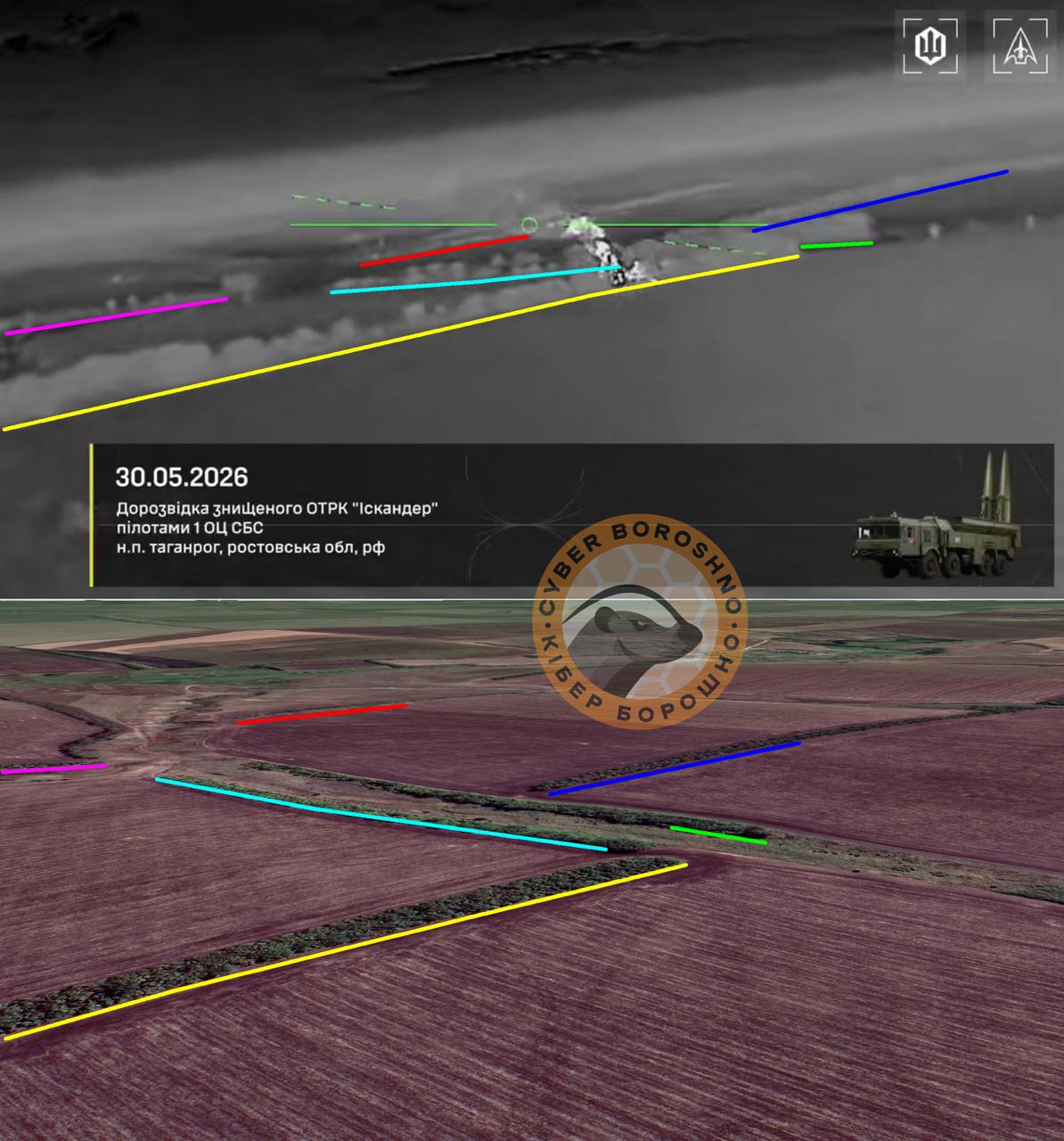
And that something shows up in USF² Commander Magyar’s report. Our Good Birds tracked and destroyed an Iskander launcher sitting at a launch position 30 kilometers from Taganrog in Russia’s Rostov Oblast. Magyar published footage of the strike. The attack destroyed the launcher together with two missiles that crews had already loaded and prepared for launch. Ukraine’s Unmanned Systems Forces got there first and eliminated the Iskander just hours before it was supposed to fire at Ukrainian territory. As a result, the enemy lost the ability to launch 4 to 6 ballistic missiles in two or three salvos from that launcher alone. They can reload such launchers directly in the field.
The OSINT community CyberBoroshno has already identified the coordinates of the destroyed Iskander. The launcher was located near the settlements of Mikhaylovka and Yefremovsky, about 30 km from Taganrog and roughly 145 km from the front line.
But the enemy did not just lose a launcher. It also lost confidence that the details of its plan had stayed secret. The launcher was hit by a drone — which means that drone launched well before the Iskander even arrived at the firing position. A drone is a relatively slow aircraft and needs roughly one to one and a half hours to reach that area.
If the drone launched in advance, then the launch locations were already compromised and known to Ukrainian intelligence. In that case, the enemy has no idea how extensive the leak is — or whether similar drones are waiting in Kursk Oblast or somewhere else in Russia. Nobody can rule that out, and to preserve very expensive systems, they called off the entire operation.
Bottom Line
What we saw last night during the May 30 missile-drone strike was nothing but a truncated overture to a much larger attack. The preemptive strike did its job. It is fair to say — carefully — that Ukraine has found its own method for dealing with the enemy’s ballistic threat. And as it turns out, you do not need interceptor missiles or other expensive hardware to do it. Loitering drones, waiting for the enemy in places where he feels completely safe, can handle the job. If that approach can be scaled up, it may pull one of the main poisoned fangs from the beast known as the “two-headed rooster”.
¹Good Birds – slang for strike drones. Why “good”? Because they bring “warmth and light” to enemy military factories, ammunition depots, and oil refineries. Sarcastic? Of course. Effective? Even more so.
²USF – Unmanned Systems Forces, Ukraine’s newly established branch of the Armed Forces. No, not the U.S. Navy — in Ukraine USF means those who destroy Russian bombers, not those who park aircraft carriers.
Related posts:

To Light a Fire in Moscow: The Song Came True
Even before today’s fire in Moscow, Orc¹ moods had been getting noticeably worse, especially after the strike on the Moscow refinery. The strike on the Kapotnya plant hit [...]
Ukraine Strikes Moscow Refinery With Drones
Today’s Ukraine Strikes Moscow Refinery hit the primary distillation unit in Kapotnya. As anyone following these strikes already knows, knocking out primary distillation shuts down everything downstream. If [...]