

Why Russia Uses Small Group Tactics and How to Counter
The unfiltered truth from Ukrainian soldiers and volunteers. Just war as it is. Reader-supported.
Support →
It looks like Russia’s top military command has concluded that the tactics its occupation army used before no longer deliver the results Pootin keeps demanding. So they changed their approach and started using small group tactics — and understanding that shift matters.
Armored assault groups are essentially a thing of the past. In a battlefield saturated with drones, armored vehicles became too visible, and despite the cages welded on top and the mobile EW systems alongside them, they simply stopped making it to the line of contact. They started getting destroyed well before any exchange of fire with the enemy could even begin. And with fiber-optic drones now in the mix, armor at the front has become something like a kamikaze mission — just without the ceremonial cup of sake.
On top of that, there are unconfirmed reports that Pootin has demanded Gerasimov keep resources ready for a lightning war on another front — most likely the Baltic states. So the tanks and light armor have not disappeared entirely. They are being held in reserve, just in case the tsar decides he wants to start a war with someone else too.
The Logic Behind Small Group Tactics
Out of all this, the Orcs¹ created a hybrid approach meant to solve most of the problems their occupation army kept running into. Armored groups no longer work well, and even forming a column far from the front now carries enormous risk. That left infantry as the only resource the enemy could still replenish in large numbers. However, infantry brought its own problem. In modern warfare, any group larger than three people will almost certainly attract drones. The only question is how many minutes remain before the strike. That is how small group tactics emerged, which the Russians call “infiltration”. It is not the offensives of earlier in the war, but it does produce at least some forward movement.
The method rests on two things. First, the availability of assault troops as a resource. Second, Ukraine’s extremely thinned-out front line, which in practice has long ceased to be a continuous line — Ukrainian forces are physically present at the nul’² only as a dotted line. That is exactly what allows small groups to seep through the forward positions of the Armed Forces of Ukraine.

Any army in the world would consider the losses these assault groups suffer catastrophic — except the Russian one. Out of a group of ten, usually only one or two soldiers complete the infiltration maneuver alive. Those losses directly shape both the fighting itself and the way the enemy replaces manpower. Somewhere in the rear, the Orcs must keep a human conveyor belt running without pause, constantly pushing new men toward the assault to replace the dead. The Wall Street Journal described it this way:
Russia’s rate of advance this year has been the slowest in two years, and losses reaching 35,000 a month are producing almost no results…
Ukrainians have learned to track and eliminate almost all enemy soldiers using drones and clearing teams, Rob Lee of the Foreign Policy Research Institute, who spends considerable time in Kyiv and on the front line, told the newspaper… In April, according to the Institute for the Study of War’s estimates, Russian forces suffered net territorial losses, losing control of 116 square kilometers. This happened for the first time since August 2024, when Ukrainian units crossed into Kursk Oblast.
Depending on how experts classify the ‘gray zone,’ some believe Russia has lost more territory than it has taken in recent weeks; others believe it still had a net gain, but minimal.
How Ukraine Is Fighting Back
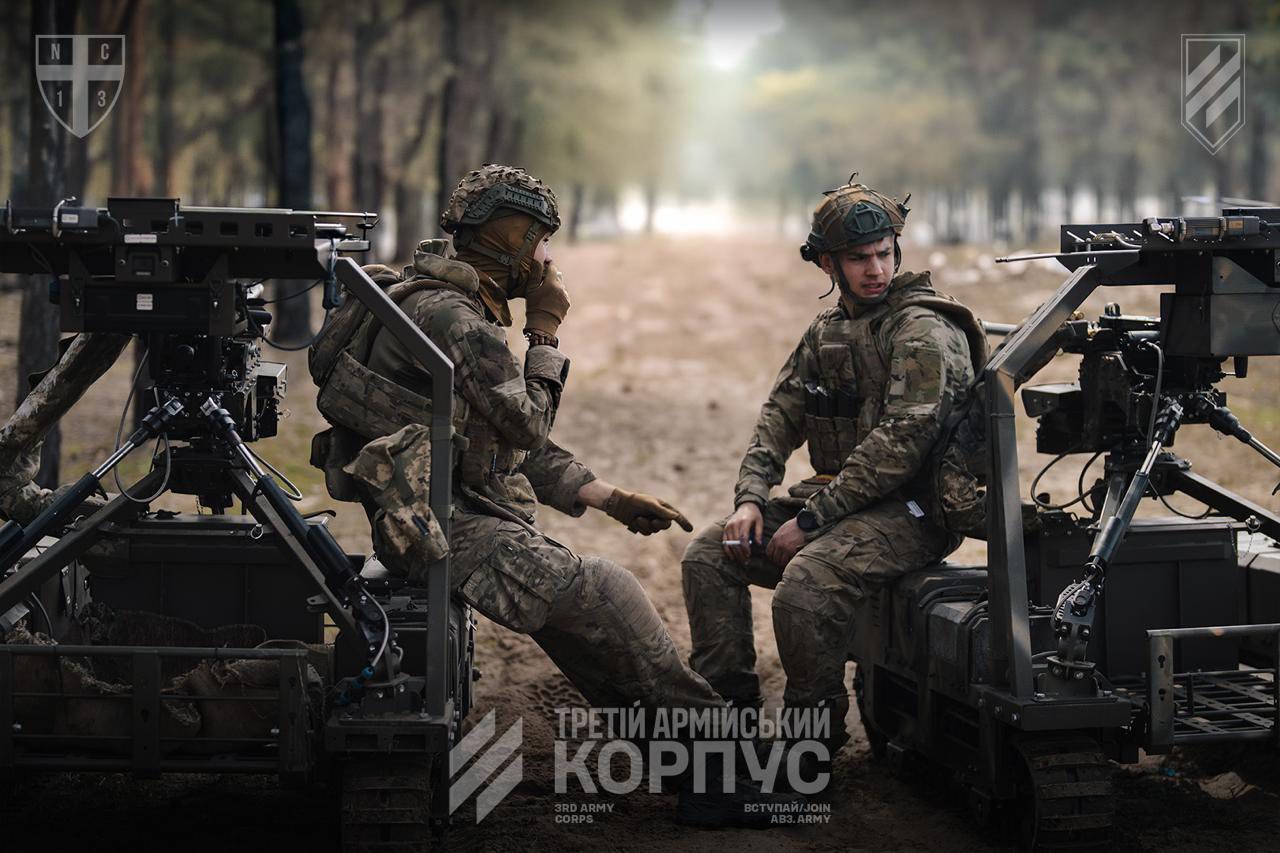
Despite the acute and chronic manpower shortage at the front, Ukraine’s Defense Forces continue conducting local counterattacks. A number of these operations have already succeeded. What makes our offensive actions fundamentally different from what the Orcs are doing is the tight coordination between personnel and drones, both aerial and ground-based. Ground strike drones advance alongside infantry and provide fire support directly on the battlefield. This is not a scene from a science fiction film — in Ukraine it is already standard practice and actively scaling. Meanwhile, aerial drones have taken over the role of frontline attack and bomber aviation, inflicting increasingly significant losses on the enemy in areas where it used to operate without much concern.
Mid-range strike UAVs like the Hornet and FP-2 now essentially control the Mariupol–Melitopol–Crimea highway. The enemy screams about it loudly enough to classify it as panic, with all the corresponding consequences. Footage shows these drones cutting through military vehicles moving along the road. Every fuel tanker that ventures onto it meets the same fate. The Armed Forces of Ukraine are clearly trying to destroy the enemy’s logistics entirely. Judging by how Ukrainian forces keep picking off ships and patrol boats guarding the Kerch Bridge further south, something very interesting is approaching. Crimea might just become an island.
But the positive shifts are not limited to drones alone. Yesterday it was publicly announced that experimental use of Ukrainian guided aerial bombs — KABs³ — has begun. Old Soviet-era aviation bombs fitted with glide and guidance systems, which turned them into precision weapons. Only yesterday came the announcement of test launches, and today there is already confirmation of successful destruction of several enemy pontoon bridges at different sections of the front. It is quite possible our KABs were used for exactly that.
The Flag-Bearers
One more thing worth noting about small group tactics that explains why the Orcs cannot simply abandon them — and it has nothing to do with military necessity. When small assault groups infiltrate behind Ukrainian lines, they are also performing another, extremely important function. They have been nicknamed “flag bearers”: after slipping through, they film themselves with a flag in some recognizable spot in a settlement, then report to Pootin that the location has been captured.
The generals file their reports to the führer, who hands out new ranks and positions. Those videos, in turn, are the only protection Russian generals have against prison for lying about capturing yet another Kupyansk or Mala Tokmachka. The fact that the assault group and its flag are subsequently found in several pieces, the Aquafresh⁴ squeezed out of them for good, is of no interest to anyone. The bald piece of garbage gets his satisfaction, the generals get their promotions — and that, apparently, is the point.
So we keep believing in the Armed Forces of Ukraine, and we keep doing what each of us can do, wherever we are.
¹Orcs – a common term for Russians who support or participate in the armed aggression against Ukraine. Dehumanizing? Yes. Accurate? Also yes.
²Nul’ (Ukrainian: “Нуль”, literally Zero) – the very edge of the front line, where enemy positions may be only a few hundred meters away.
³KAB (Kerovana Aviatsiyna Bomba) – Guided Aerial Bomb. A cheap but powerful munition the ruSSians use to strike civilian cities.
⁴Aquafresh – sarcastic term widely used among Ukrainian soldiers to describe the occupiers’ flag. Refers to the tricolor resemblance to the Aquafresh toothpaste stripes.
Related posts:

Chonhar Bridge Strike: Ukraine Expands the Crimea Blockade
On the night of June 9, Ukraine’s armed forces delivered the second consecutive devastating strike on the Chonhar Bridge, bringing all traffic across this critical crossing to a [...]
Missile Strike on the Fleet HQ: Destroyed for the Second Time
By midday, more details emerged about the missile strike on the fleet HQ building on Gogol Street in temporarily occupied Sevastopol. For those who have already forgotten the [...]