

Fourth Strike on Tuapse Refinery: OSINT Say It’s Not the Last
The unfiltered truth from Ukrainian soldiers and volunteers. Just war as it is. Reader-supported.
Support →

Last night, the Fourth Strike on Tuapse Refinery hit. We saw it coming — and honestly, it wasn’t hard to predict. Yesterday, the fire at the oil site in Tuapse finally burned out. The smoke over the city cleared, opening a window for satellites to get a clean look at the target area. That gave a chance to assess the real results of the Good Birds’¹ work and pick the next targets.
This is critically important because strikes haven’t been delivered in “hit the refinery” or “hit the seaport” mode for a long time now — precision is such that a drone arrives at a specific reservoir, tank farm, pumping station, or specific technological node. Because of that, hitting something that already burned makes no sense. First you confirm what’s gone — then you plan the next strike.
And so yesterday, local authorities cheerfully reported that through firefighters’ incredible efforts, they managed to localize and then extinguish the fire. Though locals posted plenty of videos on social media showing exactly how this “extinguishing” happened. Short version — the reservoirs stopped burning because they ran out of petroleum products.
Meanwhile, satellites photographed the remaining tanks, and the fourth strike on Tuapse refinery came at night. The Good Birds flew in again, and the familiar black smoke column returned to the city. True, local residents are confused in their testimonies and can’t quite figure out where exactly it’s burning — in the port tank farm or the refinery tank park. But most reports indicate it’s burning at the port. And there are very few intact tanks left there, so if they finished off the port specifically, most likely that topic’s closed there.
Plenty of Targets Left at the Refinery
But in the refinery’s tank park, there’s room to roam, because several dozen tanks remain there — small ones, sure, but quite nice and most importantly, densely packed together. The largest tanks, as far as we can understand, have already burned out completely, and now they need to clean up the rest. And again, the cycle repeats. What’s burning now needs to burn out completely so we can figure out where to hit next time.
Commander of Ukrainian USF Robert “Magyar” Brody reported in his characteristic sarcastic manner:
🔥Tuapse Chornobaivka-style, 4.0
Remake number four: …every week my friends and I go to Tuapse. Naftovik Street, filling station number 24…
And there goes the heat, A5.
If you’ve been following the war in Ukraine, Robert’s sarcasm is probably clear to you. If not — it’s worth explaining the origin of the “Chornobaivka” meme. This is a military airfield in Kherson Oblast where occupiers stored aircraft and helicopters in 2022. The Armed Forces struck, destroying part of the equipment. The occupiers brought in new helicopters. The Armed Forces struck again. The occupiers brought more. The Armed Forces struck again… This continued until the Ukrainian army liberated Kherson, and with it, Chornobaivka. General Staff counted that the Armed Forces delivered 26 strikes total, and the word “Chornobaivka” became synonymous with Russian military idiocy and their senseless actions.
OSINT Confirms: More Strikes Coming
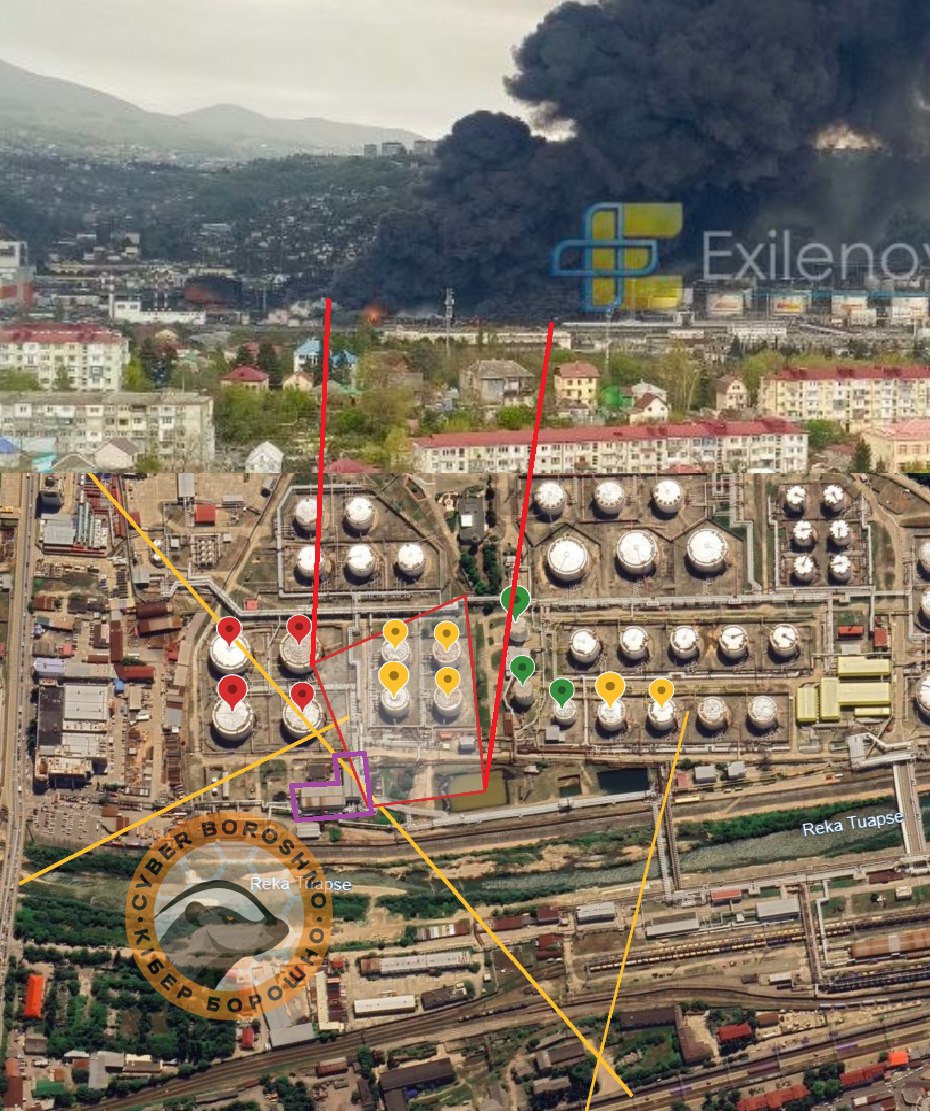
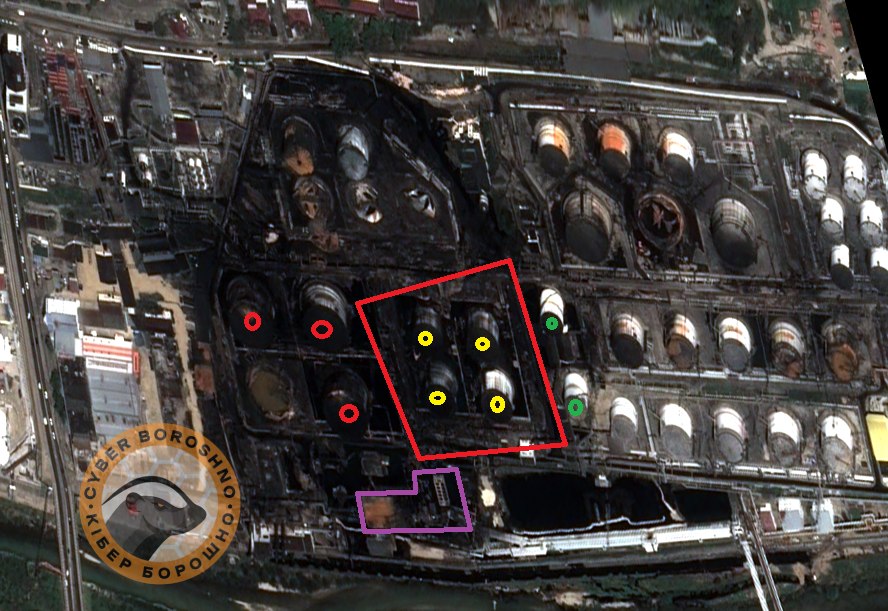
Meanwhile, OSINT community CyberBoroshno also assumes that today’s fourth strike on Tuapse refinery won’t be the last, since part of the targets will highly likely remain:
If you analyze the burning videos and satellite images from 28.04.2026, you can geolocate the fire to a zone of 4 tanks holding 10 thousand cubic meters of oil each. Of these, at least 2 are burning by conservative estimate.
Judging by the image, a pumping station in this section of the oil depot got destroyed (marked purple). The territory is completely contaminated with oil that didn’t have time to burn and remained after the collapse of one of the 20-thousand-liter reservoirs, the loading rack, and pumping station.
Therefore, the fire at this moment could encompass a total capacity of 40,000 cubic meters, and another 30 to 60 thousand cubic meters remain at risk: adjacent 20-thousand cubic meter reservoirs — red, and 5-thousand cubic meter ones — green.
At this pace of strikes, by the end of May everything connected to oil infrastructure in Tuapse will be destroyed. Only passenger ships and pleasure boats will enter the port, because tankers will simply have nothing to do there. But there’s a positive moment in this, including for locals — since no legitimate military targets will remain in Tuapse anymore, Good Birds’ flights there will stop.
¹Good Birds – slang for strike drones. Why “good”? Because they bring “warmth and light” to enemy military factories, ammunition depots, and oil refineries. Sarcastic? Of course. Effective? Even more so.
Related posts:

Strike on Ryazan Refinery: Ukraine’s Feedback for Yesterday
The Strike on Ryazan Refinery was not Pootin’s first surprise — before the so-called ceasefire, Ukraine’s Defense Forces had already sent him a private message. Not a subtle [...]
Russian Z-Channels on the Eve of the Victory Cult in Moscow 2026
As the May 9 “Victory Mania”¹ celebrations approach, signs of panic keep leaking out of the Kremlin. The closer the Victory Cult in Moscow 2026 gets, the more [...]