

Kyiv Survived May 28 Shaheds Attack on City’s Day
The unfiltered truth from Ukrainian soldiers and volunteers. Just war as it is. Reader-supported.
Support →

According to preliminary data, the May 28 Shaheds attack on the capital became the most massive drone assault. After talking with some capital residents, I concluded that most of them only reacted to the last — third — wave of Shaheds. But I had to observe and hear all three waves, and in the first waves, the mopeds flew somehow especially low. At least, I heard this more than once or twice — so there’s something to compare with. Perhaps they flew not so high before, but farther from the observation point, and therefore you could only hear the engine working. This time, you could distinctly hear the sound of the rotating propeller. I heard this sound for the first time — and so clearly.
Writing about what worked to intercept targets makes no sense. Many observed this independently, so nothing similar surprises us anymore. The mayor’s office claims this was indeed the most massive raid on the capital. Cumulatively, the enemy used the largest number of mopeds. According to AFU data, the night raid looks approximately like this:
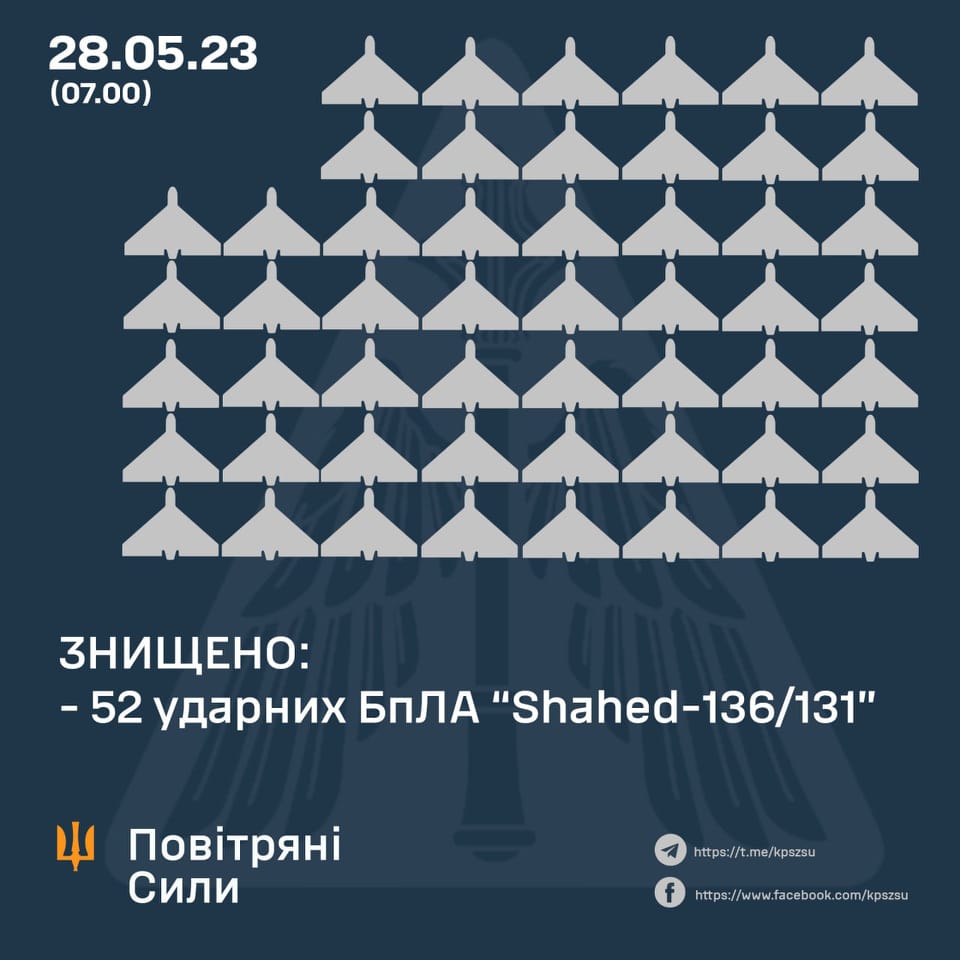
Why the May 28 Shaheds Attack Failed
In general, as we’ve noted more than once, the enemy tries to inflict maximum damage on the capital — but this works poorly for them. Practically all negative consequences, including destruction, fires, injury, or death of people, occur not from the munition’s arrival but from falling debris. This means the target the drone received for destruction wasn’t achieved. In general, specifically regarding the capital, this already happens constantly.
If the raid pursued precisely military goals, those who plan it would have long ago concluded that these goals in the capital cannot be hit with these means. Further attacks would represent only intensive expenditure of ammunition. Moreover, precisely military or infrastructure objects have already become minimally accessible for destruction. There are many reasons for this — no sense discussing them here. But to show how much everything changed, we simply suggest everyone recall how the situation with fuel at gas stations looked in the first months of full-scale invasion and how it looks now. Let everyone figure out what achieves this, and much will fall into place. Thus, attacking precisely such targets is already useless in principle. The same applies to “control centers.” Everything critically important from management is also unattainable for enemy attacks. Air defense’s excellent work ensures this — but also other organizational means.
Adaptation and Anger
By the way, using raids as a means of intimidating civilians has long become useless. Humans are adaptive creatures and get used to everything — including such raids. Most of my acquaintances have long looked at this philosophically. When you ask what thoughts arise after such a raid, practically in one voice everyone says “we need to kill them all”. So those who try to reason about “good russians” are already very late with this. By the way, they should thank pootin, Kremlin leadership, russian military, and those employed in russian defense industry. That’s not one million people. These are precisely those toward whom not a drop of pity or desire to hear anything from them remains.
What we observe is pure terror. Recalling words about a kind word and a revolver, we simply note: with terrorists, you don’t talk and you don’t negotiate. You only destroy them. The May 28 Shaheds attack proved once again — Kyiv doesn’t break and terror doesn’t work on people who’ve chosen freedom.
Related posts:

Another Russian Terror: Massive Attack on Kyiv on July 6
On the night of July 6, the enemy carried out another massive combined attack on Kyiv. Some of it landed elsewhere too, but the capital bore the main [...]
Lessons from the Massive Attack on Kyiv on July 2
The massive attack on Kyiv on July 2 was predictable even without any inside information. The enemy runs this format regularly — sooner or later it was going [...]