

The Most Shot-Down Aircraft of the 21st Century: Su-34 or Su-25?
The unfiltered truth from Ukrainian soldiers and volunteers. Just war as it is. Reader-supported.
Support →

Russia’s Su-34 — which the enemy proudly markets as its most advanced frontline bomber, and which firmly belongs in the “Anala Govnet”¹ category — has not yet secured the title of history’s most shot-down aircraft.
That record still belongs to the Il-2 of World War II, a benchmark that is almost impossible to beat. But the Su-34 has firmly earned its own distinguished award: the most shot-down bomber of the 21st century. Which, given the competition, is not exactly a title worth framing.
The Numbers Game
Look at the data from the Oryx database. Compared to its closest rival — the Su-25 ground attack aircraft — losses of the two types are roughly equal. At first glance, that looks like a draw. But step back from Oryx methodology and factor in how each aircraft is actually used, and the Su-25 pulls ahead. Part of this comes down to how Oryx counts losses, and part comes down to the Su-25’s remarkable survivability. The Su-25 operates right at the front line — where something more important than filming a falling aircraft tends to be happening at any given moment. On top of that, the Su-25 can limp back to the airfield on a single engine. It will never fly again, but Oryx does not count it as shot down. So the scorecard understates Su-25 losses significantly.
By our conservative estimate — based on both Ukrainian military data and indirect evidence like enemy pilot obituaries — real Su-25 losses run at least 40% higher than Oryx shows. Real Su-34 losses run about 25% above Oryx figures.
For this reason the Su-25 still holds the overall crown for most shot-down aircraft of the 21st century. The Su-34 leads specifically among bombers — and since Russia has nothing newer in that class, it simultaneously qualifies for another title: most shot-down modern aircraft. Quite the résumé.
Three More Down Today
Today our forces downed three more Su-34s — further proof the most shot-down bomber title is not going anywhere. All three were used by the enemy for KAB² strikes. One at 1:00 AM on the Eastern front, another in the morning on the Avdiivka direction, and one on the Mariupol direction. Screenshots from Air Force Command:
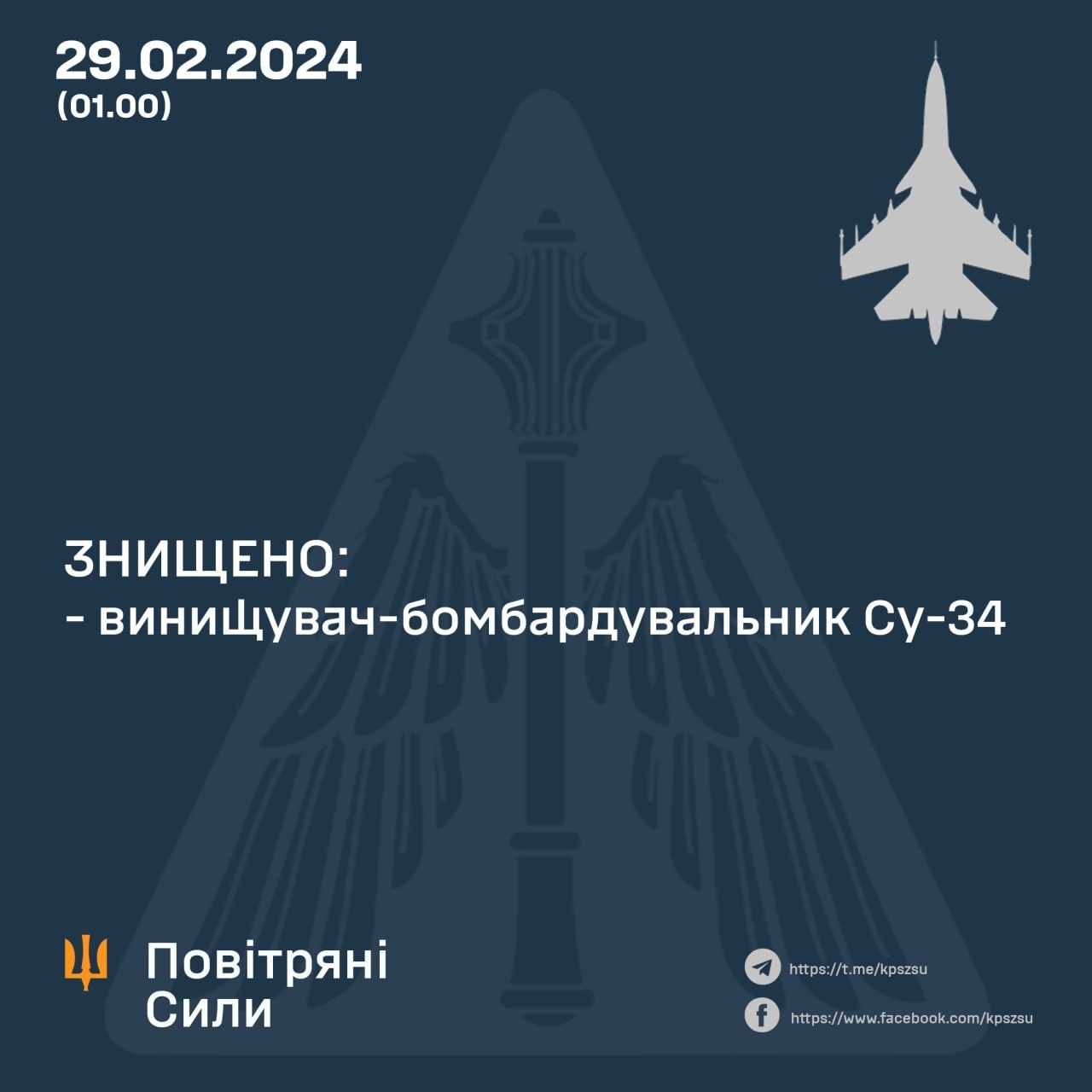
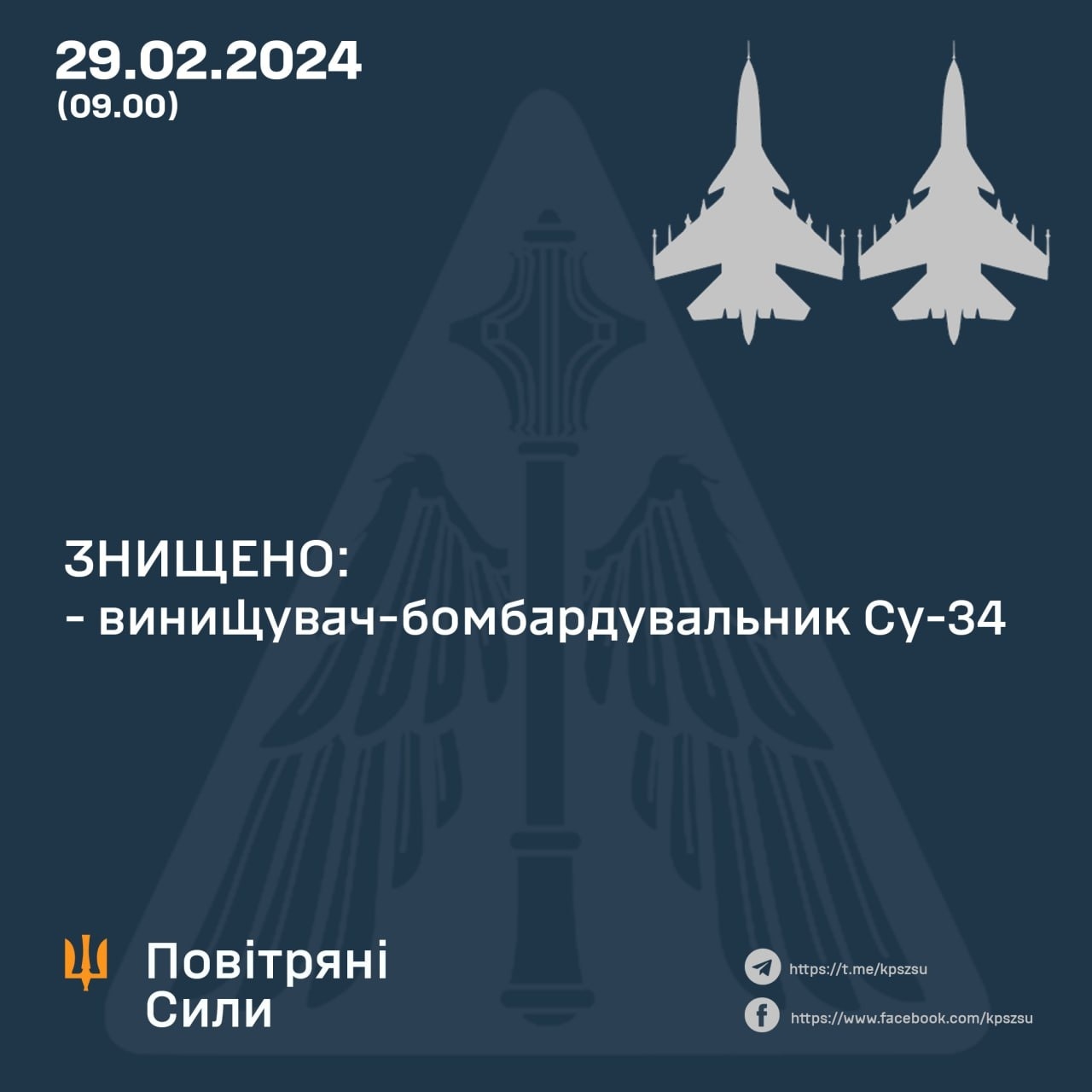
Just as a reminder: in February 2024 alone, the enemy lost 11 aircraft, the majority of them Su-34s. Reports are showing more and more Su-34s and fewer and fewer Su-35s — and that shift in ratio carries additional information.
Since last summer it became clear that enemy aviation operates in groups of two Su-34 frontline bombers and one Su-35 fighter. The logic was straightforward: bombers hit targets with KABs, the fighter provides cover and engages our aviation if needed. In theory it looked clean and elegant, and that exact composition was observed repeatedly. Clean, simple, predictable.
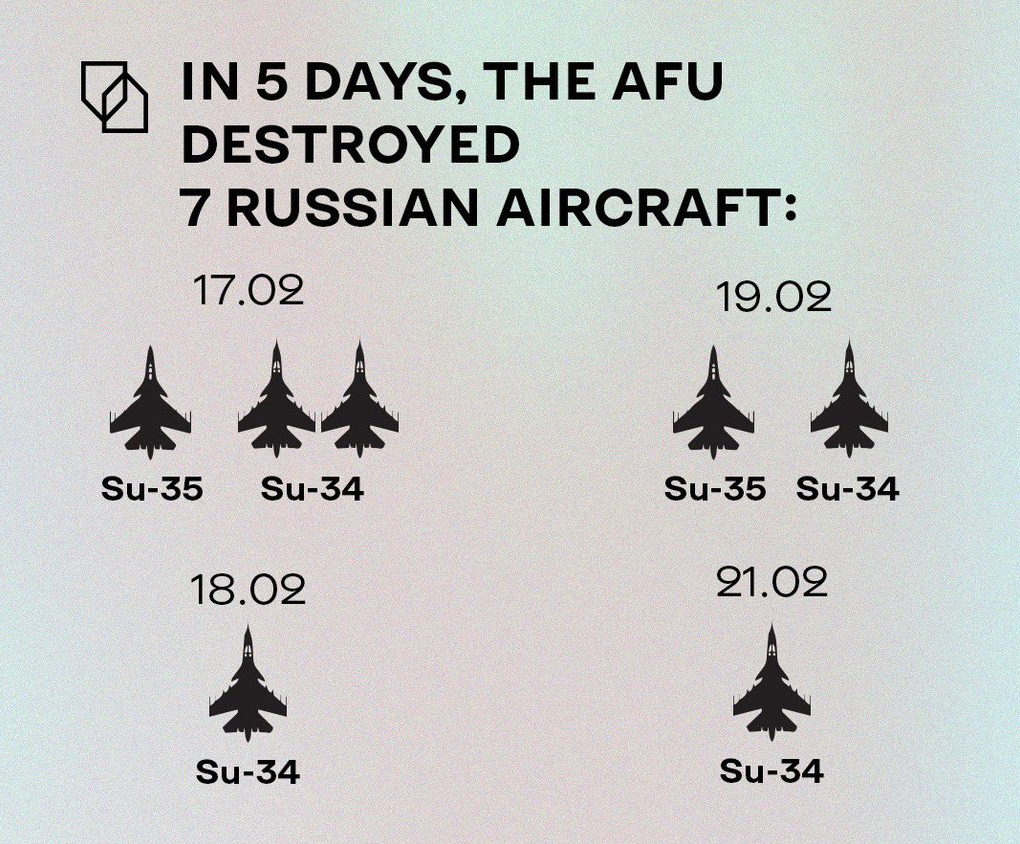
Then February happened. As the shoot-downs piled up, something shifted. The last confirmed Su-35 kill was February 19. Since then — five Su-34 bombers down, zero Su-35 fighters. The absence of Su-35s from the reports suggests they are no longer being sent to cover the bombers. Whether that’s because they can’t afford the losses or because they’ve quietly admitted the escorts weren’t helping anyway is an open question.
The Collapse of a Concept
What the world is watching right now is the live failure of Russia’s entire vision for future combat aviation — and the failure arrived in a form nobody quite expected. Working backwards from the evidence, the American approach turned out to be correct. Russia didn’t follow that path not because they rejected it on principle, but because they couldn’t master the required technology. And that’s not something you fix with a decree or a budget increase. Getting there requires transforming industry, science, and society — and Russia is incapable of doing any of it.
Russians themselves wrote at length about how fifth-generation aircraft were unnecessary for them, and that the technologies involved were immature and could be countered in dozens of ways. But the Americans moved too far ahead in materials science and applied engineering. That gap allowed them to develop not just a new airframe and new coatings, but to put into serial production several engine designs with characteristics simply unavailable to the previous generation. Both Russia and China ran straight into that wall.
From F-117 to B-21
The Americans have been working in this direction since the F-117 era. Their industry has long moved past the early production runs of new airframes, coatings, and engines. The F-22 followed — with engines so advanced that competitors have not reached that level even thirty years later. American industry demonstrated serial production of next-generation components back then — and, as one might expect, kept moving. Each new aircraft iteration pushed the technology further. Now the B-21 strategic bomber is flying, incorporating advances that make everything before it look like a draft.
The Pentagon also built modularity into its requirements from the earliest design stage. A specific aircraft produced at the start of a production run can be upgraded to the latest iteration simply by swapping out defined modules. This is not just about next-generation airframes, coatings, and engines — it is about a different philosophy of what an aircraft should be. And that philosophy differs fundamentally from the Russian or Chinese school of aircraft design.
First to See, First to Shoot
Alongside this came real combat experience with aircraft of this generation. The guiding principle is not aerobatics — it is a different logic entirely: whoever sees first, shoots first. The engagement ends there, and the two aircraft may be over 100 kilometers apart when it does.
Russia, unable to match American engines, coatings, or avionics, decided stealth was overrated. Their logic: if the enemy spots you first and fires a fast, long-range, highly maneuverable missile, it doesn’t matter — as long as the missile can’t get close enough to detonate. Against the American doctrine of “first to see, first to shoot”, Russia countered with “seeing first doesn’t mean hitting first”.
The Khibiny Fairy Tale
The solution they bet everything on was the Khibiny L-175V electronic warfare system. The concept was straightforward: during flight in contested airspace, the system automatically tracks all incoming threats and uses electromagnetic interference to knock approaching missiles off course — or induce an internal guidance failure, causing the missile to miss and fail to detonate near the protected aircraft. Russia believed in this approach so completely that it went ahead and put the Su-35 and Su-34 into serial production on the basis of it. Those are the aircraft falling out of the sky with such reliable regularity today.
By now it is obvious to everyone that the “most advanced” electronic warfare system installed on these aircraft is failing systemically. This is not a coincidence, not a one-off malfunction, not a single defective unit on a single aircraft. Ukraine’s forces are downing every aircraft equipped with this system — bombers and fighters alike.
Which means the theory of creating “partial stealth” for Russian aircraft turned out to be wrong. Western air defense systems see the aircraft. Modern missiles ignore the “most advanced” EW suite entirely. The American concept — whoever sees first, wins — has proven correct.
The Su-34 is bound to become the “most shot-down aircraft” sooner or later — if not this year, then next year. Or in two years. Or in five. The reason is simple: unlike the Su-25, the enemy will keep building them.
¹Anala Govnet – wordplay in Russian language: “analagov net” / “anala govnet”. Depending on spacing, it can mean either “no analogs” or “anal sex with shit”. Used ironically for Orc things that never live up to the hype. Example: Lada cars.
²KAB (Kerovana Aviatsiyna Bomba) – Guided Aerial Bomb. A cheap but powerful munition the ruSSians use to strike civilian cities.
Related posts:

2 Su-57 Destroyed Simultaneously. Almost 5th Generation…
Let’s be honest — instead of “2 Su-57 destroyed simultaneously”, we really wanted to make the headline “2 fifth-generation aircraft destroyed simultaneously”. That would’ve been good clickbait and [...]
April 16 Massive Strike: Russia Used S-400 Missiles as Ballistics
The April 16 massive strike came in two waves — a combined attack on Ukraine using multiple missile types and strike drones. Kyiv, Dnipro, Kharkiv, and Odesa all [...]