

Shahed Attack on November 25: Another Expensive Failure
The unfiltered truth from Ukrainian soldiers and volunteers. Just war as it is. Reader-supported.
Support →
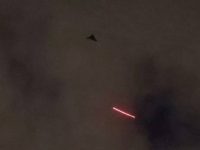
Today, Kyiv residents endured what was probably the most powerful purely drone attack since the start of the full-scale invasion. Based on what I personally managed to see and hear, the last drones were falling on Kyiv at 8:10 AM — already in broad daylight. So the enemy knew damn well that under clear skies and in daylight, drones are fairly easy to spot and shoot down even with small arms. But they launched the final batch anyway so it would reach Kyiv after sunrise. Here’s how the preliminary results of the Shahed attack on November 25 look:
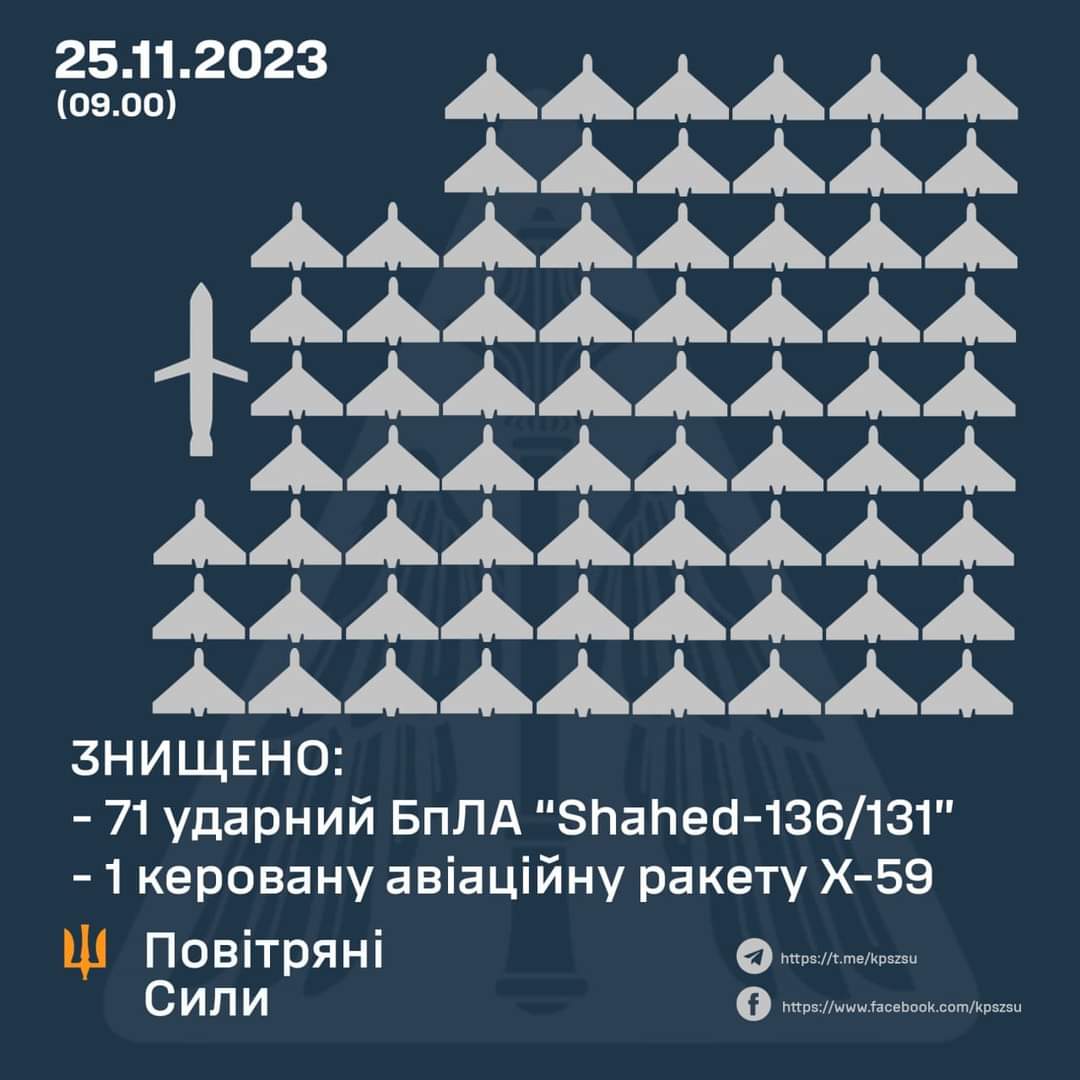
The Scale and Initial Results
As of this morning, the Air Force Command reports that a total of 75 drones were detected in Ukrainian skies, and 71 of them were shot down. After 11:00, the Ukrainian Air Force updated that 74 drones were shot down:
Enemy Telegram channels write that each major Shahed raid loses 10 to 20 percent of machines right after launch. In simpler terms, some of the launched Shaheds don’t even make it to Ukraine’s border and fail. By the way, the enemy faces the same issue — though with a lower failure rate — when launching cruise missiles. From this, we can conclude that the enemy actually launched about a hundred drones, but some simply didn’t make it. At that quantity, the percentage translates to a couple dozen units, maybe more.
The Shahed attack on November 25 had several distinctive features. Even during the raid, those who can track their flight paths warned that practically all drones launched from both southern and northern directions were heading for Kyiv. As a result, various Ukrainian oblasts intercepted some Shaheds, while around fifty got shot down directly over the capital. Though subjectively, it seemed like there were more — but as knowledgeable people write, the drones weren’t flying straight and were maneuvering over the capital, so it could create the impression there were more of them.
What We Observed During the Strike
Regarding reports that their production now uses technologies to reduce engine noise — I can’t say anything definitive. The sound was very loud and the timbre was the same as before. This time and last time, the drones flew much lower than they used to. At least the sound was more distinct and saturated. Possibly, these were machines from old batches, and the ones that supposedly should be much quieter, we haven’t observed yet.
Another observation: most likely, those several dozen Gepards that the States bought from Jordan have already arrived in Ukraine and are working. At least from where I observed the battle, missiles weren’t shooting down Shaheds anymore. Gepards were working, and anyone who’s already seen their work in the night sky can easily understand this. Some other anti-aircraft guns were also working, most likely Bofors. Apparently, they work with a different type of ammunition that gives a visual effect distinct from Gepards. And mobile groups’ heavy machine guns worked a lot. At any rate, the whole sky was lit up with searchlights. The Gepard itself doesn’t need illumination since it works based on targeting from its own radar.
What This Attack Show
Essentially, the Shahed attack on November 25 not only failed to achieve its goals but also showed that our air defense has grown stronger. Such a mass of aerial targets is no longer an unsolvable problem.
There’s another aspect that became even more insulting for the enemy. Let’s remind ourselves what the algorithm of enemy attacks looked like recently. The enemy launched a wave of 20-30 drones timed to reveal our air defense positions, then delivered either a combined strike with drones and cruise missiles, or purely cruise missiles on a route accounting for identified firing positions. Clearly, the enemy wanted to know where our heavy assets worked from — Patriot, IRIS-T, and NASAMS. They needed this so if the raid started successfully, they could bring in ballistics too.
But this time — and observers who saw the air battle in different parts of Kyiv and the oblast confirm this — everything was different. According to General Naiev, 55 drones got destroyed over Kyiv and its suburbs. Almost half fell to mobile group assets. You could observe their work by columns of light from searchlights they used to illuminate targets and blast away with anti-aircraft machine guns and Soviet-era cannons.
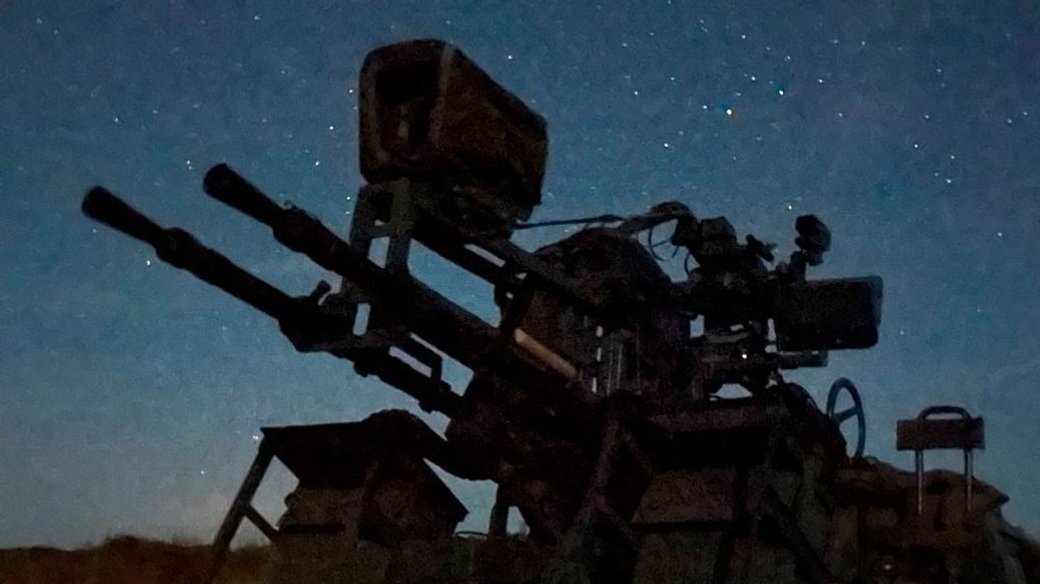
Old Weapons, New Victories
In other words, the enemy used the cheapest long-range strike asset at their disposal, while our anti-aircraft gunners destroyed 28 drones with old ZU guns and heavy machine guns. The enemy failed to reveal our air defense system because both Gepards and other firing assets are mobile. The locations from which they fired that night won’t be used next time. This means that if the enemy conducted this reconnaissance for a missile strike, it was unsuccessful.
Moreover, data recently emerged that the enemy is finishing Iranian drones at their production facility in Yelabuga and supplementing them with electronic warfare countermeasures, which gives them a more tenacious grip on satellite positioning signals for target guidance. Obviously, the more additional electronics are used in the drone’s stuffing, the more expensive that drone becomes — and therefore, the loss of each one will be more painful.
It’s also interesting that the Orcs* started painting Shaheds in radically black color to make them harder to spot against the night sky. However, based on how it felt, up to half the drones were dropped at dawn and even after sunrise. Against a blue sky, a black drone looks like a target at a shooting range — which our anti-aircraft gunners demonstrated. Considering everything above, this was a fiasco cubed. Our anti-aircraft gunners showed they understand all these innovations the Orcs spent money on and are ready to drop this crap even wholesale.
*Orcs – a common term for Russians who support or participate in the armed aggression against Ukraine. Dehumanizing? Yes. Accurate? Also yes.
Related posts:

May 24 Air Attack Exposes Putin’s Failures on the Battlefield
There is not much point writing about the May 24 air attack for Ukrainians — we all saw and heard it ourselves. But for those watching from outside [...]
May 13 Shahed Attack: Ukraine’s Largest Drone Strike Ever
The drone phase of the enemy’s prolonged attack has just wound down to a minimum — though “wound down” is relative, since a few drones are still in [...]