

Strike on Voronezh — Unknown Weapon, Undeniable Results
The unfiltered truth from Ukrainian soldiers and volunteers. Just war as it is. Reader-supported.
Support →

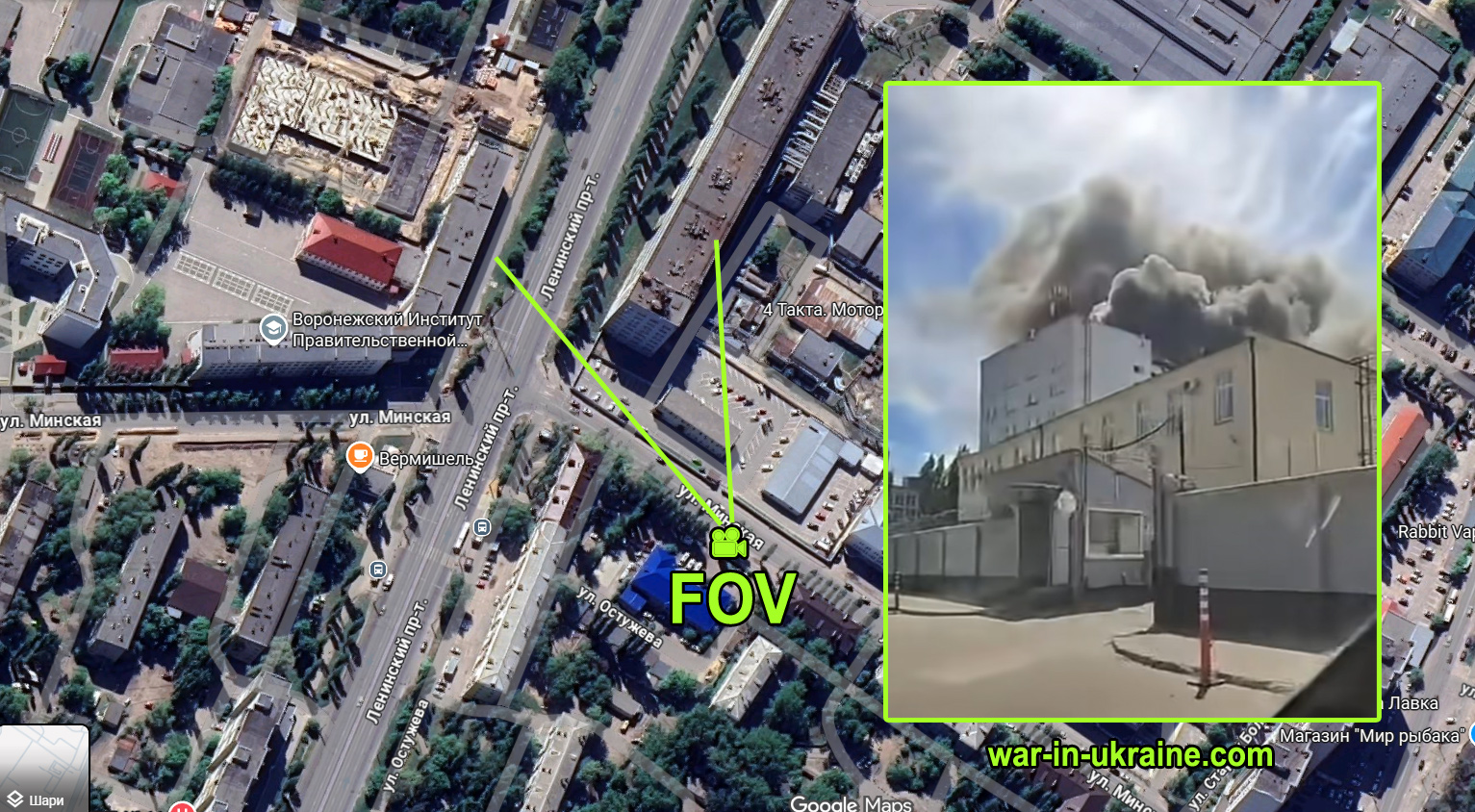
On June 22 the Ukrainian Defense Forces landed a solid hit on one of the enemy’s military-industrial facilities — JSC VZPP-Sborka. The Strike on Voronezh was timed perfectly and, importantly, took place around midday. In this case, timing matters, but we will get to that later.
First, however, let’s look at how the enemy itself describes what happened. Usually, they claim that a dairy plant or a beer bottle factory was attacked. This time, however, they suddenly became unusually honest. After all, a facility like this absolutely should have had air defense coverage. Here is what they wrote:
Governor of Voronezh Oblast Alexander Gusev publicly confirmed that production facilities at one of the region’s enterprises were damaged as a result of a Ukrainian attack. It is no longer a secret that the strike hit the semiconductor plant Sborka.
According to information available to us, five employees of the enterprise were killed and another remains missing. Emergency services are searching for him, although his body is likely still trapped under the rubble. Sborka manufactures electronics for the Pantsir-S1 air defense system, as well as Iskander and Kh-101 missiles. The enterprise is genuinely important, and the target was not chosen by accident.
The enemy essentially signed its own confession. This isn’t just any defense plant — it produces key components for the very missiles that cause us the heaviest losses, the destruction, injuries, and civilian deaths. Our own sources provide a much longer list of military products that rely on components manufactured by Sborka, officially known as JSC VZPP-S. However, even the weapon systems openly mentioned by the enemy are more than enough to justify the kind of gifts that forced this plant to stop operating, if not forever, then for a very long time. Viewed from that perspective, the Strike on Voronezh hit one of the factories helping keep Russia’s missile arsenal alive.
Never Going to Simply Bounce Back
You have probably heard of clean rooms used in electronics manufacturing. To understand why a single cubic meter of such a facility can cost as much as a cubic meter aboard the International Space Station, it helps to understand that cleanliness requirements for microelectronics exceed those of the pharmaceutical industry by a wide margin. Purity is measured by the number of airborne particles per cubic meter, while sophisticated ventilation systems continuously replace and filter the air.
In simple terms, modern technology giants such as Intel or Samsung manufacture products in facilities rated ISO 1–3. Pharmaceutical giants like Bayer or Pfizer generally operate at ISO 5–7. The cleanrooms at “Sborka” sat at ISO 5–7, roughly the cleanliness level that electronics manufacturing needed back in the 1980s or 1990s. One can always joke about Russian technological backwardness, which was never a secret, but even that outdated kills people. In any case, nothing cleaner than this existed anywhere inside the Rabid Federation.
This digression is necessary to understand one simple thing — the cleanroom complex was the most critical part of the entire Sborka plant. Even a tiny crack in the walls, floor, or ceiling instantly compromises a clean room and renders all equipment inside unusable. Restoring the required cleanliness standards requires a massive reconstruction effort, along with access to imported German and Japanese filtration systems, calibration equipment, and micro-welding machinery.
The Scale of the Damage
There is little doubt that the blast wave and structural vibrations disabled every clean room inside the surviving sections of the facility. Some rooms may still be standing geometrically, yet that does not mean they remain operational. In practical terms, the plant has been knocked out of action, and likely for a very long time.
A similar fate previously befell the Kremniy EL plant in Bryansk. However, its proximity to the Ukrainian border allowed for the use of different categories of weapons. Voronezh is at least 500 kilometers away, and yet something arrived there with real weight and left an exemplary result. According to early reports, the main building took at least four hits — locals heard no fewer than four explosions.
Four Hits, No Warning Sound
And here a purely technical question arises. It is highly unlikely that all four strikes arrived simultaneously, or within half a second of each other. That tight a gap would blur into one large combined blast for the human ear — impossible to count separate detonations. So there were likely a few seconds between each hit. Yet the whole sequence unfolded so quickly and unexpectedly that by the time people grabbed their phones, it was already over. Their videos show only rubble and smoke.
We know that a cruise missile attack announces itself with sound — the turbine whine of the incoming missile. With Storm Shadow or FP-5 Flamingo strikes, videos of the approaching weapon appear online almost immediately. People hear the turbine and get their cameras out in time. None of that happened here, though these missiles came in from the west and crossed the Don River on approach.
The strike on Voronezh already rules out SCALP and Storm Shadow on distance alone. Add to this — no audio warning, multiple separate detonations, and a notably vague General Staff announcement. The official statement read only “High-precision, air-launched cruise missiles were used to engage the target“, with the weapon type conspicuously absent. Everything points toward a coordinated hit by something new.
What Hit Voronezh?
It was probably not Storm Shadow. The distance to Voronezh is one reason. Another is that the General Staff traditionally identifies Storm Shadow strikes when those missiles are involved.
It was probably not a weapon from the ERAM program, such as the AGM-188A or AGM-189A. Those missiles possess sufficient range, but their warheads weigh only around 45 kilograms and would be incapable of producing the level of destruction seen at the VZPP-S Sborka facility.
It was probably not the upgraded Neptune missile, often referred to as the “Long Neptune” — the modernized version of the same weapon that sent the Russian flagship Moskva to the bottom of the Black Sea. The missile has both the required range and a suitable warhead, yet the General Staff has consistently identified Neptune strikes in the past.
It was probably not the FP-5 Flamingo either. Its warhead exceeds one ton, and the resulting destruction would have been significantly greater than what can be seen in available footage. Furthermore, the General Staff has openly acknowledged Flamingo strikes before, including attacks on the Votkinsk Plant and the VNIIR-Progress facility.
The implications are difficult to ignore
Therefore, there are solid reasons to believe that the Strike on Voronezh involved a previously unknown weapon of either Ukrainian or European origin.
Voronezh is only about one hundred kilometers closer to Kyiv than Moscow is. If the same unidentified missiles are eventually aimed at Moscow, the nature of this war may begin changing even faster than it already is.
Related posts:

Flamingo Missiles Strike a Military Factory in Volgograd
On the night of June 27, Good Birds¹ with the well-known name “Flamingo” delivered a strike on a military factory in Volgograd. Their target was not the city [...]
Russian Ground Robots: Origins, Failures, and a Growing Threat
Ukraine’s Ministry of Defense plans to shift 100% of frontline logistics to NRKs¹. But where does the enemy stand on this technology? How are Russian ground robots developing [...]