

Attack on the Tyumen Refinery: Distance Matters More Than the Hit
The unfiltered truth from Ukrainian soldiers and volunteers. Just war as it is. Reader-supported.
Support →
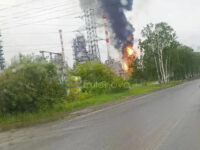
On the morning of June 20, Ukraine drones pulled off an attack on the Tyumen refinery — right in the oil and gas capital of the Rabid Federation, deep inside Siberia. According to General Staff of the Armed Forces of Ukraine, the local refinery was the target. Tyumen Region Governor Alexander Moor stepped forward to clarify that this was not, technically, an attack — merely an “attempted attack” where certain debris happened to fall on the facility grounds.
What he conveniently “forgot” to address was how drones that had flown nearly two thousand kilometers managed to turn into debris directly above the plant. Local residents were equally unable to solve this mystery — none of them noticed anything that could have converted airborne drones into falling wreckage. Instead, residents of Antipino took to social media. Their neighborhood sits right next to the refinery, and they reported at least two explosions and a thick column of smoke rising over the facility. Their conclusion was clear — these were direct strikes. They spotted no other aerial activity whatsoever, which strongly suggested the local air defense had taken the day off. Or maybe the whole week.
Locals also counted at least ten fire trucks rolling toward the plant. The Governor — clearly unaccustomed to making public statements on topics like this — announced that all “expert services” had arrived on scene. Which expert services, exactly, and why in the plural, he did not elaborate on, leaving observers genuinely baffled. Perhaps those services now operate across various departments, or perhaps in Tyumen the experts themselves pitch in to fight fires.
Either way, the attack on the Tyumen refinery landed well. The facility is a mid-tier operation, processing around eight million tons of oil per year. That’s roughly comparable to Moscow’s Kapotnya plant and well short of the twenty-million-ton flagships. However, what sets it apart is an exceptionally high processing depth of up to 98%. This plant produces premium-grade petroleum products — gasoline and diesel, fuels that russia is running increasingly short of. So the attack is a positive development, even if the full extent of the damage remains unknown.
The Distance Factor
But here is the part that matters most — the distance. The Good Birds* mastered deep-strike missions at ranges approaching two thousand kilometers long ago and have been operating at those distances with confidence ever since. But the straight-line distance from Kyiv to Tyumen is 2,387 kilometers, with road routes stretching to 2,800–3,150 km. Can we map total flight distance against road mileage? Almost certainly yes.
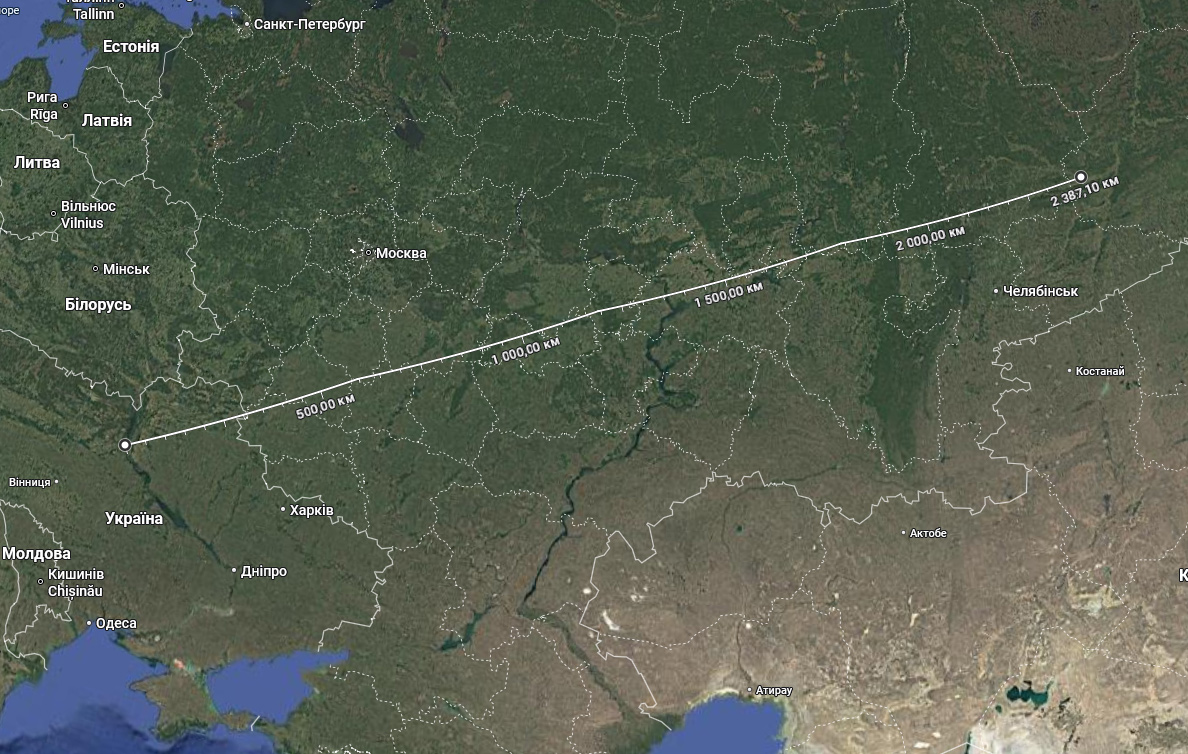
The Good Birds cannot fly a straight line, since they must route around enemy air defense positions. A flight range of 2,700–3,000 kilometers is therefore entirely plausible, and within that range sit targets far beyond everything that has happened so far. Within that range sit three targets worth examining closely:
- 2,400 km straight-line. Putin’s personal piggy bank in Surgut — Surgutneftegaz. The KINEF refinery in Kirishi, which Good Birds have already visited more than once, belongs to that very same Surgutneftegaz. But the Surgut Gas Processing Plant could produce a far brighter fireworks display, since gas, unlike oil, runs through the system under high pressure.
- At 1,800 km sits the so-called Yamal Cross. This is a strategic hub where pipelines from dozens of fields converge on a single massive compressor complex. Seventeen high-pressure main gas pipelines cross within a single square kilometer of tundra, carrying up to 85% of all Russian natural gas.
- At 2,250 km sits Russia’s single largest oil refinery, currently running at full capacity — 22 to 23 million tons per year, right at its design ceiling. Last year it processed 22 million tons, running near maximum the entire time. It also serves as the primary fuel supplier for the invaders’ army.
What Happens When These Targets Get Hit?
The Surgut Gas Processing Plant. The processing units are packed together tightly and an explosion on one line will inevitably tear apart the adjacent pipelines. No one can put that fire out until every last cubic meter of gas in the system has burned off. The plant was built as a single integrated chain with two enormous power stations — Surgut GRES-1 and GRES-2. Once fuel supply to those stations stops, a large-scale energy crisis will spread across the entire Urals. Not just cities go dark — the neighboring oil fields that draw power from those plants will shut down too. In simple terms, destroying Surgut GPP would knock Siberia and the Urals back into the 19th century.
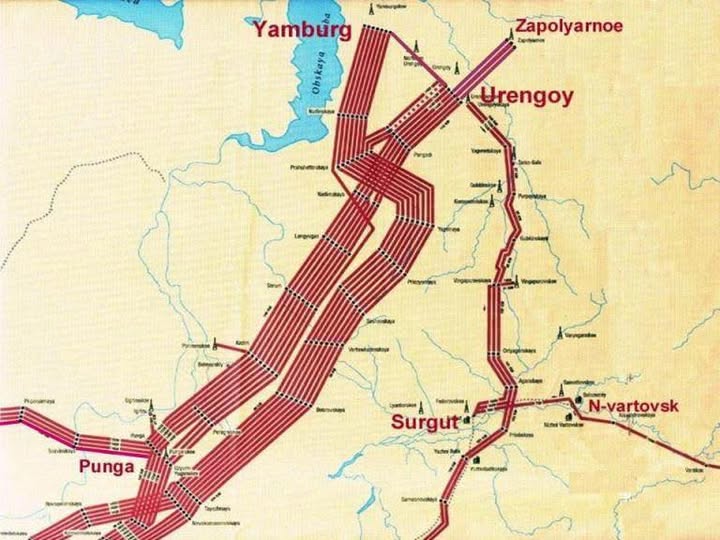
The Yamal Cross. Gas in those pipelines runs at enormous working pressure — over 60 atmospheres. One drone detonation breaches a single pipe. The blast wave and burning gas immediately rupture the other sixteen pipelines running right alongside it. And no one extinguishes that fire until hundreds of kilometers of pipeline have fully burned dry. Most thermal power stations supplying heat and electricity to Moscow, Saint Petersburg, and the Volga region run on Yamal gas. Losing 85% of gas supply will trigger emergency shutdowns across dozens of power plants in Russia’s European territory. The country’s largest cities will lose power, heat, water supply, and communications.
Reading the Signal
If attack on the Tyumen refinery was a warning shot, these two targets are the real fight. Just these two targets could do far more than push russia back to the nineteenth century. They could end the war entirely. Without gas and electricity, the steel mills, heavy engineering plants, and chemical factories producing nitric acid and ammonia for gunpowder and explosives all grind to a halt. Voltage drops across the rail network would paralyze train traffic across European Russia. That means blocking the transfer of troops, equipment, and ammunition to the front — and cutting off every goods delivery arriving from China.
The attack on the Tyumen refinery seems to point toward exactly this trajectory, hinting openly that the target list is expanding to include objects far more critical than anything hit so far. Honestly, as a Ukrainian, I could not care less whether the fireworks display out there ends up brighter than Tuapse or Moscow. What matters is that this looks like an extremely effective way to end the war — possibly the most effective one available.
*Good Birds – slang for strike drones. Why “good”? Because they bring “warmth and light” to enemy military factories, ammunition depots, and oil refineries. Sarcastic? Of course. Effective? Even more so.
Related posts:

Ukraine Strikes Moscow Refinery With Drones
Today’s Ukraine Strikes Moscow Refinery hit the primary distillation unit in Kapotnya. As anyone following these strikes already knows, knocking out primary distillation shuts down everything downstream. If [...]
St. Petersburg Oil Terminal Attack: Pootin Gets a Slap on SPIEF
On June 3, 2026, Ukraine’s General Staff confirmed the St. Petersburg oil terminal attack by Ukrainian drones — along with a string of other high-value targets. The list [...]