

Cutting off Crimea bridges, Pontoons and Truck Convoys
The unfiltered truth from Ukrainian soldiers and volunteers. Just war as it is. Reader-supported.
Support →
Our Unmanned Systems Forces have started cutting off Crimea bridges over the Syvash to choke enemy logistics — and they are doing it on a small budget. What makes this particularly satisfying is the ratio of efficiency to cost. While the occupation forces throw billions into the war, the munitions dismantling their logistics are what you would genuinely call a budget option, delivering premium results at a fraction of the price.
Remember how surprised the enemy was when the first HIMARS rockets started landing on them? Worth recalling that the warhead on an M30 or M31 round weighs 200 pounds — around 92 kilograms — with a maximum range of 92 kilometers. The export price runs between $200,000 and $300,000 depending on the variant, fragmentation or high-explosive. Domestic US pricing is roughly half that, but that is what happens when you are buying in bulk for your own army.
HIMARS rounds have not lost their relevance, but their cost — and more importantly their availability — has always been the limiting factor. It’s hard to use them systematically enough to fully destroy or disable a target.
What Worked Before — and What’s Different Now
A few years ago, when the enemy depended on the occupied Kherson corridor, HIMARS repeatedly hit the Antonivka Bridge. Those strikes reduced logistics to a trickle, yet failed to completely shut down the crossing. Most people probably remember the photos of impact craters peppering the bridge deck like a checkerboard, and that nagging feeling of unfinished business.
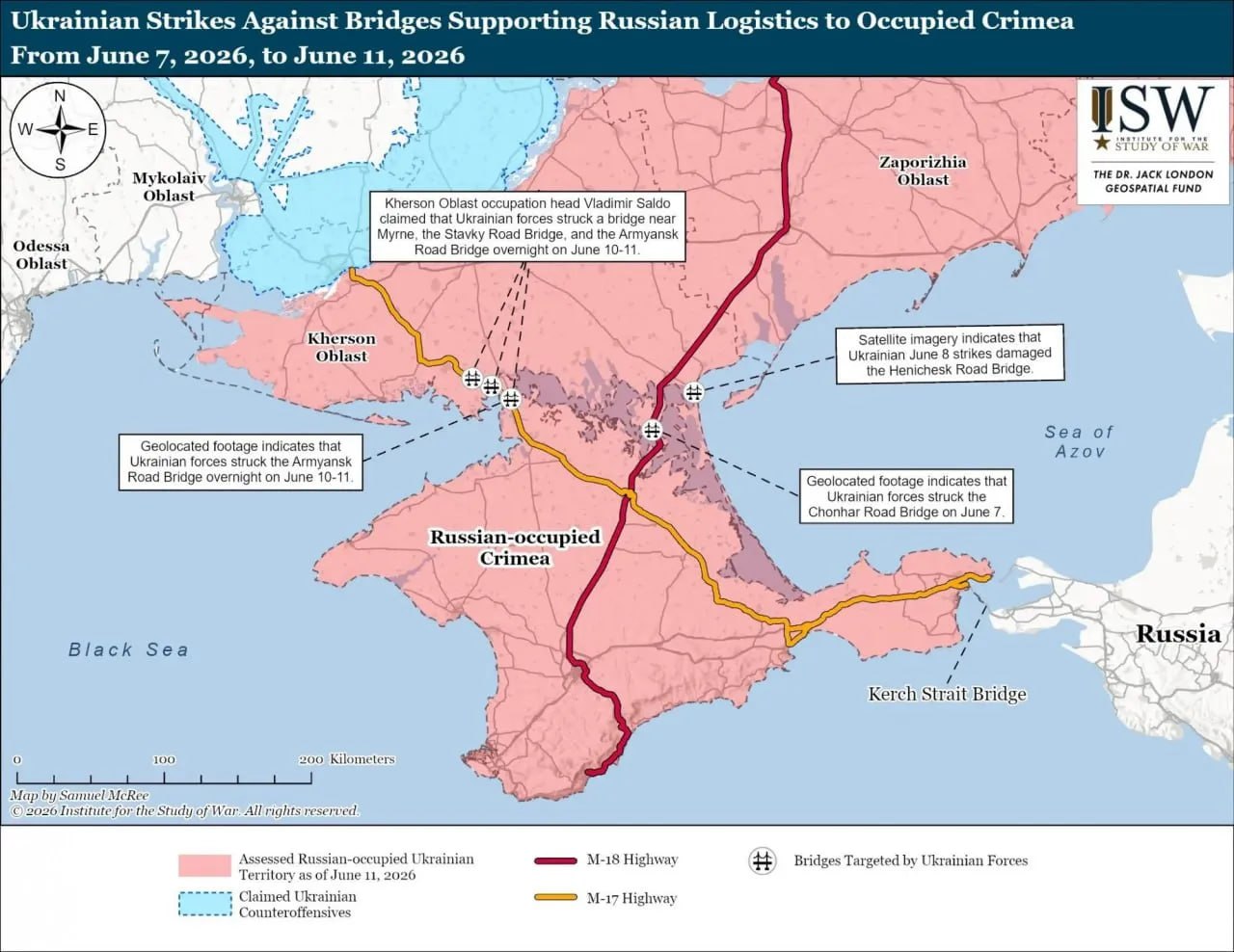
Now the situation has changed. Cutting off Crimea bridges has gone from a tactical nuisance to a systematic campaign. Nearly every bridge connecting the occupied part of Kherson region to previously occupied Crimea has been hit. At best, they are only usable for cars, carts, and bicycles. From the Arabat Spit to Armyansk, the enemy has lost the ability to use these crossings as part of a “land bridge” to Crimea.
Enter the Pontoons
The moment it became clear that the bridges were not just damaged, the enemy started building pontoon crossings. By then, our operators had already made it obvious they intended to finish them off beyond any possibility of repair. I think that was exactly the goal our drone operators were working toward. A pontoon crossing is a fixed target. You can destroy it with far lighter munitions than a concrete bridge requires.
And by the classic rules of military engineering, such crossings should be covered by dense air defense. If the enemy could not protect its permanent bridges, pontoons become both attractive and easy targets at the same time.
This might be one of those rare situations where Ukraine can run a conveyor-belt elimination of the enemy’s pontoon assets. The same way it has been grinding down enemy air defense. After cutting off Crimea bridges, pontoons are simply the next logical target. If pontoons become scarce, crossing any water obstacle turns into an unsolvable problem for the enemy. That alone could seriously undermine its offensive potential. The enemy is already constrained by shortages of armor, air defense, and much else. A pontoon shortage on top of that would be a serious addition to the list.
A Familiar Pattern, Scaled Way Up
This might sound like a minor detail, but remember what our forces did to the pontoon crossing on the Siverskyi Donets. They turned it into something like a scrap yard for vehicles that tried to cross to the right bank. And that was done by just a handful of our soldiers. The current situation multiplies that effect many times over: back then, the enemy needed to rush armored vehicles across in one quick push. Here, they need to sustain logistics — meaning hundreds of trucks in a continuous flow, dozens of times denser.
So the enemy is now stuck with a real dilemma. They can use pontoon crossings sparingly, moving small batches of military equipment at a time. Or they can take the risk and try to restore full logistics. That means running hundreds of trucks across, and accepting that dozens of pontoons will inevitably end up at the bottom of the river.
Camouflage, Convoys, and the Geneva Convention
There is already footage online of the enemy trying to disguise military fuel trucks and other equipment as civilian vehicles, which is a direct violation of the Geneva Convention on the rules of war.


These tricks rarely fool anyone for long, and they usually bring exactly the consequences you would expect. The irony is that this camouflage makes things more dangerous for actual civilian transport. Anyone unlucky enough to be driving next to a fuel truck or an ammunition-laden lorry disguised as a milk tanker or a timber delivery will share in whatever happens when that target gets hit. Whatever detonates there takes out everyone nearby, civilian or not.
A Gift for Our Drone Operators
There is also a fairly nice opportunity opening up for our drone teams. Because the pontoon crossings only allow single-lane traffic, trucks, fuel tankers, and military vehicles are already starting to pile up in front of them, forming dense, juicy targets. Based on reports from the last 24 hours, these clusters are already taking real hits.
In other words, there is no longer a need to chase individual vehicles along the highway — entire clusters can be taken out in one go wherever they form. The ultimate move for our drone operators and reconnaissance teams would be timing a strike for the exact moment when one, or better yet a couple, of ammunition trucks are crossing the pontoon. A hit like that could shut down the crossing for a long time. And for anyone watching from a distance, it would be quite the demonstration.
And for that opportunity, Ukraine’s forces can thank the local collaborator administration, which banned civilian traffic on these roads. Once that ban is in place, anything moving — and especially anything piling up in front of these crossings — is military by definition, and should burn accordingly.
Where Does This Leave the Kerch Bridge?
The bigger the traffic jams at these temporary crossings get, and the heavier the losses from strikes there, the closer the enemy gets to deciding it has no choice but to reroute everything through the Kerch Bridge. My guess is that the good news about something irreversible happening to that illegally built structure has not arrived yet simply because our specialists are waiting for the right moment. A moment when, instead of a few hundred kilograms of explosives delivered by missile or drone, they can use ten tons of the enemy’s own ammunition sitting in a truck.
Either way, cutting off Crimea bridges is only the next move. Ukraine’s armed forces have already made it clear that the connection between Crimea and temporarily occupied mainland Ukraine is over. Anyone who decides to take a drive in that direction does so entirely at their own risk.
Related posts:

Missile Strike on the Fleet HQ: Destroyed for the Second Time
By midday, more details emerged about the missile strike on the fleet HQ building on Gogol Street in temporarily occupied Sevastopol. For those who have already forgotten the [...]
Why Russia Uses Small Group Tactics and How to Counter
It looks like Russia’s top military command has concluded that the tactics its occupation army used before no longer deliver the results Pootin keeps demanding. So they changed [...]